Federal Reserve Chair Kevin Warsh walks onto the Jackson Hole stage Friday facing a significantly more hawkish backdrop than he did only a few weeks ago.
Several Fed officials used the opening day of the Kansas City Fed’s annual symposium to warn that inflation remains too high, current monetary policy may not be restrictive enough and another rate increase may ultimately be necessary. Their comments have raised the stakes for Warsh’s 10 a.m. EDT address: investors are looking less for a firm prediction about September than for a clearer explanation of what would make the new Fed chair tighten policy again.
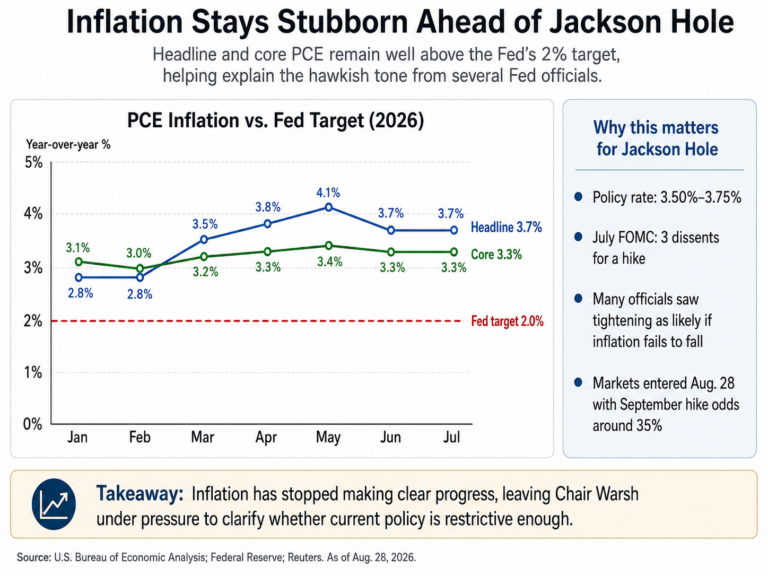
That question has become increasingly difficult to avoid. The Fed has held its target rate at 3.50%–3.75% since December, but July’s FOMC minutes revealed substantially greater concern about inflation than the unchanged policy rate might suggest. “Several” participants were prepared to raise rates at the July 28–29 meeting, three policymakers formally dissented in favor of a quarter-point hike, and “many” participants believed additional tightening would likely become necessary if inflation failed to decline.
Wednesday’s PCE report did little to settle that debate. Headline PCE inflation remained at 3.7% year over year in July, while core PCE held at 3.3%. At the same time, real consumer spending was essentially flat during the month, highlighting the tension confronting policymakers: inflation remains too high, but parts of the economy are increasingly sensitive to restrictive financial conditions.
Hammack: The Clearest Case for a Hike
Cleveland Fed President Beth Hammack has emerged as one of the Committee’s most forceful inflation hawks.
Hammack, who dissented in favor of a rate hike at the July meeting, said Thursday that she believes “now is the time to act.” Her concern extends beyond the current inflation numbers to the risk that businesses and households begin to treat above-target inflation as permanent. She said contacts in her district are increasingly displaying what she described as an emerging inflationary mindset, potentially threatening the Fed’s credibility if price pressures remain elevated for too long. Hammack expects inflation to finish 2026 around 3% and believes even next year may produce only limited improvement toward the mid-2% range. Her argument is straightforward: unemployment and the labor market appear sufficiently balanced that the Fed can afford to prioritize price stability, while waiting too long could require more aggressive tightening later.
That view appears to have meaningful support inside the FOMC. July’s minutes specifically noted concern among policymakers favoring a hike that delaying action could eventually force the Fed into a steeper and more economically costly tightening cycle.
Schmid: Is Policy Actually Restrictive?
Kansas City Fed President Jeffrey Schmid, this week’s Jackson Hole host, raised an even more fundamental question: whether the current policy rate is restrictive at all. Schmid described inflation as persistent and questioned what the Fed is actually restraining with rates currently at 3.50%–3.75%. Strong investment, resilient demand and relatively easy financial conditions make it difficult, in his view, to argue that monetary policy is exerting enough downward pressure on inflation. That does not mean Schmid is committed to a September increase. He said more information is needed to determine how much current inflation is being driven by demand. The distinction matters. If inflation is primarily being generated by oil, tariffs and other supply shocks, raising interest rates may have limited effectiveness and impose unnecessary economic costs. If demand remains too strong, however, the Fed has a much stronger case for tightening. Schmid therefore looks hawkish on the destination of policy while remaining data-dependent on the timing.
Goolsbee: Inflation Risk Is Real, But the Trend Is Not Yet Broken
Chicago Fed President Austan Goolsbee represents a more nuanced middle ground. Goolsbee said inflation remains his biggest near-term concern and warned that policymakers should be particularly alert to the combination of high energy prices, shifting tariff policies and affordability pressures. But he also noted that the most recent three-month inflation trend does not look particularly alarming. If incoming data demonstrate that inflation is moving sustainably back toward 2%, Goolsbee still believes interest rates could eventually move lower. His position illustrates why the September decision remains open despite increasingly hawkish rhetoric. The Fed does not need to decide whether inflation is too high—it clearly is. It needs to determine whether inflation is persistently moving away from target or merely being temporarily held above it by supply-related pressures. That difference may determine whether the next policy move is a hike or an extended hold.
Collins: July Inflation Was More Encouraging Beneath the Surface
Boston Fed President Susan Collins remains more comfortable with the existing policy stance. Collins characterized the latest inflation report as “mixed” and argued that some of July’s upward pressure came from unusual factors, including portfolio-management fees linked to rising stock prices. She sees more encouraging inflation behavior among components driven directly by market supply and demand. Her baseline remains one of gradual disinflation, with current monetary policy modestly restrictive. Collins is nevertheless prepared to support higher rates if inflation proves more persistent than she expects.
The Collins view is effectively the argument for patience: don’t respond mechanically to a 3.7% headline reading if the underlying inflation process is gradually improving and existing financial conditions are already slowing rate-sensitive parts of the economy.
The Bigger Question for Warsh: What Is the Fed’s Reaction Function?
The biggest issue confronting Warsh today therefore isn’t whether he explicitly signals a September hike. It is whether he explains how he will decide. Warsh has deliberately reduced the emphasis on forward guidance since taking over the Fed, arguing that central banks should provide less explicit direction about future policy and allow markets to perform more of the price-discovery process themselves. He has repeatedly committed to the 2% inflation objective but has provided much less detail about how incoming economic data translate into policy decisions. That approach is now being tested.
Inflation has remained above the Fed’s target for years, the July meeting produced three dissents for tighter policy, and several regional Fed presidents are publicly arguing that current policy may not be restrictive enough. If Warsh continues to avoid explaining what conditions would trigger a hike, investors may interpret the silence not simply as reduced forward guidance but as uncertainty about the Fed’s inflation strategy. The market is already demanding an answer.
Ahead of Friday’s speech, futures were pricing roughly a 35% probability of a September hike, while a quarter-point increase was effectively priced by December. The 10-year Treasury yield was near 4.68% Friday morning, while the dollar was trading close to a one-week high.
What Bond Investors Should Listen For
Three elements of Warsh’s speech will matter most. First is whether he explicitly acknowledges that the inflation risks identified by Hammack, Schmid and other FOMC participants have increased. Second is whether he describes today’s 3.50%–3.75% policy rate as restrictive. If Warsh agrees with Schmid that monetary policy is doing relatively little to constrain demand, the threshold for another hike would appear considerably lower. Third—and perhaps most importantly—is whether Warsh defines his reaction function. Investors do not necessarily need him to promise a September move. They need to understand what combination of inflation, employment, growth and financial conditions would trigger one.
A firm inflation-first message that keeps a September increase on the table could push front-end yields higher and favor a flatter Treasury curve, particularly if Warsh simultaneously reassures investors that the Fed remains committed to preventing inflation expectations from becoming unanchored. A more dovish message could initially benefit risk assets and shorter-duration bonds, but there is a complication: if investors interpret dovishness as insufficient commitment to the 2% target, long-duration Treasury yields could rise instead as inflation and term-premium compensation increase. That makes today’s Jackson Hole address unusually important.
The debate inside the Fed is no longer primarily about whether inflation is above target. It is about whether the current policy stance is strong enough to bring it back down.
Hammack and Schmid increasingly believe it isn’t. Collins believes it probably is. Goolsbee remains somewhere between those positions. At Jackson Hole today, investors finally get to hear where Kevin Warsh stands.
Sourced from Reuters, FactSet, BEA