Minutes from the Federal Reserve’s July policy meeting revealed a more hawkish committee than the 9–3 vote to leave rates unchanged initially suggested, with a broader group of policymakers prepared to tighten monetary policy if inflation fails to resume its decline.
The minutes, released Wednesday, August 19, from the July 28–29 FOMC meeting, showed that most officials supported keeping the federal funds target at 3.50%–3.75%, preferring to collect more information on inflation. But several participants favored an immediate 25-basis-point increase, while “many” judged that additional tightening would probably be necessary if inflation remained elevated. Some officials went further, questioning whether financial conditions were restrictive enough to return inflation sustainably to 2%.
Three voting members—Beth Hammack, Neel Kashkari and Lorie Logan—formally dissented in favor of a quarter-point hike, producing the Fed’s 9–3 decision to hold rates steady. A few officials supporting a hike argued that acting sooner could reduce the risk of having to tighten more aggressively later.
Inflation, Not Growth, Dominated the Debate
The central concern was that inflation had become broader and potentially more persistent. At the time of the meeting, Fed staff estimated June headline PCE inflation at 3.7% year over year and core PCE at 3.3%, both well above the 2% target. Officials cited tariffs, energy prices associated with the Middle East conflict and demand generated by the artificial-intelligence investment boom as potential sources of continued price pressure.
Most policymakers still expected inflation to ease during the remainder of 2026 as earlier tariff and energy effects faded. But many warned that persistent above-target inflation could eventually influence wage-setting, business pricing and consumer inflation expectations. The committee characterized inflation risks as tilted to the upside, even while longer-term inflation expectations remained broadly consistent with the Fed’s objective.
The minutes therefore reinforce an important distinction for bond investors: the Fed has not committed to another hike, but its reaction function remains distinctly asymmetric toward inflation. A renewed acceleration in prices is more likely to provoke tightening than moderate deterioration in growth is to produce an immediate rate cut.
New Data Have Complicated the Hawkish Message
There is an important catch. The minutes describe conditions policymakers saw in late July, and several releases since then have weakened the case for immediate tightening.
July nonfarm payrolls fell by 23,000, while May and June payroll growth was revised lower by a combined 103,000 jobs. The unemployment rate stood at 4.1%. That deterioration makes the labor side of the Fed’s dual mandate considerably less comfortable than it appeared during the July meeting.
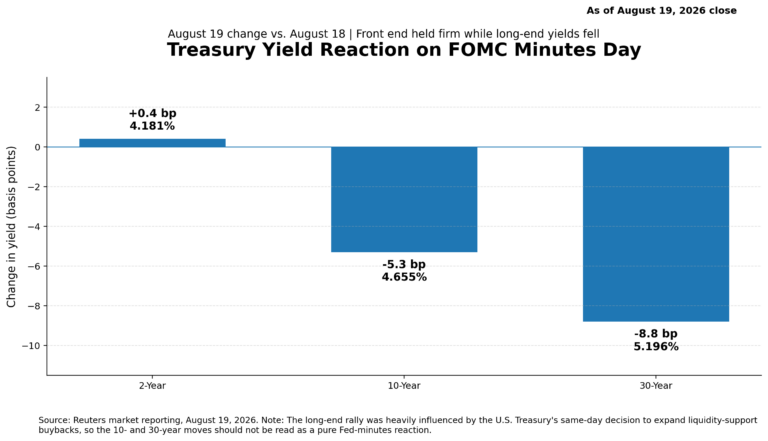
That helps explain why markets did not treat Wednesday’s minutes as confirmation of an imminent September hike. The policy-sensitive 2-year Treasury yield edged higher to about 4.18%, consistent with the minutes’ hawkish tone, but the 10-year yield fell to roughly 4.66% and the 30-year to about 5.20%. Those long-end moves were driven principally by the Treasury Department’s separate decision to expand long-maturity debt buybacks, making Wednesday’s curve reaction unusually difficult to interpret as a pure Fed signal.
Fixed Income Implications
For fixed income investors, the minutes argue against aggressively pricing near-term easing. The Fed remains uncomfortable with inflation, and a meaningful bloc is already prepared to tighten again. That should keep the front end of the Treasury curve sensitive to every inflation release, particularly PCE and the August CPI report ahead of the September meeting.
At the same time, weakening employment and housing data create a growing counterweight. The result is a Fed increasingly dependent on incoming data rather than committed to a predetermined hiking cycle.
That tension is also visible in the Fed’s latest dot plot. The June Summary of Economic Projections placed the median federal funds rate at 3.8% for year-end 2026, 3.6% in 2027 and 3.4% in 2028, versus March medians of 3.4%, 3.1% and 3.1%, respectively. The June revisions represented a substantial hawkish shift before the July meeting even occurred.
The next major test comes September 15–16, when policymakers will receive a new Summary of Economic Projections—and a new dot plot. Until then, the bond market is likely to remain caught between persistent inflation risk supporting higher front-end yields and softer real-economy data limiting how far the Fed can realistically tighten.
Sources
- Federal Reserve — July 28–29 FOMC Statement: The Committee voted 9–3 to hold the federal funds target at 3.50%–3.75%, with Beth Hammack, Neel Kashkari and Lorie Logan dissenting in favor of a 25-basis-point increase.
- Federal Reserve — July 28–29 FOMC Meeting Minutes, released August 19, 2026: Primary source for policymakers’ discussion of persistent inflation, upside inflation risks and the possibility that additional tightening could be necessary.
- Reuters — August 19, 2026: Analysis of the minutes, including the broader hawkish lean within the Committee and the tension between persistent inflation and softer employment data.
- Reuters — August 19, 2026: Treasury-market reaction, including the sharp decline in longer-term yields following Treasury’s expansion of long-duration debt buybacks.
- Federal Reserve — June 17, 2026 Summary of Economic Projections: Latest official Fed economic projections and dot plot; no new dot plot was released with the August 19 minutes.
Disclaimer: This material is provided for informational and educational purposes only and does not constitute investment advice, a recommendation, or an offer to buy or sell any security. Market prices, economic data and policy expectations can change rapidly, and economic data may be revised. Investors should consider their objectives, risk tolerance and financial circumstances before making investment decisions.