
Treasury yields stabilize below 5% as investors await the Fed, but oil, inflation and positioning leave the bond market vulnerable to a hawkish surprise
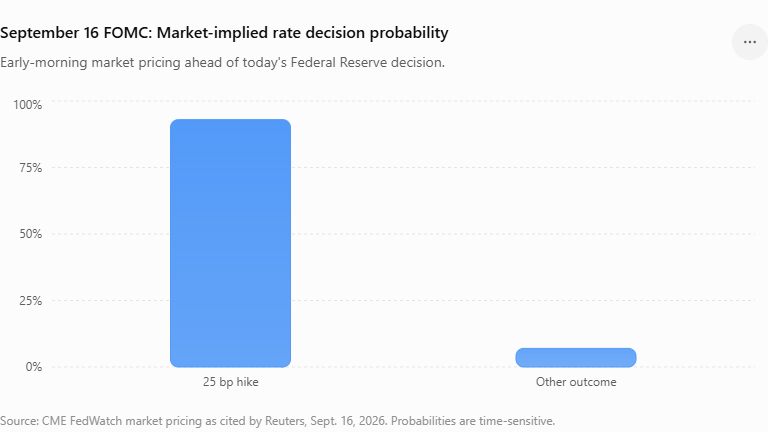
The Federal Reserve heads into today’s September meeting with the immediate policy decision largely priced into the market. As of early Wednesday morning, futures markets were assigning roughly a 93% probability to a 25 basis-point rate hike, which would lift the federal-funds target range to 3.75%-4.00%. The decision is due at 2:00 p.m. ET, followed by Chair Kevin Warsh’s press conference at 2:30 p.m. Because this is a quarterly meeting, investors will also receive an updated Summary of Economic Projections and dot plot, making the expected hike arguably less important than what policymakers signal about the path beyond September.
The dramatic change in expectations has followed another deterioration in the inflation backdrop. August CPI increased 0.4% month over month and 3.4% year over year, while core CPI rose 0.3% for the month and 2.4% from a year earlier. Producer prices were even firmer, increasing 0.4% in August and 5.4% over the previous 12 months. Energy has become an increasingly important part of that story: gasoline alone accounted for more than one-third of August’s monthly CPI increase.
That inflation repricing has hit the Treasury market hard. The 10-year yield moved above 5% on Tuesday for the first time since 2007, reflecting not only expectations for tighter Fed policy but persistent concern about energy inflation, fiscal deficits and Treasury supply. Yields have eased modestly this morning as oil prices retreat, but the fundamental question for bond investors has shifted. Instead of debating whether the Fed will hike today, investors increasingly need to decide whether September is the beginning of a genuine tightening cycle or a one-off credibility move.
Oil remains the complication the Fed cannot easily solve
Energy continues to make the policy calculation unusually difficult. Brent crude eased this morning to around $108 per barrel, with WTI near $105, after U.S. industry data showed an unexpected 7.1 million-barrel increase in crude inventories and Saudi Arabia offered additional crude through Oman. That provides some near-term relief following the latest surge in prices, but the underlying supply environment remains tight. Saudi infrastructure disruptions, constrained Middle East flows and lost Russian refining capacity continue to keep diesel and other refined products exceptionally expensive.
For fixed-income markets, the distinction between an energy shock and generalized inflation is critical. The Fed cannot produce more crude oil or repair damaged energy infrastructure by raising overnight interest rates. But policymakers cannot ignore the risk that prolonged energy inflation feeds into consumer expectations, transportation costs and broader pricing behavior. That tension increases the importance of the Fed’s inflation forecasts today. A meaningful upward revision to the inflation path accompanied by additional hikes in the dot plot would reinforce the recent bear move in Treasuries even if today’s quarter-point increase is already fully discounted.
The dots matter more than today’s hike
Market pricing has moved beyond September. Interest-rate markets are beginning to discount roughly 60 basis points of additional tightening by year-end, meaning investors are effectively debating another two to three quarter-point moves after today. That is a much more consequential assumption for fixed-income portfolios than the September hike itself.
A dot plot showing policymakers broadly expecting additional increases would validate the repricing that has already occurred at the front end. In that scenario, two-year yields could remain under upward pressure while the 5- to 10-year sector would have to absorb both higher expected policy rates and an elevated term premium. Conversely, a hike accompanied by relatively restrained dots would create the possibility of a classic “hawkish action, dovish path” reaction, particularly given how aggressively short the Treasury market has become.
Positioning is important here. Recent dealer and investor surveys point to unusually large Treasury shorts ahead of the meeting, with some measures of bond positioning near historically negative extremes. Extreme short positioning has sometimes coincided with near-term peaks in yields because even a mildly dovish surprise can force rapid short covering. That makes the risk around today’s decision unusually asymmetric: the Fed does not necessarily need to sound dovish to generate a bond rally—it may simply need to be less hawkish than the market currently expects.
Retail sales provide one last data point
Before the Fed decision, investors will receive August retail sales at 8:30 a.m. ET. Consensus expectations call for a 0.8% monthly rebound following July’s 0.6% decline, with sales excluding autos expected to increase 0.5% and the control group expected to rise 0.4%. Recent card-spending data have pointed to continued consumer resilience, while some of July’s weakness appears related to the timing shift of Amazon’s Prime Day.
A materially stronger report would reinforce the argument that the economy can withstand tighter policy and could push the front end higher ahead of the meeting. A weaker report would be unlikely to derail today’s expected hike given the inflation backdrop, but it could strengthen the case for a slower tightening path after September.
What Fixed-Income Investors Should Watch at 2:00
The first market reaction will likely center on the dot plot. A median projection implying multiple additional hikes would validate the recent selloff, while a shallower path could encourage a rally from deeply oversold Treasury levels. The second signal will be the Fed’s inflation forecast—particularly whether policymakers treat the oil shock as temporary or incorporate more persistence into the outlook.
The third issue is the shape of the curve. Another rise in two-year yields accompanied by relatively stable long yields would suggest investors view the Fed as getting ahead of inflation. A renewed rise in 10- and 30-year yields despite tighter policy would be more troubling because it would suggest the market continues to demand compensation for inflation, fiscal risk and Treasury supply independently of the policy rate.
Finally, Chair Warsh’s 2:30 p.m. press conference may matter more than the statement itself. Markets have had difficulty identifying a consistent reaction function from the new Fed leadership, and investors will be listening carefully for whether today’s hike represents the start of a sequence or a data-dependent response to the recent inflation shock.
For now, the September hike is largely priced. The trade after 2:00 p.m. will be about whether the market has priced enough of what comes next.
Sources
- Federal Reserve Board — FOMC policy materials, meeting calendar, Summary of Economic Projections and Chair press conference materials.
- CME Group FedWatch — Fed-funds futures market pricing used to estimate the probability of today’s rate decision. Reuters reported derivatives markets assigning roughly a 93% probability to a 25 bp hike this morning.
- U.S. Bureau of Labor Statistics — August 2026 CPI and Producer Price Index releases used to assess the latest inflation backdrop.
- U.S. Census Bureau — Advance monthly retail-sales data and historical retail-sales releases.
- Reuters, September 16, 2026 — Pre-FOMC market coverage addressing expectations for a 25 bp hike, Treasury yields, oil-driven inflation pressures and the importance of Chair Warsh’s forward guidance.
- Reuters, September 14–16, 2026 — Treasury-market coverage examining the rise of the 10-year yield through 5%, fiscal and supply concerns, expectations for further tightening and broader bond-market conditions.
- September 16 Morning Headlines / StreetAccount market summary supplied for this report — sell-side FOMC expectations, Treasury positioning, retail-sales consensus and discussion of unusually large bond-market short positions.
Disclaimer: This material is provided for informational and educational purposes only and does not constitute investment advice, a recommendation, or an offer to buy or sell any security. Market prices, interest-rate expectations and implied probabilities can change rapidly. Fixed-income securities are subject to interest-rate, credit, inflation, liquidity and market risks, and investors should consider their own objectives, risk tolerance and circumstances before making investment decisions.

