Wednesday’s economic releases showed weaker private-sector hiring, improving factory demand and modest regional growth—but continued cost pressures kept the data from delivering an unambiguously bullish signal for bonds.
U.S. economic data released Wednesday, September 2, presented fixed-income investors with a familiar but increasingly consequential mix: employment growth is cooling, manufacturing demand remains resilient, and inflation pressures have not fully subsided.
The reports strengthened the case that economic growth is moderating without collapsing. That backdrop can support high-quality bonds, but persistent price pressures and firm business investment continue to limit the scope for a sustained decline in longer-term Treasury yields.
ADP Shows Private Hiring Losing Momentum
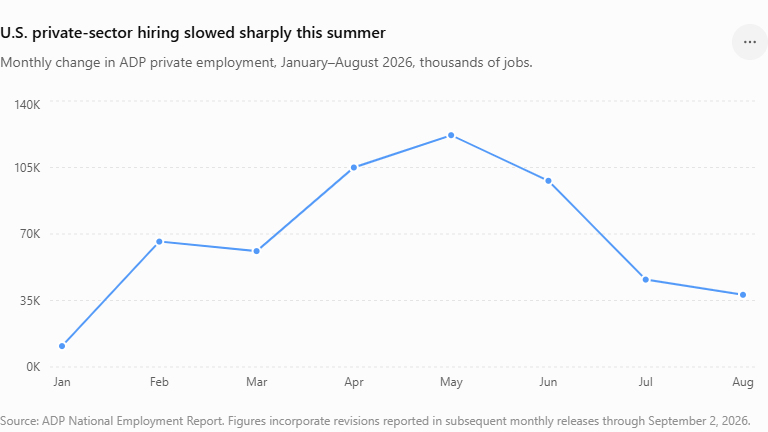
Private employers added just 38,000 jobs in August, according to the ADP National Employment Report, below July’s upwardly revised 46,000 increase and the slowest pace of private-sector job creation since January.
The weakness was broad enough to merit attention. Goods-producing employers eliminated 10,000 positions as manufacturing lost 17,000 jobs and natural resources and mining shed 5,000. Construction partially offset those declines by adding 12,000 positions.
Service-sector employment increased by 48,000, but the gains were concentrated. Education and health services added 45,000 jobs, while leisure and hospitality contributed 16,000. Professional and business services lost 16,000 positions, trade and transportation declined by 5,000, and information employment fell by 4,000.
Hiring was also heavily concentrated among large employers. Companies with at least 500 employees added 34,000 positions, compared with only 3,000 among small businesses and no net growth among midsized firms.
Wage data offered a more moderate inflation signal. Base pay increased 3.2% from a year earlier across all private-sector workers. Base-pay growth was 3.0% for workers remaining in their jobs and 4.7% for job changers. ADP reported that pay growth has been decelerating for several years, particularly among lower-paid workers. ADP National Employment Report
ADP is not a direct forecast of the Bureau of Labor Statistics payroll report, but the release reinforces the pattern visible in Tuesday’s JOLTS data: businesses are hiring cautiously even though layoffs remain relatively contained. Attention now turns to the official August employment report scheduled for Friday, September 4. BLS Employment Situation
Factory Orders Rebound, but Capital-Spending Signal Is Mixed
Manufacturing data were more constructive. New orders for manufactured goods increased 0.9% in July to a seasonally adjusted $663.6 billion, reversing two consecutive monthly declines. June’s decrease was revised to 0.2%.
Shipments increased 0.8% to $658.8 billion and have now risen in nine of the past ten months. Unfilled orders advanced 0.6% to $1.600 trillion—the 24th increase in 25 months—while inventories rose 0.4% to $966.9 billion.
The rebound indicates that manufacturing demand remains intact despite elevated borrowing costs and supply-chain disruptions. However, some of the headline strength came from volatile transportation equipment, including civilian aircraft. Orders excluding transportation still increased 0.6%, suggesting that the improvement was broader than aircraft alone, but core capital-goods orders were approximately flat.
For the bond market, the factory data provided a counterweight to the weak ADP report. Rising orders, shipments and backlogs reduce near-term recession concerns and remain supportive of corporate credit fundamentals. At the same time, resilient demand makes it harder to conclude that restrictive monetary policy has fully slowed the economy. U.S. Census Bureau Manufacturers’ Orders
Beige Book Finds Modest Growth and Persistent Cost Pressure
The Federal Reserve’s Beige Book described economic activity as increasing modestly since early July. Ten of the 12 Federal Reserve districts reported slight-to-moderate growth, while two reported little change.
Employment increased only slightly overall, consistent with ADP’s softer hiring data. Several districts reported that employers were maintaining existing staffing levels or becoming more selective about new hires. Wage growth generally remained modest to moderate.
Inflation signals were less reassuring. Prices continued to rise moderately, with strong input-cost pressures reported in manufacturing, transportation, energy and health care. Businesses remained cautious about passing all those increases to customers because consumers have become more price-sensitive.
Regional manufacturing conditions were generally positive. The Cleveland district reported robust demand associated with data centers and defense spending, while Dallas recorded stronger manufacturing, banking and energy activity. New York also reported improving manufacturing conditions but noted supply-chain strains affecting technology and defense companies.
Housing remained one of the softer areas. Residential real estate activity declined in the San Francisco district and remained restrained elsewhere as high mortgage rates weighed on affordability and transaction volumes.
The Beige Book was based on information collected through August 24 and represents anecdotal evidence rather than the views of Federal Reserve officials. Nevertheless, it gives policymakers a timely look at conditions ahead of the September policy meeting. Federal Reserve Beige Book
Treasury Market: Weak Hiring Meets Sticky Inflation
Treasury yields initially rose with the broader global bond selloff before reversing from their intraday highs after the soft ADP report. The official Treasury curve finished with the two-year yield at 4.39%, the 10-year at 4.79% and the 30-year at 5.27%—essentially unchanged from Tuesday’s closes. U.S. Treasury yield curve
The muted closing move captured the conflict within the data. Weak hiring supports the front and intermediate portions of the Treasury curve by reducing the likelihood of sustained wage inflation. Stronger factory orders and the Beige Book’s continued reports of elevated input costs argue against an aggressive rally in long-duration bonds.
Fixed-Income ETF Read-Through
Short-duration Treasury ETFs such as SGOV and BIL continue to offer substantial income with limited sensitivity to changes in longer-term yields. Intermediate Treasury exposure through IEF offers more upside if Friday’s employment report confirms meaningful labor-market weakness, but it carries greater price risk if inflation concerns dominate.
Long-duration funds such as TLT remain most exposed to the combination of high real yields, Treasury supply concerns and persistent inflation risk. Wednesday’s reversal from intraday yield highs was constructive, but it did not establish a decisive change in the longer-term rate trend.
For credit, resilient factory orders and modest economic growth remain supportive of investment-grade and high-yield fundamentals. LQD could benefit if slower employment eventually produces lower Treasury yields, while HYG and JNK remain more dependent on the economy avoiding a sharper downturn.
The central message from Wednesday’s releases is that the economy is slowing unevenly. Hiring has weakened enough to command the Fed’s attention, but manufacturing demand and business cost pressures remain too firm to deliver a clear all-clear for duration.
Sources
- August 2026 ADP National Employment Report
- June 2026 ADP National Employment Report
- May 2026 ADP National Employment Report
- April 2026 ADP report and March revision
- March 2026 ADP report and February revision
- February 2026 ADP report and January revision
Disclaimer: This article is for informational purposes only and does not constitute investment advice or a recommendation to buy or sell any security.