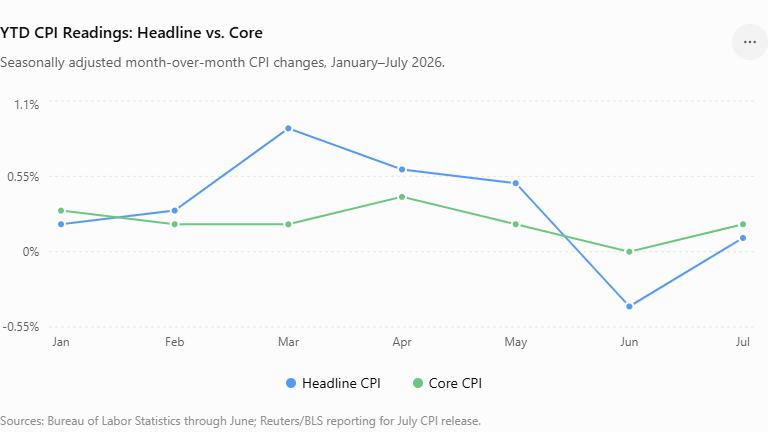
Wednesday’s July CPI report gave fixed income investors a modest dose of relief, but not enough to settle the debate around duration. Headline CPI rose 0.1% month over month in July, in line with expectations, while year-over-year inflation eased to 3.4% from 3.5% in June. Core CPI rose 0.2% month over month and slowed to 2.5% year over year, down from 2.6% in June.
The report was constructive because it did not validate the market’s worst fears around the recent rebound in oil and geopolitical inflation risk. Gasoline prices fell 2.9% in July, helping offset a modest increase in shelter costs and keeping headline inflation contained. Core CPI was firmer than June’s flat reading, with Reuters pointing to higher healthcare, airfares and technology-product prices, but the overall message remained one of gradual inflation cooling rather than renewed acceleration.
For fixed income investors, the key takeaway is that the report supports a more patient Federal Reserve but does not guarantee an imminent easing cycle. Reuters reported that the July data, combined with the weak July payroll report, reduced the perceived likelihood of a September rate hike, with market-implied odds dropping to roughly 38% after the release. That keeps front-end policy pressure contained and supports cash-plus, ultrashort, short Treasury and intermediate-duration exposure.
The bond-market reaction was constructive but restrained. Treasury yields initially reflected relief that inflation did not surprise higher, but the long end did not deliver a decisive rally. MarketWatch reported that after the CPI release, the 2-year Treasury yield slipped to 4.174% from 4.183%, while the 10-year yield moved to 4.651% from 4.641% and the 30-year yield rose to 5.216% from 5.185%. That mix shows a familiar pattern: the front end responded to lower Fed-tightening risk, while the long end remained pressured by term-premium, supply and inflation-uncertainty concerns.
The reaction also explains why duration remains tactical rather than a broad all-clear. If the CPI print had been meaningfully softer, long Treasuries likely would have had a cleaner path to rally. Instead, the report was “good enough” to reduce immediate Fed pressure but not strong enough to pull the 30-year yield decisively away from the 5% area. The result was a curve-steepening bias: shorter maturities looked better supported, while long-duration Treasuries and longer-duration investment-grade credit remained more vulnerable.
For ETF investors, the best read-through is to stay balanced. The July CPI print supports continued exposure to ultrashort Treasuries, floating-rate Treasuries, short investment-grade credit, AAA CLOs, municipal bonds and intermediate core bonds. It also gives some support to tactical Treasury duration, but the long end still needs confirmation from lower oil prices, softer PPI and calmer Treasury-supply pressure before long-duration ETFs can move from tactical dip-buying to a more durable leadership role.
The next inflation test comes quickly. The BLS calendar shows the July PPI release scheduled for Thursday, August 13 at 8:30 a.m. ET. A softer PPI print would reinforce the CPI relief and help validate intermediate-duration exposure. A hotter producer-price reading would put the focus back on pipeline inflation, energy costs and margin pressure.
The bottom line: July CPI was friendly for bonds, but not powerful enough to change the whole fixed income playbook. The front end and intermediate part of the curve look better supported because the report reduces immediate Fed-hike risk. The long end remains more complicated because the 30-year yield is still elevated, oil remains volatile and investors continue to demand more compensation for duration risk. Fixed income investors can lean into income, quality and intermediate duration, but long Treasuries still need to be treated as tactical until the long end stabilizes.
Sources
- Reuters July CPI and market reaction reporting
- MarketWatch Treasury yield reaction to July CPI
- U.S. Bureau of Labor Statistics CPI and release-calendar data
Disclaimer: This article is for informational and educational purposes only and should not be considered investment advice. Fixed income investments are subject to interest-rate risk, credit risk, liquidity risk, inflation risk, tax considerations and potential loss of principal.