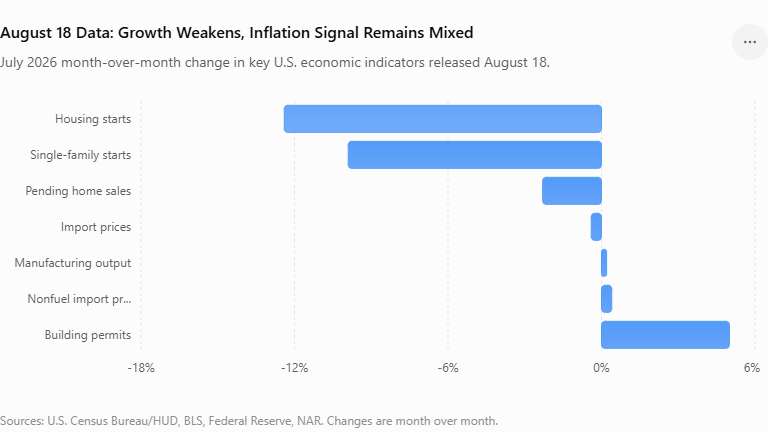
Tuesday’s U.S. economic releases reinforced a slower-growth, still-uneven-inflation backdrop for the fixed income market. Housing activity weakened materially, industrial production expanded only modestly, and headline import prices declined. But beneath the surface, nonfuel import costs continued to rise. That combination helped Treasury yields retreat from their intraday highs while leaving the Fed with little reason to signal an imminent policy move.
The clearest evidence of rate-sensitive economic weakness came from housing. July housing starts fell 12.4% to a 1.239 million annualized pace, with single-family starts dropping 9.9% to 808,000, their weakest pace since late 2022. The decline was substantially larger than economists had expected. Building permits were more encouraging, rising 5.0% to 1.443 million, including a 2.5% increase in single-family permits, but permits remain a forward indicator rather than evidence of current construction activity.
Existing-home demand was similarly soft. Pending home sales declined 2.3% in July and 2.2% from a year earlier, falling to their lowest level since January. The weakness was broad, with contract signings declining across all four U.S. regions. High mortgage rates continue to constrain affordability, suggesting the restrictive effects of current long-term borrowing costs are increasingly visible in the real economy.
Manufacturing offered a somewhat firmer signal. Industrial production increased 0.2% in July, slightly below expectations, while manufacturing output also rose 0.2%. Capacity utilization edged up to 76.3%, but remained 3.1 percentage points below its long-run average. The details showed an uneven economy: consumer-goods production fell 0.4%, while business-equipment output increased 0.8% and construction-supply production rose 0.8%, evidence that capital investment remains stronger than household-sensitive activity.
Inflation data were more complicated. Import prices fell 0.4% in July, versus expectations for an increase, largely because imported fuel prices plunged 7.2%. Yet prices for nonfuel imports rose 0.4% and were 4.5% higher than a year earlier, the strongest annual increase since 2022. Import prices from China jumped 0.8% for the month. The headline therefore looks dovish for bonds, but the underlying figures suggest imported goods inflation has not disappeared. Importantly, the BLS import-price indexes exclude tariffs themselves, so the decline in the headline index should not be interpreted as evidence that tariff-related price risks have vanished.
Treasuries reflected that tension. The 2-year yield slipped to 4.177%, the 10-year to 4.708%, and the 30-year to 5.284% Tuesday after yields had risen sharply earlier in the session. Meanwhile, five-year breakeven inflation rose to roughly 2.28% and the 10-year breakeven held near 2.30%, suggesting investors remain concerned about medium-term inflation even as growth-sensitive data soften.
What It Means for the Fed Today
One important distinction: there is no new FOMC policy meeting today. At 2:00 p.m. ET, the Fed will release the minutes of its July 28–29 meeting, when policymakers voted 9–3 to leave the federal funds target at 3.50%–3.75%. Beth Hammack, Neel Kashkari and Lorie Logan dissented in favor of a 25-basis-point increase.
Tuesday’s data obviously cannot change minutes written about a July meeting, but they change how investors should interpret them. Any hawkish language showing substantial support for another hike will now be weighed against deteriorating housing, softer consumer-facing production and recent weakness in employment and retail sales. Markets currently assign roughly a 67% probability that the Fed holds rates unchanged in September, while 90% of economists in a recent Reuters survey expect no change.
For fixed income investors, the message is increasingly one of policy-rate stability but persistent long-end risk. Softer growth data support short- and intermediate-duration Treasuries, but elevated nonfuel import inflation, oil-related geopolitical risk and stubborn inflation expectations make a sustained rally at the long end harder to justify. The Fed appears increasingly likely to wait for August employment data and July PCE inflation before deciding whether July’s three hawkish dissenters represent the beginning of a broader tightening coalition—or the high-water mark for the 2026 rate-hike debate.
Disclaimer: This material is provided for informational and educational purposes only and does not constitute investment advice, a recommendation, or an offer to buy or sell any security. Economic data are subject to revision. Investors should consider their objectives, risk tolerance and financial circumstances before making investment decisions.