The Federal Reserve received little relief from its preferred inflation measure Wednesday, as July personal consumption expenditures data showed that price pressures remain stubbornly above target even as household spending lost momentum.
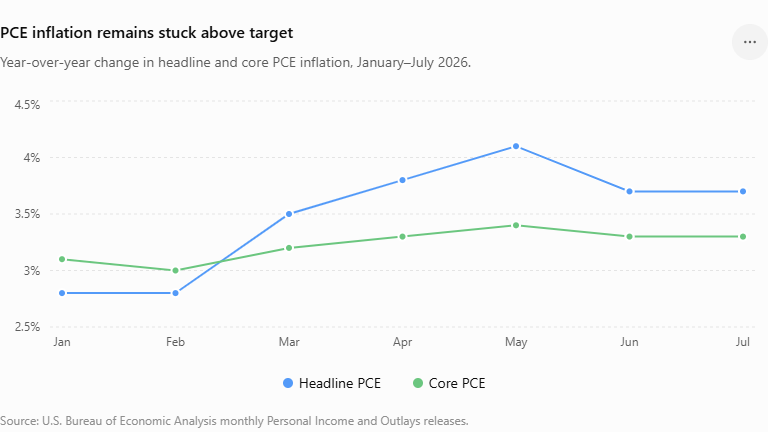
The headline PCE price index rose 0.2% in July and 3.7% from a year earlier, while core PCE, excluding food and energy, also increased 0.2% for the month and 3.3% year over year. Headline inflation was slightly hotter than economists expected and remained far above the Fed’s 2% target.
The report leaves the Fed with an uncomfortable combination: inflation isn’t cooling quickly enough to declare victory, but consumers are showing increasing sensitivity to high prices and restrictive interest rates.
Inflation Has Stopped Improving
Perhaps the most consequential part of Wednesday’s report was not that inflation accelerated dramatically—it didn’t. The problem is that the underlying inflation trend has stopped making meaningful progress.
Core PCE has now been running above 3% throughout 2026. Headline inflation accelerated from 2.8% in January to a 4.1% peak in May before retreating, but at 3.7% in both June and July, the improvement has stalled well above the Fed’s objective.
Even the relatively benign 0.2% monthly core reading deserves some caution. The unrounded increase was approximately 0.246%, just short of rounding to 0.3%, which translates into a roughly 3% annualized one-month pace.
That keeps the central bank focused on inflation persistence rather than simply the direction of the most recent monthly number.
Consumer Spending Hit the Brakes
The demand side of the report was much softer.
Nominal personal consumption expenditures increased only 0.2% in July, down from 0.3% in June. After adjusting for inflation, real consumer spending was essentially unchanged.
The composition also showed a meaningful split. Consumers increased spending on services by $86.2 billion, but spending on goods declined by $49.9 billion. That suggests households are becoming more selective after several years of price increases and elevated borrowing costs.
Income provided a somewhat better signal. Personal income increased 0.4%, disposable personal income gained 0.5%, and real disposable income rose 0.4%. The personal saving rate increased to 3.0% from 2.7% in June.
That improvement in purchasing power could support consumption later this year, but the savings rate remains historically low, leaving households with a relatively thin cushion if employment or income growth deteriorates.
The Broader Economy Is Not Yet Weak Enough to Rescue Bonds
The difficulty for fixed-income investors is that Wednesday’s data did not arrive in isolation.
The government’s second estimate of second-quarter GDP left growth unchanged at a 1.5% annual rate, but consumer spending was revised up to 3.4% from 3.2%. Final sales to private domestic purchasers—a useful measure of underlying private-sector demand—were revised to a strong 4.2% annualized rate.
Corporate profits also surged by $400.9 billion during the quarter, while business investment continued to receive substantial support from AI-related capital spending.
The result is not a classic stagflation picture. July consumption weakened, but broader private-sector activity remains resilient enough that the Fed cannot easily dismiss inflation as yesterday’s problem.
Bond Market Nudges Toward More Fed Tightening
Markets initially interpreted the report as modestly hawkish.
Fed funds futures moved from roughly a 36% probability of a September rate hike before the report to around 40%–44% afterward, according to Reuters. Markets were also pricing a substantially higher probability that the Fed would raise rates at some point before year-end.
Treasury yields increased approximately 1–3 basis points across the curve Wednesday, while the dollar gained about 0.3%. The reaction was contained rather than disorderly, reflecting the fact that the inflation surprise was relatively small.
But the direction matters.
For several months, fixed-income investors have been balancing softer housing and employment indicators against inflation that remains resistant to the Fed’s existing policy restraint. Wednesday’s PCE report shifted that balance slightly toward the inflation side.
The Fed’s Problem Is Becoming Clearer
The Fed has maintained its target rate at 3.50%–3.75% since December, leaving policymakers to determine whether current policy is restrictive enough to bring inflation back toward 2% without another increase.
July did little to answer that question in a dovish direction.
Headline inflation remains 1.7 percentage points above target. Core inflation remains 1.3 percentage points above target. The economy continues to generate solid income and investment growth, while underlying consumer demand was stronger than previously estimated during the second quarter.
At the same time, July’s flat real consumption, weak housing data and low household saving rate argue against assuming the economy can absorb substantially higher rates without consequences.
That makes Fed Chair Kevin Warsh’s Jackson Hole address Friday considerably more important. Investors will be listening for whether the Fed views current inflation as a temporary plateau or evidence that monetary policy is still insufficiently restrictive.
For fixed-income investors, Wednesday’s report reinforces a familiar but increasingly important conclusion: the path toward lower yields still requires convincing evidence that inflation is returning toward 2%.
July PCE did not provide it.