U.S. retail sales fell sharply in July, adding another piece of evidence that economic momentum is cooling as weaker hiring and elevated prices begin to weigh on consumers.
Retail and food-services sales declined 0.6% in July to $763.6 billion, the first monthly decline in nine months and the largest drop in 14 months. Economists surveyed by Reuters had expected sales to rise 0.1%. Despite the setback, sales remained 5.0% above July 2025 levels, indicating that consumer demand has slowed rather than collapsed.
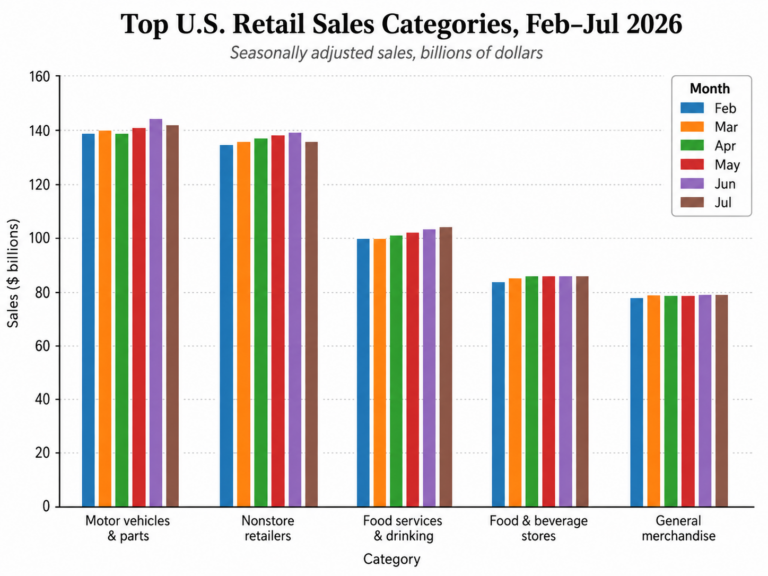
The composition of the report was important. July weakness was led by nonstore retailers, where sales fell 2.2%, and motor vehicle and parts dealers, where sales dropped 1.8%. Electronics and appliance sales also declined, while lower gasoline prices reduced receipts at service stations.
Some of the online decline appears to be timing-related. Amazon shifted its Prime Day promotion into June this year, and competing retailers moved sales events forward as well. Nonstore sales consequently climbed to roughly $140 billion in June before falling to $136.9 billion in July, making part of July’s weakness a reversal of unusually strong June promotions.
The consumer was not uniformly weak. Restaurant and bar spending continued to increase, clothing sales improved, and general-merchandise and food-store sales were broadly stable. That matters because dining out is a discretionary purchase and can provide a useful read on household willingness to spend. The pattern looks more like consumers becoming selective than consumers shutting down.
The more concerning signal came from the measure that feeds most directly into GDP calculations. So-called control-group retail sales fell 0.4%, prompting economists to mark down third-quarter growth expectations. Goldman Sachs lowered its third-quarter GDP tracking estimate to 2.2% following the release.
A Softer Consumer Changes the Rates Debate
The July report takes on greater significance because it follows an unexpectedly weak employment report and relatively mild July inflation. Taken together, the data increasingly argue against another Federal Reserve rate increase in September.
Markets responded accordingly. After the retail report, expectations for a September Fed hike fell to roughly 31%, while the dollar weakened as investors reassessed the likelihood of further tightening.
For fixed-income investors, the important distinction is between slower growth and recession. July retail sales support the former but do not yet establish the latter. Year-over-year spending remains positive, restaurants remain firm, and several retail categories continue to trend higher.
That backdrop is increasingly constructive for high-quality intermediate-duration bonds. A consumer that is losing momentum reduces the need for the Fed to tighten further, while still-positive economic growth limits the immediate threat to investment-grade credit fundamentals.
The preferred positioning remains intermediate Treasuries, agency MBS, high-quality securitized credit and shorter-to-intermediate investment-grade corporates. Lower-quality credit deserves more selectivity if employment and consumer spending continue to weaken.
Bottom Line
July retail sales reinforce the emerging macro message: the economy is slowing enough to make additional Fed tightening less likely, but not yet enough to signal a recession.
The decline was meaningful, particularly in autos and online spending, but it was not broad-based. Restaurants, apparel and several core categories remained resilient.
For fixed-income investors, that combination strengthens the case for adding high-quality intermediate duration while continuing to harvest income from investment-grade and securitized credit. The consumer is no longer providing the same growth cushion it did earlier this year—and that makes the current level of bond yields increasingly attractive.
Sources: U.S. Census Bureau, Advance Monthly Retail and Food Services Sales, released August 14, 2026. Reuters coverage of the July retail-sales report and market reaction.