
The third monthly ETFFixedIncome.com model updates examines how the Alternative Credit Strategy navigated rising Treasury yields and generated positive relative performance in August.
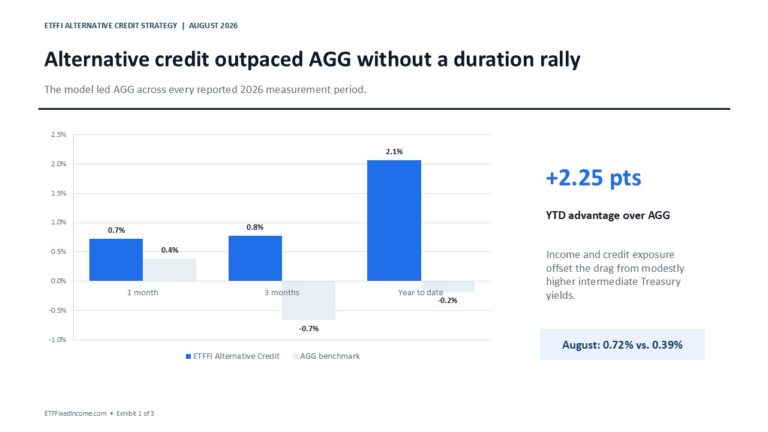
August offered a useful demonstration of why alternative credit can complement a traditional core bond allocation. Treasury yields finished the month modestly higher, inflation remained above the Federal Reserve’s comfort zone and economic data sent conflicting signals. Against that backdrop, the ETFFI Alternative Credit Strategy returned 0.72%, outperforming its benchmark, the iShares Core U.S. Aggregate Bond ETF (AGG), which gained 0.39%.
The resulting 0.33 percentage-point advantage was not driven by a major duration rally. Instead, it came primarily from the strategy’s emphasis on credit income, shorter maturities and lower interest-rate sensitivity. That distinction matters for Registered Investment Advisors seeking to generate dependable portfolio income without making client outcomes excessively dependent on falling Treasury yields.
The economic backdrop was unusually mixed. July nonfarm payrolls declined by 23,000, retail sales fell 0.6% and housing activity weakened. At the same time, service-sector activity remained firm, second-quarter GDP grew at a revised 1.5% annualized rate and core personal consumption expenditures inflation held at 3.3% year over year. Markets were therefore forced to balance softer employment and consumption data against persistent inflation and pockets of continued economic strength.
Treasury yields responded by moving slightly higher. The two-year yield increased approximately 7 basis points during August to 4.34%, while the 10-year yield rose about 3 basis points to 4.75%. The 30-year yield was roughly unchanged at 5.24%. Higher intermediate yields limited returns from duration-heavy core bonds, but declining interest-rate volatility and resilient corporate fundamentals supported credit-sensitive assets.
The strategy’s positioning was well suited to that environment. As of August 31, approximately 65% of the portfolio was allocated to the iShares iBoxx $ High Yield Corporate Bond ETF (HYG), which returned 0.90% during the month. HYG was the largest contributor to portfolio performance. Allocations to the Hilton BDC Corporate Bond ETF (HBDC), short-duration investment-grade credit and public/private credit strategies added diversification across several income-producing segments.
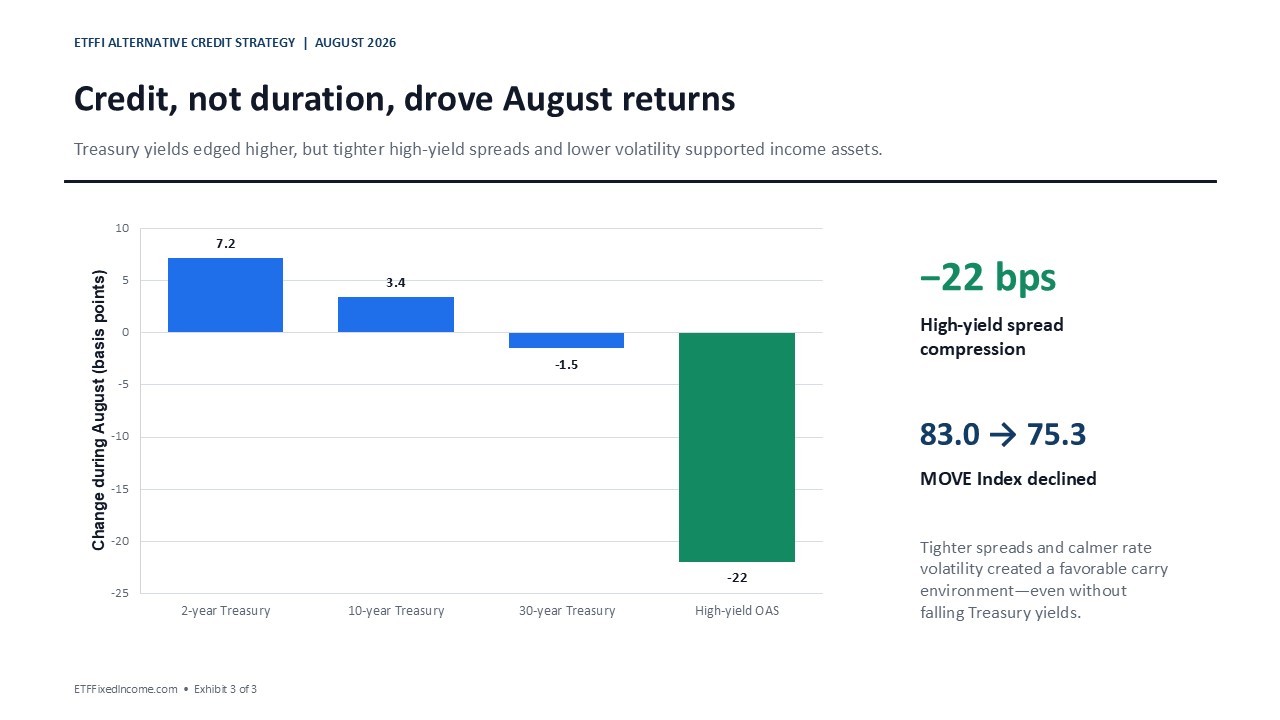
Credit spreads provided an additional tailwind. The ICE BofA U.S. High Yield option-adjusted spread narrowed from 285 to 263 basis points during August. The combination of spread compression and coupon income allowed high-yield securities to outperform the broader investment-grade bond market even as Treasury yields edged upward.
The portfolio’s structural characteristics help explain the difference. Its effective duration was 2.8 years, compared with 5.7 years for the benchmark. The model also offered a 6.1% yield to worst and a 5.63% distribution yield, versus a 4.9% yield to worst for AGG. In practical terms, the strategy entered the month with more income potential and approximately half the benchmark’s interest-rate sensitivity.
Performance over longer measurement periods reinforces the August result. The model returned 0.77% over three months, compared with a 0.66% decline for AGG. Year to date, the strategy gained 2.07% while the benchmark declined 0.18%, producing a 2.25 percentage-point advantage. These figures remain hypothetical model results rather than the performance of an investable client account.
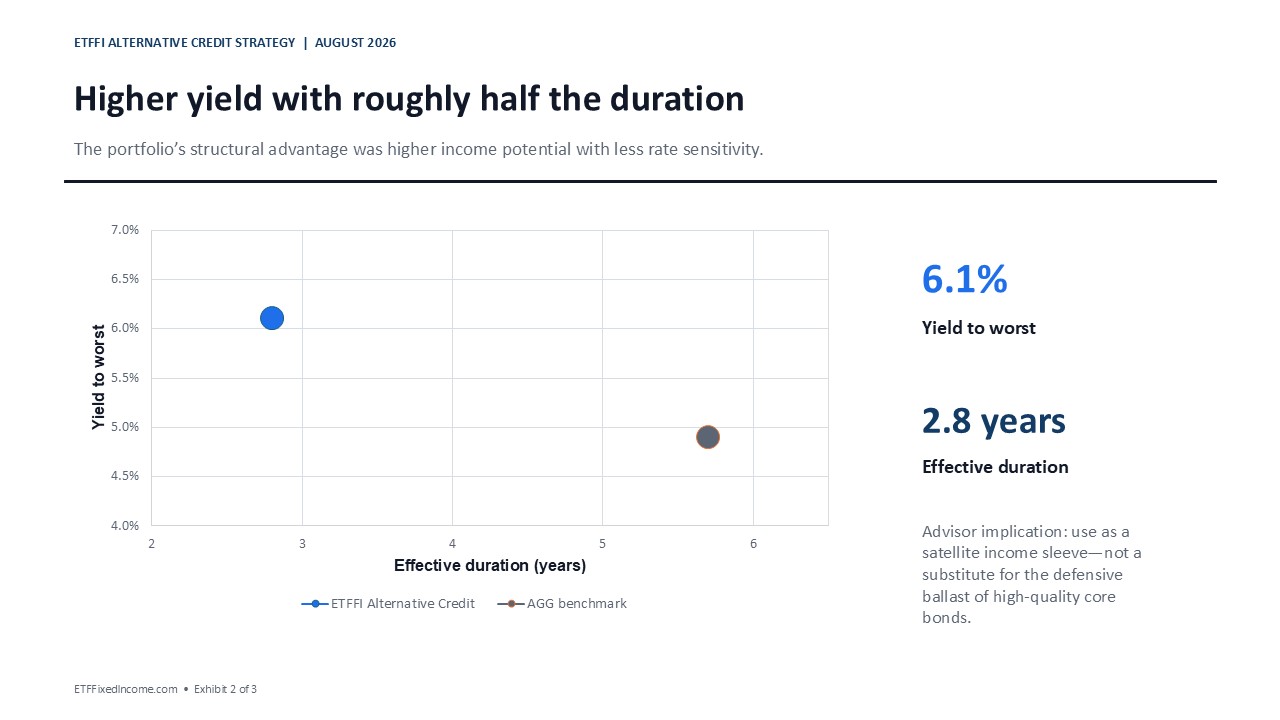
For advisors, the strategy is best viewed as a satellite income allocation rather than a complete replacement for core fixed income. Its higher allocation to below-investment-grade and alternative credit introduces greater default, liquidity and economic-cycle risk. The portfolio will likely be most effective when paired with Treasuries and high-quality bonds that can provide protection during a material risk-off event.
August nevertheless showed the model operating as designed: harvesting credit income, limiting duration exposure and diversifying beyond the conventional Aggregate Bond Index. For wealthy clients seeking additional portfolio income, that combination can be valuable—provided the allocation is sized appropriately within the client’s liquidity needs, tax circumstances and tolerance for credit-market volatility.
Sources: ETF Action/FactSet ETFFI Alternative Credit Model Fact Sheet, August 31, 2026; ETFFixedIncome.com Fund Universe Returns and Flows; ETFFixedIncome.com Fixed Income Macro Data; ETFFixedIncome.com Economic Calendar. FactSet data supplied by the user.
Disclaimer: This material is for informational and educational purposes only and does not constitute investment advice or a recommendation to purchase or sell any security. Model results are hypothetical and may differ materially from actual client results. Past performance does not guarantee future results.
