The Lead
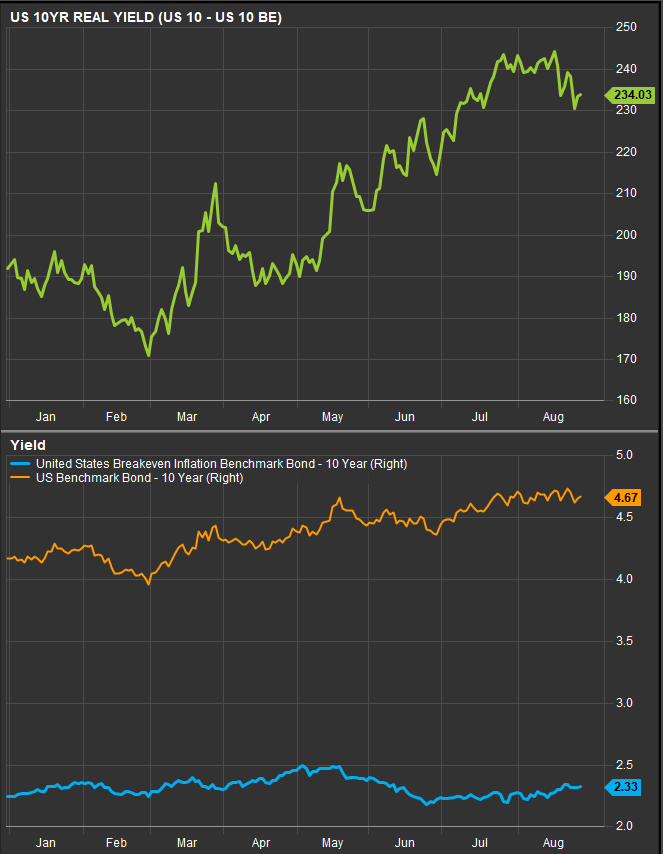
Fixed income starts Friday with yields still elevated and markets waiting for Fed Chair Kevin Warsh’s 10:00 a.m. ET Jackson Hole speech. The 10-year Treasury rose to 4.67%, the 30-year Treasury moved to 5.19%, and the 10-year real yield held at 2.34%. The long end is below last week’s stress levels but still high enough to keep long-duration Treasuries tactical.
Jackson Hole is the key policy event. Reuters reported that Warsh is under pressure to clarify how the Fed plans to respond to inflation that remains above target, with some officials still arguing for additional tightening. Current market reporting also shows the 30-year Treasury near 5.20%, still down on the week but not far from the recent 2007-era highs.
Oil remains a swing factor. Reuters reported that WTI was on track for a weekly decline, with crude flows through the Strait of Hormuz showing tentative recovery, but still below normal.
The setup still favors an income-oriented allocation: collecting yield from lower-volatility bond segments rather than relying on a sharp decline in Treasury rates to drive total return. Keep emphasis on ultrashort, short-duration, intermediate investment-grade, core bond, MBS, municipal, and AAA CLO exposure while keeping long-duration Treasury exposure tactical.
Rates Tape
| Rate | Latest | 1D Change | 1W Change |
| 2Y Treasury | 4.23% | +1.5 bp | +4.6 bp |
| 10Y Treasury | 4.67% | +1.5 bp | -2.8 bp |
| 30Y Treasury | 5.19% | +1.2 bp | -5.5 bp |
| 2s10s Curve | 44.0 bp | -0.1 bp | -7.3 bp |
| 5s30s Curve | 79.4 bp | -1.1 bp | -6.7 bp |
Duration returns remain positive over the past week, but the one-day backup argues for restraint. TLT gained 1.32% over the past week, EDV rose 2.32%, ZROZ gained 2.59%, and VGLT rose 1.19%. Intermediate duration was firmer but less powerful, with IEF up 0.44% and VGIT up 0.05%.
Macro Signal Board
| Signal | Latest | 1D Change | 1W Change | 1Y Percentile | Trading Read |
| 10Y Treasury | 4.67% | +1.5 bp | -2.8 bp | 94th | Yields remain high despite weekly relief. |
| 30Y Treasury | 5.19% | +1.2 bp | -5.5 bp | 94th | Long-end risk improved but remains elevated. |
| 10Y Real Yield | 2.34% | 0 bp | -1 bp | 89th | Real yields still limit duration upside. |
| 10Y Breakeven | 2.33% | +1 bp | -1 bp | 60th | Inflation compensation is stable but not falling. |
| Fed Funds Implied Rate | 3.63% | -0.3 bp | 0 bp | 13th | Front-end pricing remains relatively dovish. |
| IG OAS | 79 bp | -1 bp | -3 bp | 58th | IG spreads remain contained. |
| HY OAS | 263 bp | -4 bp | -12 bp | 1st | HY spreads are extremely tight. |
| MOVE Index | 69.9 | +0.4 | -3.3 | 38th | Rates volatility is manageable. |
| WTI Crude | $83.53 | +$1.30 | -$4.30 | 68th | Oil is lower on the week but still a policy-risk input. |
The macro setup is more balanced than last week. Long yields, real yields, oil, and rate volatility have improved on a weekly basis. The constraint is that yields remain historically high, high-yield spreads are very tight, and Jackson Hole creates event risk for the front end and the long end.
Calendar Watch
Thursday’s data was mixed. Initial claims fell to 203K versus 210K consensus, while continuing claims fell to 1.778M versus 1.789M consensus. That undercuts the labor-slowdown argument at the margin. Wholesale inventories rose 1.3%, well above 0.3% consensus, while the Kansas City Fed Manufacturing Index held at 10.0.
Today’s calendar is centered on Jackson Hole, Chicago PMI, and Michigan sentiment:
| Time | Release | Consensus | Prior |
| 9:45 a.m. | Chicago PMI | 57.0 | 57.6 |
| 10:00 a.m. | Fed Chair Warsh Jackson Hole remarks | — | — |
| 10:00 a.m. | Michigan Sentiment, final | 50.8 | 51.0 prelim. |
For bonds, Warsh matters more than the data calendar. A clear anti-inflation message could keep the long end cautious even if front-end Fed pricing stays relatively dovish. A softer tone that acknowledges weaker housing, weaker retail sales, and lower oil risk would support intermediate duration and core bonds.
ETF Flow Leaders
| ETF | Segment | 1W Return | 1W Flows | 1M Flows |
| VGSH | Short Treasuries | +0.02% | +$2.72B | +$3.41B |
| SGOV | Ultra-Short Treasuries | +0.03% | +$1.32B | +$5.84B |
| VCIT | Intermediate IG Credit | +0.48% | +$1.30B | +$2.90B |
| GLD | Gold / Macro Hedge | -0.18% | +$1.10B | +$5.26B |
| SCHO | Short Treasuries | +0.04% | +$1.06B | +$1.31B |
| SPTS | Short Treasuries | +0.03% | +$1.05B | +$1.05B |
| BND | Broad Market Bonds | +0.43% | +$709M | +$2.39B |
| MBB | Agency MBS | +0.34% | +$656M | +$656M |
| IAU | Gold / Macro Hedge | -0.20% | +$447M | -$78M |
| BNDX | Global Bonds | +0.10% | +$381M | +$1.10B |
The flow signal moved shorter. VGSH, SGOV, SCHO, and SPTS show strong demand for ultrashort and short Treasury exposure. VCIT remains the clearest credit flow leader, pointing to demand for intermediate investment-grade income. BND, MBB, and BNDX show core bond, agency MBS, and global bond allocations remain active.
Long-duration dip-buying is still present but less dominant. TLT attracted $150M over the week and $4.33B over the past month, while EDV, SPTL, and ZROZ also attracted smaller inflows. That is constructive, but not strong enough to justify a broad long-duration overweight with the 30-year Treasury still above 5%.
The macro-hedge signal remains important. GLD and IAU were both weekly flow leaders, consistent with investor demand for inflation, fiscal, currency, and geopolitical protection ahead of Jackson Hole. Reuters also noted that Treasury buyback actions have revived dollar-debasement concerns, supporting demand for alternative stores of value.
The main caution is lower-quality credit and duration-sensitive Treasury exposure. HYG saw $1.22B of weekly outflows, GOVT lost $2.10B, VGIT lost $2.03B, IEF lost $430M, and LQD lost $107M.
Trading Implications
Core bonds: Maintain exposure. BND, MBB, and BNDX flows are constructive, and lower rate volatility helps, but total-return confidence remains tied to the long end.
Duration: Keep long Treasuries tactical. TLT returns improved, but weekly inflows are modest, GOVT/VGIT/IEF flows are negative, and the 30-year Treasury remains above 5%.
Credit: Prefer intermediate investment-grade exposure. VCIT remains a major flow leader, while LQD outflows show longer-duration corporate demand remains fragile.
High yield: Stay cautious. HY spreads are extremely tight, and HYG outflows suggest investors are reducing lower-quality risk despite positive weekly returns.
Cash management: Keep ultrashort and short-duration ETFs in the allocation mix. VGSH, SGOV, SCHO, SPTS, SHY, and JPST remain supported by flows.
Munis: Maintain tax-aware municipal exposure, but manage duration carefully. Weekly flow leadership is stronger in short Treasuries and VCIT, while VTEB and MUB demand is softer.
TIPS / inflation hedges: Favor short-term inflation protection and macro hedges over broad long-duration TIPS. Oil is lower on the week, but Jackson Hole and inflation credibility remain important risks.
CLOs / loans: Senior floating-rate credit remains useful as a volatility buffer. JAAA flows remain positive, while broader loan demand remains uneven.
Bottom Line
The August 28 setup is supportive for income but still tactical for duration. Long yields and oil are lower on the week, rate volatility has eased, and ETF flows show strong demand for VGSH/SGOV/SCHO/SPTS short Treasury exposure, VCIT intermediate IG credit, core bonds, MBS, and gold hedges. The constraints are still clear: the 30-year Treasury remains above 5%, real yields are elevated, PCE inflation remains sticky, and Jackson Hole is today’s key policy event. Keep long Treasuries and longer-duration credit tactical until the 30-year yield and Fed messaging stabilize.
Sources
- FactSet Research Systems Inc., ETFFixedIncome.com Fund Universe Return & Flow Database, August 28, 2026
- FactSet Research Systems Inc., August 28 rates, credit, volatility, commodity, FX, and economic-calendar data
- Reuters reporting on Jackson Hole, Treasury yields, oil prices, Strait of Hormuz flows, gold, Fed policy expectations, and global market conditions
- CME Group / New York Fed reference materials on Fed funds futures methodology
Disclaimer: This commentary is for informational and educational purposes only and should not be considered investment advice. ETF return and flow data can change quickly and may reflect short-term trading activity rather than durable allocation trends. Fixed income investments are subject to interest-rate risk, credit risk, liquidity risk, inflation risk, tax considerations, and potential loss of principal.