The Lead
Fixed income starts Monday with softer consumer data helping Fed expectations, but the long end remains the constraint. The 10-year Treasury ended Friday at 4.69%, the 30-year Treasury rose to 5.26%, and the 10-year real yield held at 2.41%. Those levels keep long-duration Treasuries tactical, even as markets continue to reduce the odds of near-term Fed tightening.
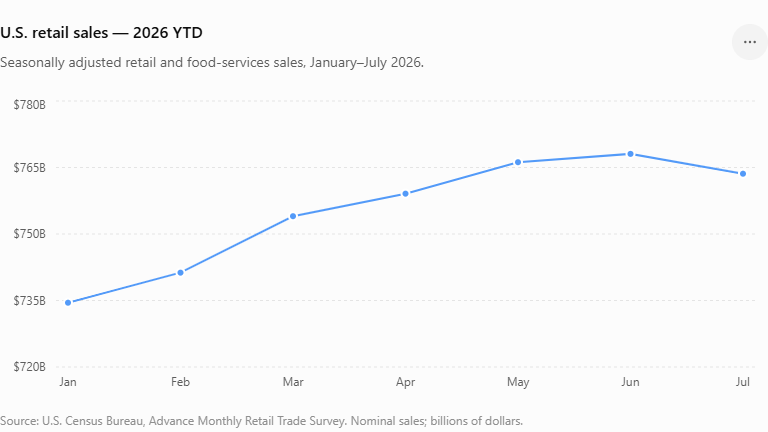
Friday’s retail sales report was bond-friendly. July retail sales fell 0.60% versus expectations for a 0.10% gain, while the control group dropped 0.44% versus expectations for a 0.30% gain. Reuters reported that retail sales posted their first decline in nine months and that softer consumer and inflation data lowered the market-implied probability of a September Fed hike from roughly 50% to 30%.
Oil is still the offsetting risk. August 17 market reports showed Brent near $89.42 as supply concerns and Iran-related geopolitical risk remained in the tape.
The setup still favors an income-oriented allocation: collecting yield from ultrashort, short-duration, municipal, AAA CLO, short investment-grade, and selective credit segments while keeping long-duration Treasury exposure tactical.
Rates Tape
| Rate | Latest | 1D Change | 1W Change |
| 2Y Treasury | 4.17% | +2.8 bp | -2.2 bp |
| 10Y Treasury | 4.69% | +4.7 bp | +4.8 bp |
| 30Y Treasury | 5.26% | +4.6 bp | +6.2 bp |
| 2s10s Curve | 51.9 bp | +1.9 bp | +7.0 bp |
| 5s30s Curve | 89.7 bp | +0.4 bp | +5.0 bp |
The curve steepened again, with the long end bearing the pressure. TLT fell 0.67% on the day and was roughly flat over the past week at -0.02%. VGLT fell 0.68% over the week, ZROZ declined 0.28%, and EDV fell 0.24%. Intermediate duration held up better, with IEF up 0.30% over the week, although flows were sharply negative.
Macro Signal Board
| Signal | Latest | 1D Change | 1W Change | 1Y Percentile | Trading Read |
| 10Y Treasury | 4.69% | +4.7 bp | +4.8 bp | 98th | Yields remain near one-year highs. |
| 30Y Treasury | 5.26% | +4.6 bp | +6.2 bp | 100th | Long-end risk remains the main constraint. |
| 10Y Real Yield | 2.41% | +2.0 bp | +1.0 bp | 96th | Real yields still limit duration upside. |
| 10Y Breakeven | 2.27% | +3.0 bp | +2.0 bp | 32nd | Inflation compensation is contained but rising. |
| Fed Funds Implied Rate | 3.63% | +0.3 bp | 0.0 bp | 15th | Front-end pricing remains relatively dovish. |
| IG OAS | 80 bp | +1 bp | +2 bp | 71st | IG spreads remain contained but wider. |
| HY OAS | 267 bp | -4 bp | -3 bp | 3rd | HY spreads remain very tight. |
| MOVE Index | 69.6 | +0.4 | -2.5 | 37th | Rates volatility is manageable. |
| WTI Crude | $82.40 | +$1.15 | +$4.22 | 68th | Oil remains the main inflation-risk input. |
The macro message is mixed. Softer retail sales and weaker sentiment support the front end, while contained breakevens and lower MOVE volatility help core bonds. The constraint is that the 30-year Treasury is at a one-year high, real yields remain restrictive, and oil is still elevated.
Calendar Watch
Friday’s data was broadly bond-friendly. Retail sales fell 0.60%, retail sales ex-auto fell 0.30%, the retail sales control group fell 0.44%, business inventories were flat, and Michigan Sentiment fell to 51.0 versus 54.5 consensus.
Today’s calendar is lighter:
| Time | Release | Consensus | Prior |
| 8:30 a.m. | Empire State Index | 9.0 | 15.6 |
| 10:00 a.m. | NAHB Housing Market Index | 33.0 | 34.0 |
The week’s larger catalysts come later: housing starts, import prices, and industrial production on Tuesday, FOMC minutes on Wednesday, jobless claims and Philadelphia Fed on Thursday, and S&P Global PMIs on Friday. Reuters noted that investors are watching the July Fed minutes and this week’s activity data after the surprise retail-sales decline.
ETF Flow Leaders
| ETF | Segment | 1W Return | 1W Flows | 1M Flows |
| TLT | Long Treasuries | -0.02% | +$5.61B | +$4.21B |
| SGOV | Ultra-Short Treasuries | +0.06% | +$1.10B | +$4.67B |
| FBND | Broad Active Bonds | +0.20% | +$842M | +$1.22B |
| GLD | Gold / Macro Hedge | -0.26% | +$832M | +$2.60B |
| BSV | Short-Term Bonds | +0.22% | +$605M | +$1.91B |
| LQD | Investment Grade Credit | -0.40% | +$402M | -$1.56B |
| VCIT | Intermediate IG Credit | +0.20% | +$300M | +$1.06B |
| SLV | Silver / Macro Hedge | -1.57% | +$287M | +$703M |
| BNDX | Global Bonds | -0.15% | +$271M | +$1.07B |
| AGG | Broad Market Bonds | +0.25% | +$263M | +$457M |
The flow signal is constructive but still barbelled. TLT saw very large inflows, showing aggressive dip-buying in long-duration Treasuries. But IEF lost $4.14B over the week, so the duration message is not broadly bullish.
SGOV and BSV confirm demand for cash management and short-duration ballast. FBND, BND, AGG, and BNDX show core bond allocations remain active. VCIT and LQD show interest in investment-grade credit, though LQD’s one-month flows remain negative, pointing to fragile demand for longer-duration credit.
The macro-hedge signal remains notable. GLD and SLV were both among the weekly flow leaders, consistent with continued demand for inflation and geopolitical hedges.
Trading Implications
Core bonds: Maintain exposure. Broad bond ETFs are attracting assets, and softer retail data supports the near-term case for core fixed income.
Duration: Keep long Treasuries tactical. TLT inflows are strong, but the 30-year Treasury at 5.26%, elevated real yields, and large IEF outflows argue against a broad duration chase.
Credit: Prefer short and intermediate investment-grade exposure. VCIT, VCSH, and IGSB remain better aligned with the current rate environment than longer-duration credit.
High yield: Stay selective. HY spreads are very tight, HYG had modest weekly inflows, but JNK saw more than $500M of weekly outflows.
Cash management: Keep ultrashort and short-duration ETFs in the allocation mix. SGOV and BSV remain key flow leaders.
Munis: Maintain tax-aware municipal exposure. VTEB continues to attract assets, but longer-duration muni exposure should still be managed carefully.
TIPS / inflation hedges: Favor short-term inflation protection and macro hedges over broad long-duration TIPS. VTIP, GLD, and SLV flows show investors still want protection against oil and geopolitical risk.
CLOs / loans: Senior floating-rate credit remains useful as a volatility buffer. JAAA flows are positive, while broader loan demand is more uneven.
Bottom Line
The August 17 setup is more supportive for fixed income after soft retail sales and weaker sentiment reduced near-term Fed-hike pressure. However, the long end remains the key problem: the 30-year Treasury is at a one-year high, real yields remain restrictive, and oil is still elevated. ETF flows show a barbell of TLT dip-buying, SGOV/BSV cash and short-duration demand, broad bond allocations, investment-grade credit interest, and macro hedging through GLD and SLV. Keep long Treasuries and longer-duration credit tactical until the long end stabilizes.
Sources
- FactSet Research Systems Inc., ETFFixedIncome.com Fund Universe Return & Flow Database, August 17, 2026
- FactSet Research Systems Inc., August 17 rates, credit, volatility, commodity, FX, and economic calendar data
- Reuters reporting on retail sales, consumer sentiment, Fed pricing, Treasury yields, oil prices, and global market conditions
- CME Group / New York Fed reference materials on Fed funds futures methodology
Disclaimer: This commentary is for informational and educational purposes only and should not be considered investment advice. ETF return and flow data can change quickly and may reflect short-term trading activity rather than durable allocation trends. Fixed income investments are subject to interest-rate risk, credit risk, liquidity risk, inflation risk, tax considerations, and potential loss of principal.