COMMENTARY:
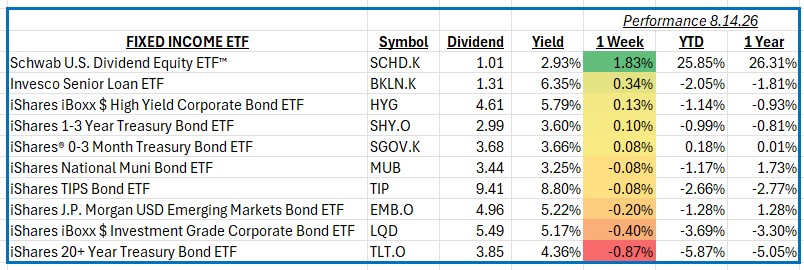
U.S. fixed-income markets were mixed for the week ended August 14, 2026, as investors assessed inflation data, economic resilience, and the likely path of Federal Reserve policy. Short-duration government securities and floating-rate credit held up well, while longer-maturity bonds declined as yields moved higher at the long end of the curve. Credit markets remained relatively orderly, but performance increasingly reflected duration exposure and sensitivity to changes in Treasury yields.
Dividend-oriented equities, while not a bond exposure, led the listed income-oriented allocations with a 1.83% gain and a 2.93% indicated yield. Large, established companies in areas such as health care, consumer staples, industrials, financials, and energy were important contributors. The group outperformed every fixed-income category, reflecting investor preference for quality balance sheets, dependable cash flows, and shareholder distributions amid a modestly constructive equity backdrop.
Senior secured loans returned 0.34%, supported by their floating-rate coupons and priority position in corporate capital structures. This category outperformed high-yield corporate bonds by 0.21%, short-term Treasuries by 0.24%, and all longer-duration exposures. Bank loans from leveraged corporate issuers contributed through carry income and comparatively limited interest-rate sensitivity, while generally stable credit conditions helped offset modest concerns about borrowing costs and refinancing needs.
High-yield corporate bonds advanced 0.13%, ahead of short-term Treasuries and the remaining bond categories. Returns were driven primarily by coupon income and continued demand for below-investment-grade credit, with energy, telecommunications, health care, and consumer issuers among influential segments. Credit spreads remained relatively contained, suggesting investors saw limited near-term evidence of broad financial stress, although lower-quality issuers remained sensitive to growth and refinancing developments.
Short-duration Treasury securities gained 0.10\%, while cash-like government obligations returned 0.08%. Their results reflected attractive prevailing yields and low duration risk, but they lagged higher-carry floating-rate and high-yield credit. Municipal bonds and inflation-protected Treasuries each fell 0.08%, reflecting modest upward pressure on yields; municipal performance also responded to tax-exempt supply and seasonal demand, while inflation-linked securities were influenced by inflation expectations and real-yield movements.
Emerging-market dollar-denominated bonds declined 0.20%, investment-grade corporate bonds lost 0.40%, and long-duration Treasuries fell 0.87%, the weakest outcome. Longer maturity exposure was hurt most as higher yields reduced bond prices; long Treasuries trailed investment-grade corporates by 0.47%, emerging-market debt by 0.67%, and senior loans by 1.21%. Emerging-market returns also reflected country-specific and currency-related risk sentiment, while investment-grade corporates faced both duration pressure and spread sensitivity.
This week reinforced the value of yield, credit selectivity, and shorter duration as long-term rates rose. Investors will continue to monitor inflation, labor-market data, Treasury supply, and Federal Reserve communication for direction in bond yields and credit spreads.