COMMENTARY:
U.S. fixed income markets faced meaningful pressure during the week ending August 21 as longer-term Treasury yields climbed and investors reassessed inflation, fiscal and monetary-policy risks. The 10-year Treasury yield finished near 4.69%, while the 30-year reached approximately 5.23%, its highest level since 2007. The Treasury responded by doubling its planned long-dated bond buybacks, while investors looked ahead to Federal Reserve Chair Kevin Warsh’s Jackson Hole speech for guidance on future policy.
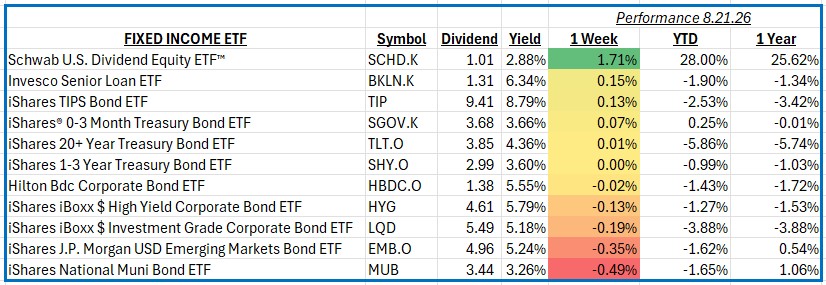
Dividend-oriented equities were the strongest exposure in the group, gaining 1.71%. The advance reflected the relative appeal of income-producing companies as Treasury yields remained elevated and equity markets declined. Large holdings such as Exxon Mobil, Chevron, Home Depot and Verizon helped support performance. With a yield of approximately 2.88%, the strategy also provided a combination of income and equity participation that differentiated it from traditional bond exposures.
Senior loans gained 0.15%, narrowly outperforming inflation-protected bonds at 0.13% and short-term Treasuries at 0.07%. Floating-rate loans benefited from their limited interest-rate sensitivity as longer-term yields increased. Strong corporate fundamentals and relatively resilient credit conditions also helped support demand. The performance illustrates why floating-rate securities can provide diversification when conventional fixed-rate bonds face duration pressure.
Treasury securities were broadly flat, but performance varied by maturity. Short-term Treasuries gained 0.07%, while intermediate Treasuries were essentially unchanged and long-term Treasuries advanced just 0.01% despite the sharp increase in yields during the week. The Treasury buyback announcement helped stabilize the long end, although fiscal concerns continued to weigh on longer maturities. Inflation-protected securities gained 0.13%, supported by continued concern that higher energy prices could keep inflation elevated.
Corporate credit was mixed. High-yield bonds declined 0.13%, while investment-grade corporate bonds fell 0.19% and business-development corporate debt slipped 0.02%. The modest weakness reflected the broader increase in Treasury yields rather than a sharp deterioration in credit fundamentals. Importantly, investment-grade issuance was elevated, partly driven by technology companies financing significant AI infrastructure spending, creating additional supply for investors to absorb.
Emerging-market and municipal bonds were the weakest exposures in the group. Emerging-market bonds declined 0.35%, while municipal bonds fell 0.49%, making munis the largest weekly laggard. Rising Treasury yields generally pressured tax-exempt bonds, while emerging-market debt faced the additional challenge of a stronger global risk-off environment. Overall, the week’s results favored floating-rate, short-duration and income-oriented exposures over longer-duration fixed income.
In summary, the bond market remains caught between attractive yields and concerns surrounding inflation, fiscal deficits and the long-term supply of government and corporate debt. With Jackson Hole and upcoming inflation data ahead, investors enter the new week focused on whether higher yields represent an opportunity to add duration—or a signal that patience remains warranted.