COMMENTARY:
U.S. fixed income markets faced competing forces during the week ending September 4. A sharp escalation in U.S.-Iran tensions pushed oil prices higher, reinforcing inflation concerns and driving Treasury yields toward multi-year highs. The 10-year Treasury yield reached approximately 4.82% during the week before easing, while the stronger-than-expected August employment report added to expectations that the Federal Reserve could keep rates higher for longer. Payrolls increased by 162,000 versus expectations of 56,000, while unemployment remained at 4.1%.
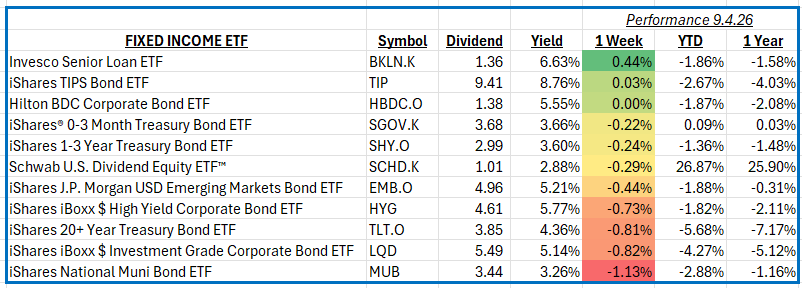
Bank loans were the strongest-performing fixed income exposure, gaining 0.44%. Floating-rate loans benefited from their limited duration sensitivity as Treasury yields moved higher. The asset class also continued to offer attractive income, with the representative portfolio yielding approximately 6.63%. Stronger economic data helped support credit fundamentals, although investors remained attentive to the potential impact of higher-for-longer rates on leveraged borrowers.
Treasury Inflation-Protected Securities were essentially flat, returning 0.03%, as higher nominal yields were offset by continued concerns about inflation. Energy prices were an important factor, with oil approaching $90 per barrel as Middle East tensions intensified. The stronger jobs report subsequently pushed yields higher, limiting gains in inflation-sensitive government debt.
Short-term government bonds declined modestly, with three-month Treasury exposure falling 0.22% and one-to-three-year Treasuries declining 0.24%. The moves reflected higher short-term yields following the employment report and renewed expectations for a potential September Fed rate increase. Federal Reserve Governor Christopher Waller’s more patient comments earlier in the week had temporarily pushed yields lower before the jobs data reversed much of that move.
Corporate and credit markets generally weakened as higher Treasury yields pressured fixed-rate securities. High-yield corporate bonds declined 0.73%, while investment-grade corporates fell 0.82%. Emerging-market bonds declined 0.44%, reflecting higher U.S. rates and a firmer dollar. Within equities with bond-like characteristics, dividend stocks also declined 0.29%, while longer-duration Treasuries fell 0.81%. Municipal bonds were the weakest exposure, declining 1.13%, as their longer duration amplified the impact of rising yields.
Overall, the week reinforced the importance of duration management as inflation and Fed expectations remain unsettled. Higher yields created headwinds for longer-duration assets, while floating-rate credit demonstrated greater resilience.