COMMENTARY:
U.S. fixed income markets finished the week ending October 23, 2026, with positive returns across most major bond categories as Treasury yields declined. Concerns about artificial intelligence spending and stock-market volatility prompted investors to seek the relative safety of government bonds. The 10-year Treasury yield fell approximately 11 basis points to 4.99%, marking its third consecutive weekly decline. However, rising oil prices and persistent inflation concerns complicated the interest-rate outlook ahead of the Federal Reserve’s upcoming policy meeting. Investors widely expected the Fed to maintain its current policy rate while monitoring inflation and economic growth.
Government Bonds and Treasury Securities
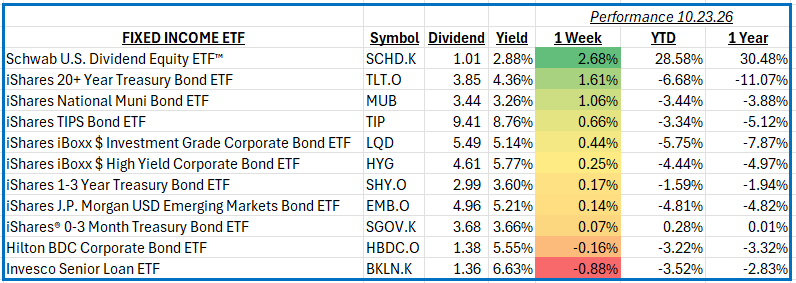
Long-term government bonds led the performance among the exposures provided, gaining 1.61% as declining yields boosted prices. Their longer duration made them particularly sensitive to falling interest rates. Short-term Treasury securities advanced 0.17%, considerably less than long-term bonds, reflecting their lower interest-rate sensitivity. Meanwhile, Treasury inflation-protected securities gained 0.66%. Although inflation concerns persisted amid higher energy prices, falling Treasury yields supported positive returns across government bond investments.
Municipal Bonds and Tax-Advantaged Income
Municipal bonds advanced 1.06%, benefiting from declining interest rates and continued investor demand for tax-advantaged income. Improving market conditions supported the sector as investors evaluated yields relative to taxable alternatives. Municipal securities offered an attractive option for investors seeking income, particularly those in higher tax brackets. Their performance exceeded that of investment-grade corporate bonds and short-term Treasuries during the week.
Investment-Grade and High-Yield Corporate Bonds
Investment-grade corporate bonds gained 0.44%, supported by falling Treasury yields, although concerns about financing costs and artificial intelligence-related borrowing limited broader enthusiasm. High-yield corporate bonds rose 0.25%, trailing investment-grade debt as investors became more selective about credit risk. Companies with stronger balance sheets remained better positioned to withstand elevated borrowing costs, while lower-quality issuers faced greater scrutiny amid economic uncertainty.
Emerging-Market Debt and Dividend-Paying Equities
Emerging-market bonds gained 0.14%, reflecting modestly positive returns despite currency, geopolitical, and credit risks. Dividend-paying equities advanced 2.68%, outperforming every fixed-income category in the comparison. Established companies with consistent dividend payments attracted investor interest amid market volatility, although equity investments remain more exposed to market fluctuations than traditional bonds.
Senior Loans and Specialized Credit
Senior loans declined 0.88%, making them the weakest-performing exposure in the group. Their floating interest rates provide less benefit from falling market yields, while concerns about borrower credit quality weighed on performance. Specialized corporate credit also slipped 0.16%, reflecting uneven investor appetite for credit-related investments.
Closing Thoughts: Falling Treasury yields supported most bond categories, while longer-duration government bonds and dividend-paying equities led performance. Investors will continue weighing inflation, energy prices, credit conditions, and the Federal Reserve’s next decision.