COMMENTARY:
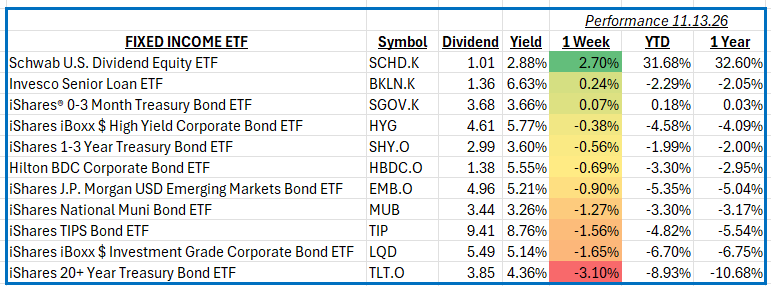
U.S. fixed income had a difficult week ending November 13 as Treasury yields rose and bond prices fell, especially for longer maturities. October consumer inflation came in hotter than expected, while producer prices rose 6.5% from a year earlier, the fastest annual increase since 2022. The 10-year Treasury yield moved above 5%, as investors reassessed the likelihood of further Federal Reserve rate increases.
Dividend-paying U.S. stocks rose 2.70%. This equity exposure benefited from the week’s stock market rebound; large holdings such as Chevron and Coca-Cola are examples of established dividend payers. Its return reflects share-price changes as well as income, so it is not directly comparable to bond returns.
Senior loans gained 0.24%, supported by their floating-rate coupons, which adjust as short-term rates change. Loans from large borrowers such as Serta Simmons and Asurion are examples of the leveraged credit exposure in this market; issuer-specific credit concerns can still weigh on individual loans.
Very short Treasury bills returned 0.07%. Their low sensitivity to changing yields helped limit price swings, while their short maturities meant little capital appreciation as rates rose. The return largely reflects income accruing over the week.
High-yield corporate bonds fell 0.38%. Coupon income offered some support, but the higher-rate environment pressured prices. Holdings from issuers such as TransDigm and Carnival illustrate the credit exposure; weaker borrowers can face added pressure when financing costs rise.
Short-term Treasuries declined 0.56%. Even with limited duration, rising yields pushed prices lower. Their shorter maturities helped cushion the decline relative to longer-dated government bonds.
Business development company debt fell 0.69%. This segment lends to smaller and mid-sized companies, so credit quality and financing conditions matter alongside interest rates. Higher yields can pressure both borrowers’ ability to service debt and the market value of existing loans.
Emerging-market dollar bonds lost 0.90%. Higher U.S. yields and a stronger dollar can raise borrowing pressure for overseas issuers. Sovereign and corporate borrowers across Latin America and Asia contributed to this broad exposure.
National municipal bonds declined 1.27%. Longer-maturity municipal securities were particularly sensitive to the rise in market yields, which reduced the appeal of existing bonds’ tax-exempt income.
Inflation-protected Treasuries fell 1.56%. Although their principal adjusts with inflation, they remain sensitive to changes in real yields; that rate pressure outweighed the week’s inflation concerns.
Investment-grade corporate bonds lost 1.65%. Bonds from large issuers such as Microsoft and JPMorgan Chase faced broad rate-driven price pressure, despite generally stronger credit quality than high-yield debt.
Long-term Treasuries were the weakest exposure, falling 3.10%. Their longer duration magnified the effect of higher yields on bond prices. The week’s rate rise weighed most heavily on longer-maturity government securities.
Overall, rising yields pressured most bond categories, with longer maturities hit hardest. Rates moved higher as inflation data reinforced the prospect of a more cautious path toward easing.