Private employers continued to add jobs, but the downshift reinforces evidence that labor demand is cooling as inflation pressures ease.
U.S. private-sector hiring slowed again in the latest high-frequency ADP report, adding to evidence that the labor market is losing momentum without yet tipping into outright contraction.
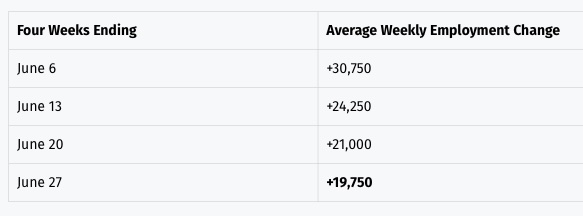
Private employers added an average of 19,750 jobs per week during the four weeks ending June 27, down from 21,000 in the previous report. Hiring has now slowed for three consecutive weeks and is nearly 36% below the 30,750 weekly average reported for the four weeks ending June 6.
| Four Weeks Ending | Average Weekly Employment Change |
| June 6 | +30,750 |
| June 13 | +24,250 |
| June 20 | +21,000 |
| June 27 | +19,750 |
The data come from ADP’s NER Pulse, a preliminary estimate based on a seasonally adjusted four-week moving average of private payroll employment. The measure has a two-week reporting lag and can be revised as additional payroll information becomes available. It should not be confused with ADP’s better-known monthly employment report.
The latest reading is consistent with the broader slowdown visible in June employment data. ADP’s monthly report showed private employers added 98,000 jobs in June, down from 122,000 in May. The official Labor Department report was weaker, showing total nonfarm payrolls increased by just 57,000, although the unemployment rate remained relatively low at 4.2%.
The combination points to a labor market that is still creating jobs but no longer generating the kind of broad hiring strength that would normally place significant upward pressure on wages and inflation. Hiring remains positive, and the unemployment rate has not risen sharply, but businesses appear increasingly cautious about adding workers.
That distinction matters for the Federal Reserve. A gradual decline in hiring could help bring wage and service-sector inflation lower without producing a recession. The softer ADP reading also arrived alongside a much weaker-than-expected June Consumer Price Index report, which showed core consumer prices were unchanged during the month.
Together, slower hiring and softer inflation weaken the immediate argument for another Fed rate increase. They could also encourage investors to price a lower path for future short-term rates, supporting Treasury bonds and rate-sensitive equity sectors.
The report is not yet a recession signal. Private payrolls are still expanding, job openings have remained relatively firm and unemployment is only 4.2%. The ADP weekly series is also preliminary and can be volatile.
Still, the direction is becoming harder to dismiss. The four-week hiring pace has fallen in each of the past three reports, while both ADP and government payroll data show job creation slowing. Continued readings near or below the current pace would strengthen the case that restrictive interest rates are finally cooling labor demand—and give the Fed greater flexibility to shift from fighting inflation toward protecting employment.
Sources
- ADP Research: ADP National Employment Report Preliminary Estimate for June 27, 2026. Private employers added an average of 19,750 jobs per week; hiring slowed for a third consecutive week. The NER Pulse is a seasonally adjusted four-week moving average with a two-week reporting lag and is subject to revision.
- ADP Research and Stanford Digital Economy Lab: June 2026 ADP National Employment Report. Private-sector payrolls increased by 98,000 in June, while annual pay growth was 4.4% for job-stayers and 6.6% for job-changers.
- U.S. Bureau of Labor Statistics: The Employment Situation—June 2026. Total nonfarm payrolls increased by 57,000, and the unemployment rate remained at 4.2%.