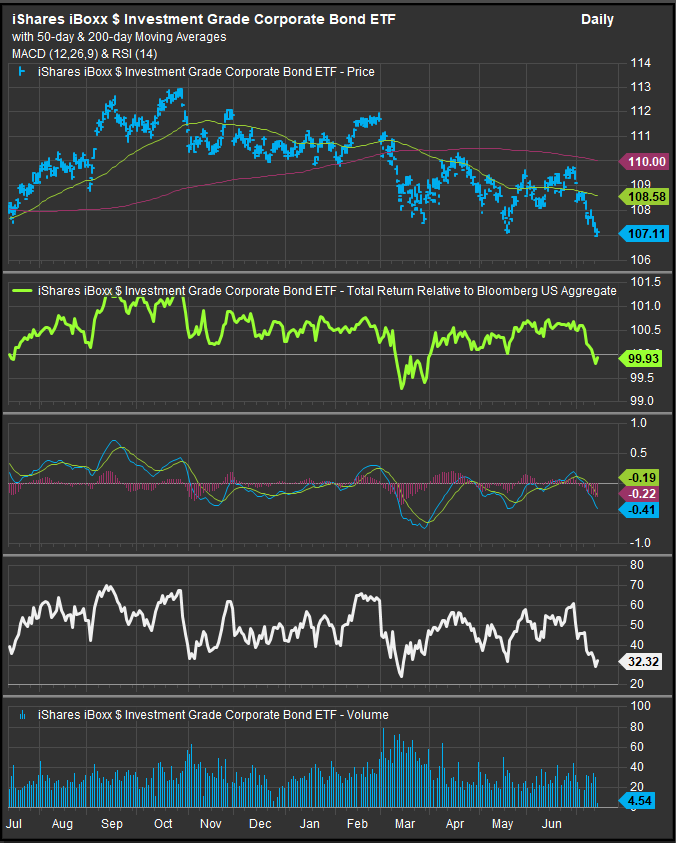
Investment-grade credit and core bond ETFs continued to dominate investor allocations over the past month, reinforcing the view that investors remain committed to generating income while limiting interest-rate risk rather than making an aggressive duration bet.
According to the July 14 ETFFixedIncome.com Fixed Income ETF Universe (FactSet data), the largest one-month inflows were concentrated in high-quality corporate bonds, broad market bond funds, Treasury ETFs and ultra-short income strategies.
iShares iBoxx Investment Grade Corporate Bond ETF (LQD) led all fixed income ETFs with $6.1 billion of one-month net inflows. Broad core bond exposure followed, with Vanguard Total Bond Market ETF (BND) attracting $3.66 billion, iShares 0-3 Month Treasury Bond ETF (SGOV) gathering $2.74 billion, iShares 20+ Year Treasury Bond ETF (TLT) receiving $2.23 billion, and iShares Core U.S. Aggregate Bond ETF (AGG) adding $2.21 billion.
Beyond those headline leaders, investors continued allocating capital across nearly every major income sleeve. JPMorgan Ultra-Short Income ETF (JPST) attracted $1.27 billion, Vanguard Intermediate-Term Corporate Bond ETF (VCIT) added $1.11 billion, while Janus Henderson AAA CLO ETF (JAAA) gathered $1.10 billion. Inflation protection also remained in demand as Schwab U.S. TIPS ETF (SCHP) surpassed $1 billion in monthly inflows despite recent moderation in headline inflation.
The flow profile suggests investors are becoming more selective rather than simply extending duration.
Investment-grade corporate credit continues to be the market’s highest-conviction trade. Strong inflows into LQD, VCIT, VCSH and IGSB indicate investors are willing to add spread exposure, but are concentrating on higher-quality issuers rather than reaching aggressively into speculative-grade credit.
The Treasury allocation tells a more nuanced story. Demand for SGOV, JPST, VGSH and VGIT shows investors continue to value liquidity and front-end yields, while the resurgence of TLT suggests a smaller group of investors is beginning to accumulate long-duration exposure at yields above 5%. Rather than signaling a broad consensus that rates are about to fall, the combination of strong inflows into both ultra-short and long-duration Treasury ETFs reflects a barbell positioning strategy as investors hedge multiple macro outcomes.
Securitized credit also remains one of the strongest themes in the fixed income market. JAAA’s billion-dollar monthly inflow reinforces recommendations from several major Wall Street strategists, including J.P. Morgan and BlackRock, which continue to highlight high-quality structured credit as an attractive source of income in an environment where traditional investment-grade spreads remain historically tight.
International diversification has also quietly improved. Vanguard Total International Bond ETF (BNDX) attracted more than $735 million during the month, while iShares J.P. Morgan USD Emerging Markets Bond ETF (EMB) added nearly $790 million, suggesting investors are becoming more comfortable expanding beyond domestic fixed income as global monetary policy paths continue to diverge.
Taken together, the flow data closely matches the current ETFFixedIncome.com model. The model continues to favor Risk-on Credit while maintaining negative signals for both duration and inflation. That combination argues for emphasizing carry (income) rather than relying on a significant decline in Treasury yields to drive returns.
For ETF investors, the preferred implementation remains diversified. Core allocations continue to favor broad bond funds such as BND and AGG, complemented by short- and intermediate-duration Treasury exposure through SGOV, VGSH and VGIT. Investment-grade credit remains attractive through LQD, VCIT, VCSH and IGSB, while active multisector strategies such as JPST provide additional flexibility. Higher-income sleeves—including JAAA for AAA CLO exposure, preferred securities, BDC-focused ETFs such as HBDC, BIZD and PBDC, and diversified REIT ETFs—can further enhance portfolio income without requiring investors to rely exclusively on traditional bond beta.
The biggest takeaway from July’s flow data is straightforward: investors are still putting money to work, but they are doing so with discipline. Rather than chasing the highest yields available, capital continues flowing toward high-quality income, diversified carry opportunities and actively managed credit strategies. Until inflation moderates further and duration signals improve, that balanced approach remains consistent with both the ETF flow data and the broader Wall Street fixed income consensus.
Sources
- ETFFixedIncome.com Fixed Income ETF Universe (July 14, 2026); data sourced from FactSet Research Systems Inc.
- Reuters — Treasury market and macroeconomic coverage.
- J.P. Morgan Asset Management – Global Fixed Income Views.
- BlackRock Investment Institute – Fixed Income Outlook.
- Morgan Stanley Investment Management – Private Credit Outlook.
- PIMCO – Fixed Income and Preferred Securities Insights.
Disclaimer: This material is for informational and educational purposes only and should not be considered investment advice or a recommendation to buy or sell any security. ETF flows and performance are historical measures and are not indicative of future results. Investors should evaluate investment objectives, risks, expenses and tax considerations before investing.