About this Study:
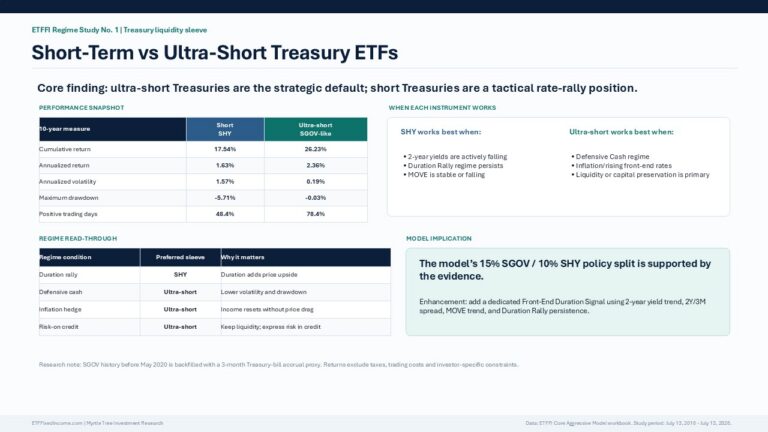
ETFFI research studies are premised on our Fixed Income 10 Spot Model, a diversified portfolio of 10 liquid fixed income and dividend etf positions that is actively managed with technical and macro regime inputs. This study looks at the performance of short-term and ultra short-term treasury etf exposures during the different macro regimes we identify in our model. The model’s proxies are the ETFs SHY and SGOV.
Executive conclusion
The model history supports treating ultra-short Treasury exposure as the core liquidity and capital-preservation allocation, with short-term Treasuries used as a tactical duration position.
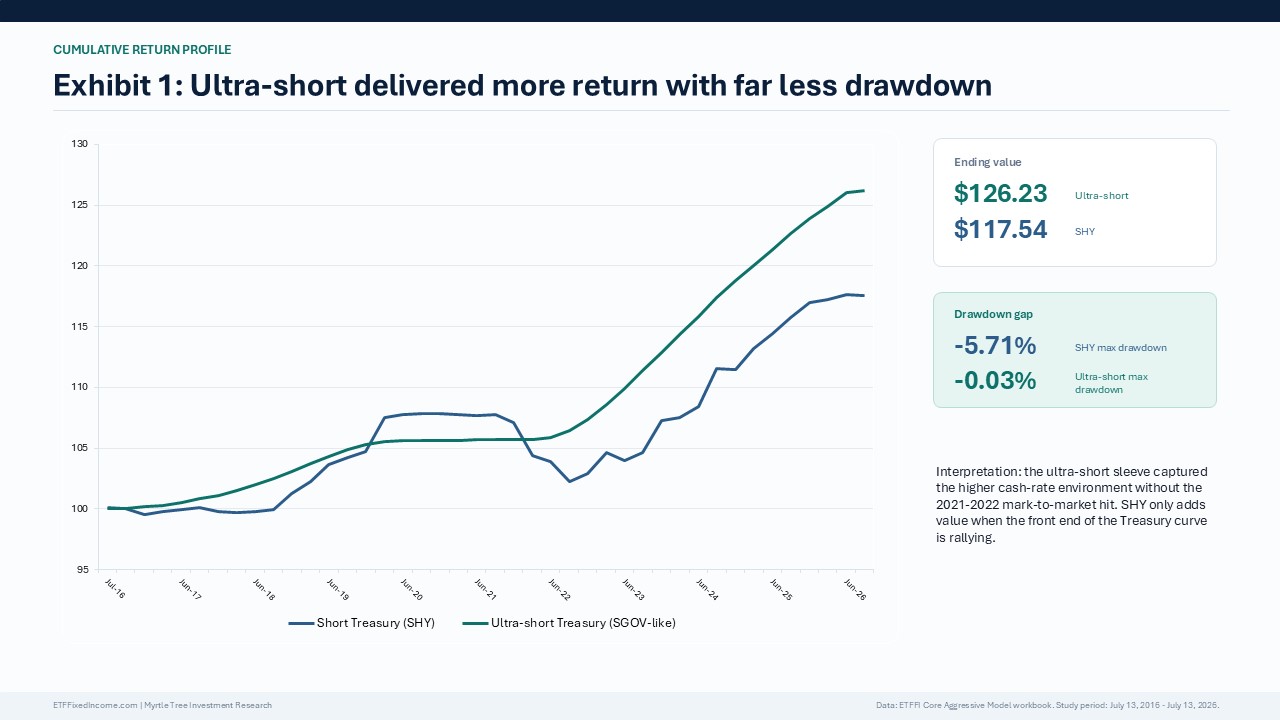
Over the ten years ended July 13, 2026, the ultra-short series produced a higher return, substantially lower volatility, and almost no drawdown:
| Ten-year result | Short Treasury: SHY | Ultra-short Treasury: SGOV |
| Cumulative return | 17.54% | 26.23% |
| Annualized return | 1.63% | 2.36% |
| Annualized volatility | 1.57% | 0.19% |
| Maximum drawdown | -5.71% | -0.03% |
| Positive trading days | 48.4% | 78.4% |
Ultra-short Treasuries outperformed by approximately 72 basis points annually and 8.6 cumulative percentage points. More importantly, they delivered that return without the meaningful mark-to-market losses experienced by SHY during the 2021–2022 rate reset.
SHY earned its keep during established duration rallies, when falling two-year Treasury yields generated price appreciation. It performed worst when yields were rising, rate volatility was elevated, or the model identified inflation and defensive stress. The model’s broad regime labels were useful for describing these environments, but they did not reliably forecast whether SHY would outperform during the following month.
The practical conclusion is:
Ultra-short Treasuries should remain the default allocation. SHY should be added when a decline in front-end yields is already developing—not merely because a broad duration score has turned positive.
Study design
Instruments
The study uses the model’s designated Treasury exposures:
- SHY: iShares 1–3 Year Treasury Bond ETF, representing short-term government exposure.
- SGOV: iShares 0–3 Month Treasury Bond ETF, representing ultra-short government exposure.
Both instruments have minimal credit risk. The principal difference is not credit quality but interest-rate duration:
- Ultra-short exposure primarily earns the prevailing Treasury-bill yield.
- SHY earns income but also gains or loses value as approximately one- to three-year Treasury yields change.
Historical window
The principal study period is July 13, 2016 through July 13, 2026, covering 2,513 trading days.
SGOV’s model history begins on May 29, 2020. To create a full ten-year ultra-short comparison, the study uses:
- Actual SGOV total returns from May 29, 2020 onward.
- A three-month Treasury-bill accrual proxy before SGOV’s history begins.
During the period where both series were available, SGOV returned 2.97% annually versus 2.99% for the bill-accrual proxy—a difference of approximately 2.5 basis points annually. The proxy therefore provided a close return-level backfill, although it modestly understated SGOV’s day-to-day volatility.
Model framework
Our regime framework has had periods of calm and volatility in its 10yr look-back period. We added a regime filter that acts as a confidence score to smooth out signal volatility and keep turnover manageable.
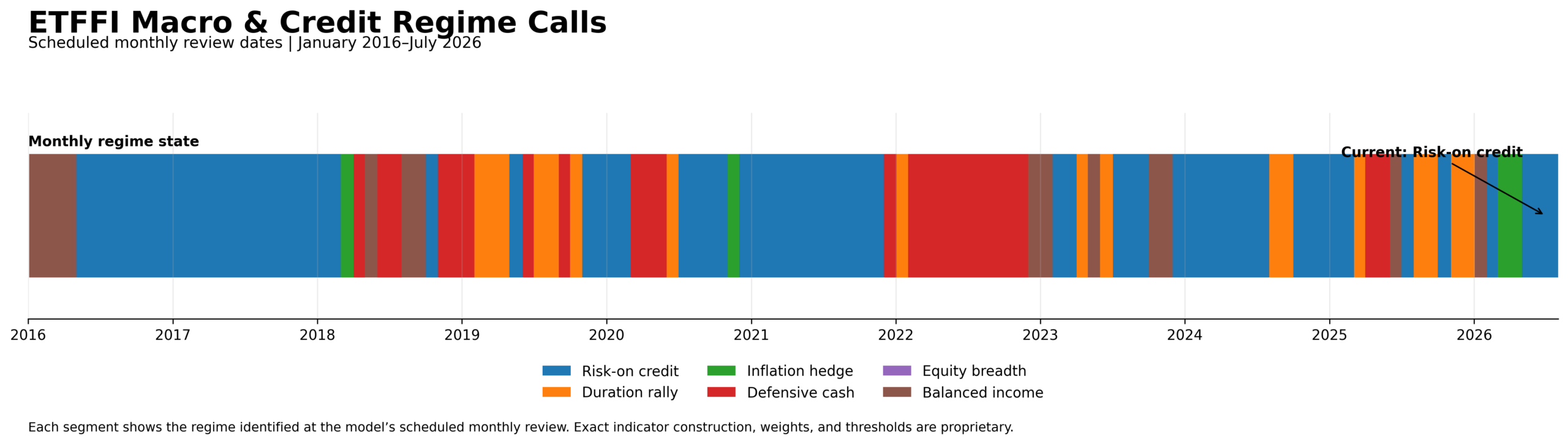
The macro filter decides whether to hold, do a partial trade or the full macro-overlay trade recommendation.
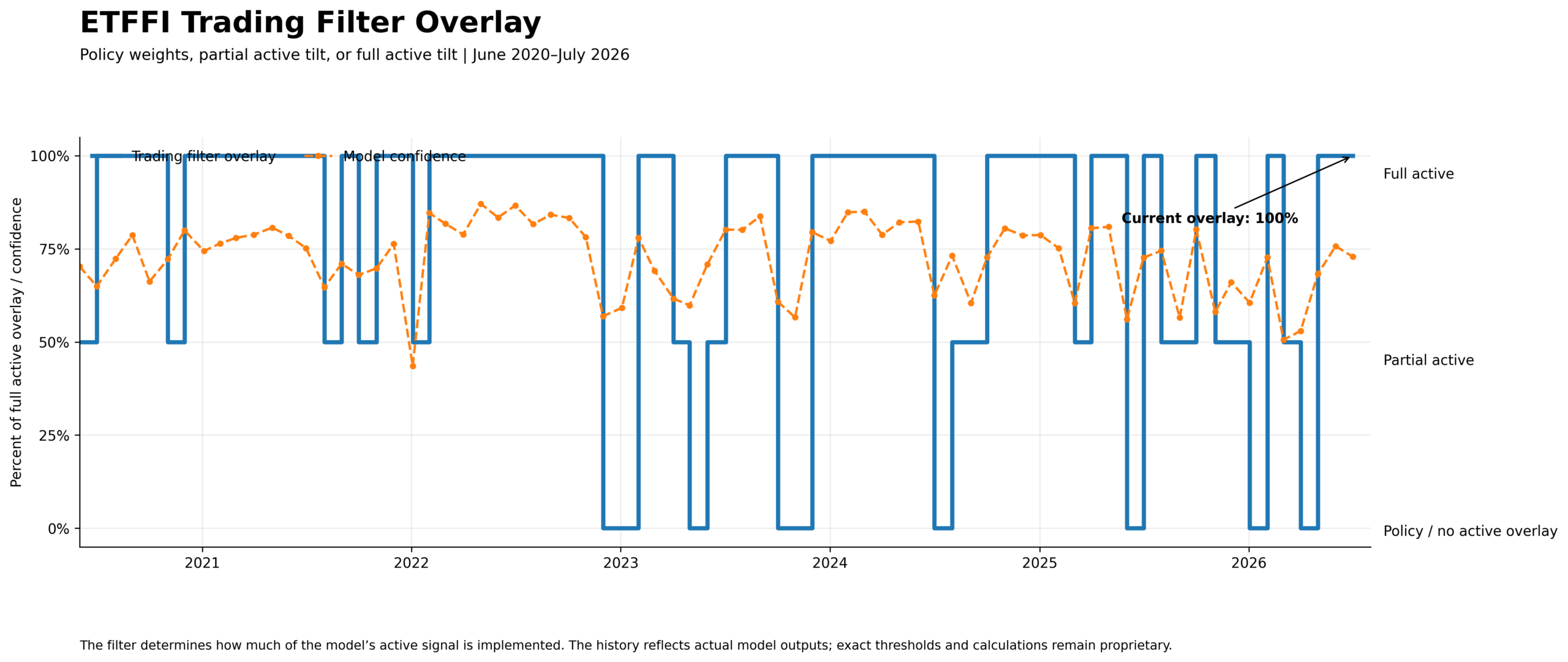
The six model regimes are:
- Risk-on credit
- Defensive cash
- Duration rally
- Inflation hedge
- Equity breadth
- Balanced income
The model’s policy weights already favor SGOV over SHY, with a 15% SGOV allocation and 10% SHY allocation. That represents a 60%/40% ultra-short-to-short split within the two-instrument Treasury sleeve.
The tilt matrix also gives SGOV the stronger response to defensive and floating-rate conditions:
| Model factor | SHY tilt coefficient | SGOV tilt coefficient |
| Credit | -0.2 | -0.5 |
| Duration | -0.2 | -0.4 |
| Inflation | -0.1 | -0.1 |
| Defensive | +0.7 | +1.0 |
| Breadth | -0.2 | -0.4 |
| Floating rate | +0.2 | +0.4 |
The historical evidence broadly validates that construction.
How the instruments behaved inside each regime
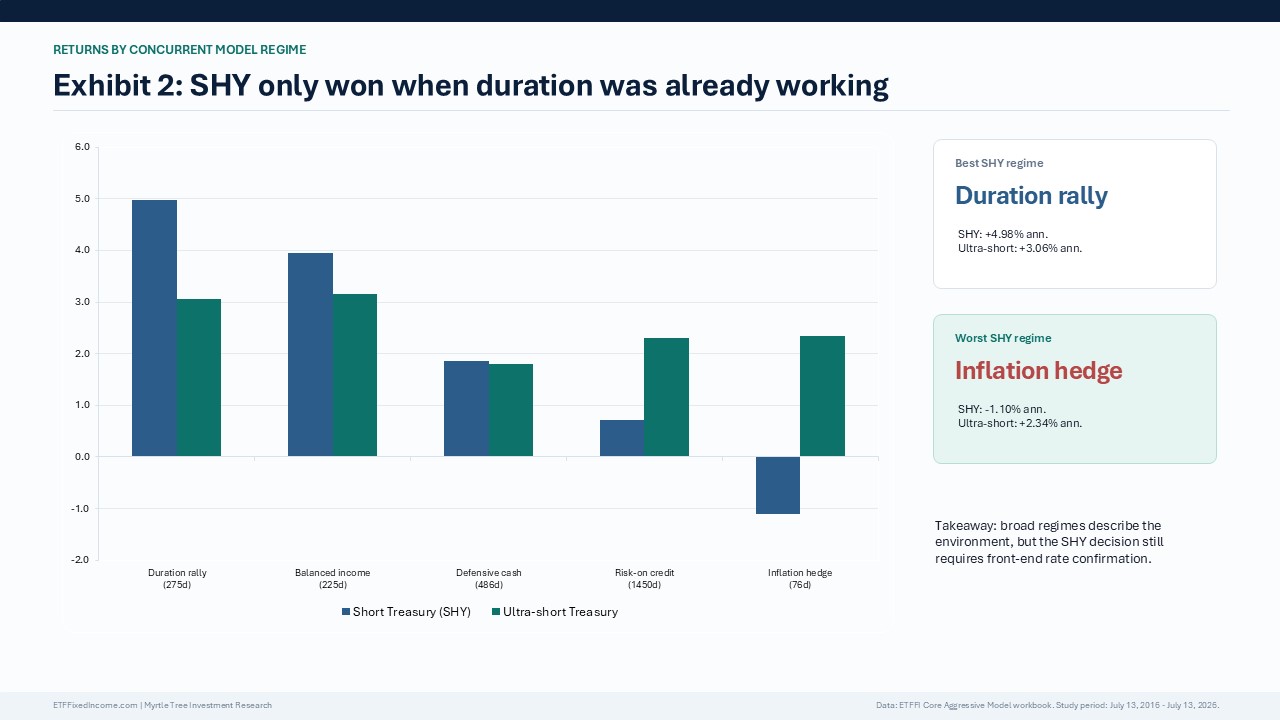
The following table compounds returns across all days classified in each regime. Because the regime classification uses information available on those dates, this is a descriptive regime study, not an investable forward test.
| Concurrent model regime | Days | SHY return, annualized | Ultra-short return, annualized | SHY minus ultra-short | SHY volatility |
| Duration rally | 275 | 4.98% | 3.05% | +1.93% | 1.65% |
| Balanced income | 225 | 3.95% | 3.15% | +0.80% | 1.71% |
| Defensive cash | 486 | 1.86% | 1.80% | +0.07% | 2.34% |
| Risk-on credit | 1,450 | 0.72% | 2.29% | -1.57% | 1.18% |
| Inflation hedge | 76 | -1.10% | 2.33% | -3.43% | 1.28% |
The Equity Breadth regime occurred for only one day and does not provide a meaningful sample.
Duration rally
This was the clearest favorable environment for SHY. Short Treasury returns annualized at 4.98%, outperforming ultra-short exposure by 1.93 percentage points.
This is economically intuitive. When front-end yields decline, SHY receives both income and price appreciation. SGOV continues earning its accrued income but has very little duration with which to benefit from falling rates.
The result also clarifies the model’s negative duration coefficients for both SHY and SGOV. A Duration Rally regime is primarily designed to direct exposure toward TLT, LQD, and MUB. Within the liquidity sleeve, however, SHY is still the better of the two instruments during an active rate rally.
Balanced income
SHY also outperformed during Balanced Income conditions, but by a smaller 80 basis points annually. This environment generally lacked a dominant inflation, stress, or credit signal, allowing modest duration exposure to add value without severe rate pressure.
The sample contained only 225 days, and the advantage did not persist in the monthly forward test. Balanced Income should therefore be treated as a neutral-to-modestly favorable SHY environment rather than a stand-alone switching signal.
Defensive cash
SHY and ultra-short Treasuries generated similar concurrent returns, but SHY did so with approximately fourteen times as much volatility.
The model is therefore correct to assign a stronger defensive coefficient to SGOV. Even when falling yields occasionally support SHY during a stress episode, ultra-short exposure provides a much more dependable capital-preservation profile.
Risk-on credit
Risk-on credit was the most common regime, accounting for approximately 58% of the study days. Ultra-short exposure outperformed SHY by 1.57 percentage points annually.
Risk-on credit is not automatically a favorable Treasury-duration environment. Strong growth, easier financial conditions, and improving credit spreads can coexist with stable or rising Treasury yields. Investors are compensated for owning credit assets such as HYG, LQD, EMB, or BKLN, but there is no equivalent credit-spread benefit in SHY.
SGOV is therefore the more efficient place to retain liquidity while other portfolio sleeves express the risk-on signal.
Inflation hedge
This was the worst regime for SHY. It lost 1.10% annually across classified days, while ultra-short exposure earned 2.33%.
Inflation pressure threatens SHY through rising policy-rate expectations and higher front-end yields. Ultra-short Treasuries reset toward the higher cash rate without sustaining comparable price losses.
The sample contained only 76 days, but both the direction and magnitude are consistent with the economic structure of the instruments.
Did the regimes predict the next month?
To test investability, the regime observed at the prior month-end was applied to the following month’s returns. This aligns more closely with the model’s monthly review framework and avoids using the current day’s regime to explain the current day’s return.
| Prior month-end regime | Months | SHY annualized | Ultra-short annualized | SHY minus ultra-short |
| Balanced income | 7 | 3.28% | 3.53% | -0.25% |
| Defensive cash | 26 | 0.06% | 1.77% | -1.71% |
| Duration rally | 17 | 2.19% | 2.66% | -0.46% |
| Inflation hedge | 2 | 0.59% | 1.82% | -1.24% |
| Risk-on credit | 67 | 1.98% | 2.40% | -0.41% |
Ultra-short exposure outperformed in every forward regime bucket.
This does not mean the regime framework is ineffective. It means the broad Duration Rally label is more effective at identifying an environment already favorable to duration than at predicting that the rally will continue for another full month. SHY’s modest duration can be overwhelmed quickly if yields reverse.
The result argues against making a binary SHY-versus-SGOV switch from the regime label alone.
The decisive variable: the two-year Treasury yield
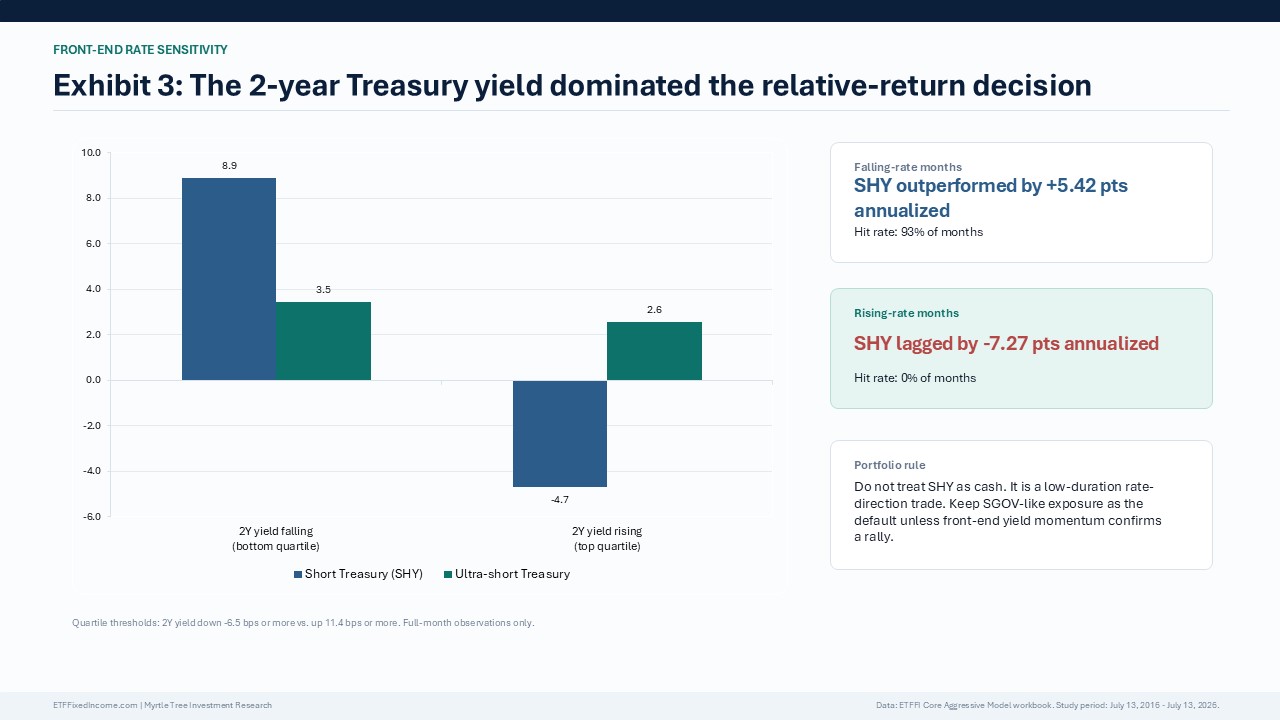
A decomposition of monthly SHY excess returns showed that the change in the two-year Treasury yield explained nearly all of the relative performance.
The estimated relationship was:
SHY minus ultra-short monthly return
≈ -0.012%
- 0.131 × starting two-year/three-month yield spread
− 1.819 × monthly change in the two-year yield
The regression explained approximately 98.4% of monthly relative-return variation.
In practical terms:
- A 100-basis-point decline in the two-year yield was associated with approximately 1.82% of SHY outperformance.
- A 100-basis-point starting yield advantage for the two-year Treasury contributed only about 0.13% of additional monthly return.
The price effect from changing yields was therefore much more powerful than the initial carry advantage.
Observed falling-rate months
During the quartile of months when the two-year yield declined by at least 5.4 basis points:
| Result | SHY | Ultra-short |
| Annualized return | 9.01% | 3.34% |
| Relative result | SHY +5.67% | |
| Months SHY outperformed | 100% |
Observed rising-rate months
During the quartile of months when the two-year yield rose by at least 13.1 basis points:
| Result | SHY | Ultra-short |
| Annualized return | -4.75% | 2.48% |
| Relative result | SHY -7.23% | |
| Months SHY outperformed | 0% |
These are contemporaneous results rather than forecasts, but they identify the economic mechanism clearly: SHY is a rate-direction instrument; SGOV is a rate-level instrument.
Best and worst holding conditions
Best conditions for short-term Treasuries
SHY has its strongest advantage when:
- Two-year Treasury yields are actively declining.
This is the most important condition and should carry more weight than a broad duration score alone. - The model is persistently in a Duration Rally regime.
A single-day or month-end classification is insufficient. Persistence and confirmation from the front end of the curve are preferable. - Rate volatility is stable or declining.
Falling yields accompanied by elevated MOVE readings can reverse quickly, reducing the reliability of the duration trade. - The investor is willing to accept mark-to-market volatility.
SHY’s ten-year maximum drawdown was 5.71%, despite its short maturity profile.
The worst outcome from holding SGOV in these conditions is generally opportunity cost: it continues earning income but does not participate materially in the bond-price rally.
Worst conditions for short-term Treasuries
SHY should generally be minimized when:
- Two-year yields are rising.
- The model is in an Inflation Hedge regime.
- MOVE is elevated while the existing two-year yield trend remains upward.
- The portfolio is seeking defensive liquidity rather than tactical total return.
- The direction of monetary policy is uncertain and cash yields remain competitive.
In the 21 monthly observations combining elevated MOVE with a rising trailing two-year yield trend, SHY returned approximately -1.75% annually versus +1.41% for ultra-short exposure.
Best conditions for ultra-short Treasuries
Ultra-short exposure is best suited to:
- Defensive Cash regimes.
- Inflationary or policy-tightening conditions.
- Rising front-end yields.
- High or uncertain rate volatility.
- Risk-on credit periods when investors want liquidity but do not need Treasury duration.
- Situations where capital preservation and yield stability are more important than potential price appreciation.
Its principal disadvantage is that it will lag even modest-duration Treasury exposure during a sharp and sustained rate rally.
Implications for the ETFFI model
The existing policy allocation is supported
The model’s 15% SGOV and 10% SHY policy weights create a 60% ultra-short and 40% short-term Treasury split. The historical study supports maintaining SGOV as the larger strategic allocation.
The defensive coefficients are correctly ordered
The model assigns a +1.0 defensive coefficient to SGOV and +0.7 to SHY. That hierarchy is validated by the substantially lower volatility and drawdown of ultra-short exposure.
The relative-duration decision needs a dedicated front-end signal
The broad DurationScore is built from the ten-year yield, real yields, MOVE, and TLT momentum. Those inputs are appropriate for long-duration assets, but the SHY-versus-SGOV decision is governed more directly by the two-year Treasury yield.
A future model enhancement should consider a separate Front-End Duration Signal combining:
- Momentum
- Short vs. Ultra short spreads
- MOVE level and trend.
- Persistence of the existing Duration Rally regime.
- Confirmation that falling yields are broadening beyond a single volatile session.
The historical evidence does not support switching from SGOV to SHY solely because the existing DurationScore crosses its positive threshold.
Final positioning framework
| Condition | Preferred instrument | Rationale |
| Confirmed decline in two-year yields | SHY | Duration-driven price appreciation |
| Persistent Duration Rally regime | Modest SHY overweight | Participation in front-end rally |
| Balanced, low-volatility rate environment | Mixed sleeve | Modest SHY benefit, limited conviction |
| Defensive Cash regime | SGOV | Similar income with much lower volatility |
| Inflation Hedge regime | SGOV | Faster income reset and minimal duration loss |
| Rising two-year yields | SGOV | Avoids SHY price depreciation |
| Elevated MOVE and uncertain policy path | SGOV | Capital preservation |
| Risk-on Credit regime | SGOV for liquidity | Express risk through credit sleeves, not SHY |
| Unclear or rapidly changing signals | SGOV | Superior default holding |
Bottom line
The ten-year evidence supports an ultra-short-first allocation hierarchy.
SHY should not be viewed as a higher-yielding cash substitute. It is a low-duration bond position whose relative success depends overwhelmingly on the direction of the two-year Treasury yield. When yields are falling, SHY can add meaningful return. When yields are rising or uncertain, SGOV has historically delivered better returns with dramatically less risk.
The model’s current policy preference for SGOV is therefore appropriate. Tactical SHY additions should require direct confirmation from the front end of the Treasury curve rather than relying solely on the broad macro regime label.
Research disclaimer: This study is provided for informational and research purposes only and is not investment advice or a recommendation to buy or sell any security. Historical relationships, model classifications, and backtested results may not persist. Returns exclude taxes, trading costs, and investor-specific constraints.