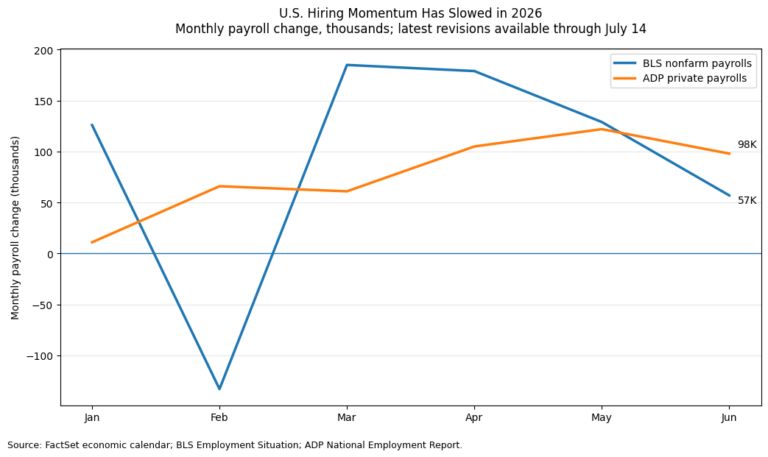
ADP’s high-frequency payroll measure weakened for a third week, while unemployment claims fell. The combination points to a slower but still-stable labor market rather than an imminent recession.
This week’s employment data delivered a nuanced message: U.S. companies are becoming more cautious about hiring, but they are not broadly cutting existing workers.
ADP’s NER Pulse showed private employers added an average of 19,750 jobs per week during the four weeks ending June 27. That was down from 21,000 in the prior report and marked the third consecutive decline. The hiring pace has fallen approximately 36% since early June and more than 50% from its recent peak of 40,750 during the four weeks ending May 2. The ADP series is preliminary, seasonally adjusted and published with a two-week lag.
The ADP decline is important because it suggests businesses are reducing the pace at which they expand payrolls. It does not, however, indicate that private employment is contracting. Employers are still adding workers, just at a considerably slower rate.
Thursday’s unemployment-claims report reinforced that distinction. Initial claims fell by 8,000 to 208,000 in the week ending July 11, while the four-week moving average declined to 214,250. Continued claims also fell by 16,000 to 1.805 million, although their four-week average edged slightly higher to 1.811 million. Claims remain below comparable year-earlier levels.
Taken together, the figures describe a labor market in which businesses are hiring less aggressively but generally retaining the employees they already have. That is a more favorable adjustment than one driven by accelerating layoffs.
Monthly Data Confirm a Broader Downshift
The weekly reports are consistent with June’s official employment figures. Nonfarm payrolls increased by only 57,000, while the unemployment rate remained at 4.2%. April and May payroll growth was revised down by a combined 74,000, adding to evidence that job creation has been weaker than initially reported.
The composition was uneven. Professional and business services added 36,000 positions, social assistance gained 25,000 and health care added 22,000. Leisure and hospitality employment fell by 61,000 as seasonal hiring disappointed. Average hourly earnings increased 0.3% for the month and 3.5% from a year earlier.
Other household-survey details were less reassuring. Labor-force participation fell by 0.3 percentage point to 61.5%, while the employment-to-population ratio slipped to 59.0%. The number of long-term unemployed remained around 1.9 million and was 286,000 higher than a year earlier.
A Lower-Hire, Lower-Fire Labor Market
The clearest interpretation is that the economy has entered a lower-hire, lower-fire phase.
Companies appear reluctant to add workers amid restrictive interest rates, elevated input costs and uncertainty about future demand. But limited unemployment claims suggest they are also reluctant to let experienced workers go. Labor shortages earlier in the cycle may have made employers more cautious about cutting payrolls too deeply.
This pattern can persist for some time, but it carries a risk: a labor market with limited hiring provides fewer opportunities for new entrants and displaced workers. Hiring weakness can therefore become more consequential even before initial claims rise materially.
The next warning sign would be a sustained increase in continued claims, suggesting unemployed workers are taking longer to find new positions. A move higher in initial claims would be more serious because it would indicate that weaker hiring had begun to turn into outright job losses.
Implications for the Fed and Markets
The employment data should reduce some of the pressure on the Federal Reserve to tighten monetary policy further. Combined with this week’s softer CPI and PPI reports, slower hiring suggests restrictive rates are cooling demand without yet producing widespread layoffs.
That is close to the market’s preferred outcome: enough labor-market moderation to ease wage and inflation pressure, but not enough to cause a sharp contraction in household income or spending.
For fixed income, the data are supportive of Treasuries because they strengthen the case that policy rates are near a peak. Intermediate maturities may benefit most from a gradual repricing of the Fed path, while longer-term yields could remain constrained by Treasury supply and fiscal concerns.
For equities, controlled cooling can support valuations by reducing real yields and rate-hike risk. Rate-sensitive growth stocks, real estate and other long-duration assets could benefit. But a further decline in hiring would eventually challenge consumer spending and corporate earnings, particularly in economically sensitive industries.
For now, the labor market is bending rather than breaking. Hiring momentum is clearly weakening, but falling unemployment claims show that employers have not yet moved from caution to retrenchment.
Sources
ADP NER Pulse, July 14, 2026.
U.S. Department of Labor, Weekly Unemployment Insurance Claims, July 16, 2026.
U.S. Bureau of Labor Statistics, Employment Situation—June 2026.