The Lead
Fixed income starts Friday with duration under renewed pressure. The 10-year Treasury rose to 4.70%, the 30-year Treasury moved to 5.17%, and the 10-year real yield climbed to 2.43%, all at the top of their one-year ranges. The front end also sold off, with the 2-year Treasury rising to 4.35%.
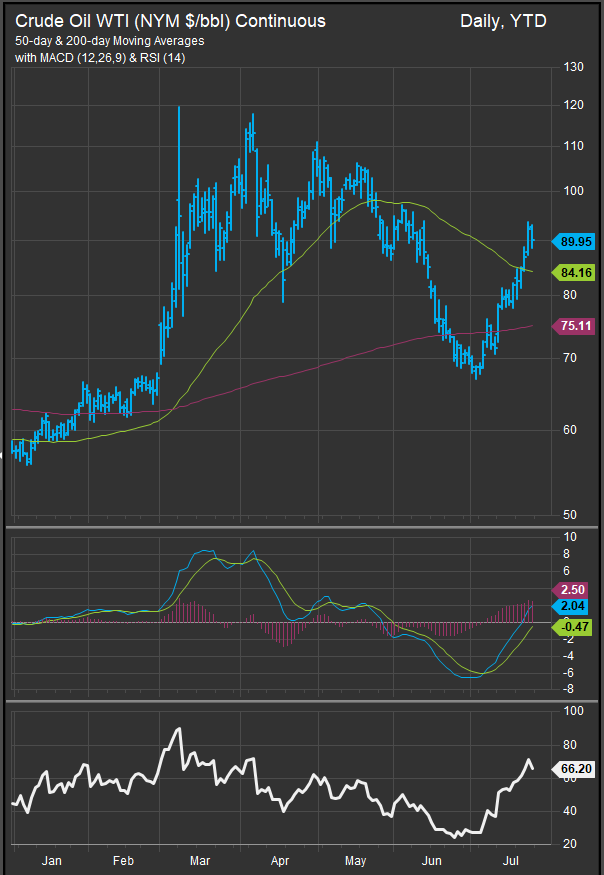
Oil remains the key macro driver. July 24 data shows WTI crude at $92.19, up more than $13 over the past week. Reuters reported Friday that oil surged again after renewed geopolitical tensions, pushing inflation concerns back into global bond markets and sending long-dated U.S. Treasury yields sharply higher.
The setup favors an income-oriented allocation: collecting yield from ultrashort, short-duration, investment-grade, and floating-rate segments while keeping long-duration Treasury exposure tactical.
Rates Tape
| Rate | Latest | 1D Change | 1W Change |
| 2Y Treasury | 4.35% | +4.4 bp | +19.6 bp |
| 10Y Treasury | 4.70% | +3.8 bp | +13.8 bp |
| 30Y Treasury | 5.17% | +1.7 bp | +8.0 bp |
| 2s10s Curve | 35.0 bp | -0.6 bp | -5.7 bp |
| 5s30s Curve | 71.4 bp | -2.7 bp | -9.7 bp |
The rate move pressured the entire duration stack. TLT fell 1.60% over the past week, VGLT fell 1.48%, EDV declined 2.16%, and ZROZ dropped 1.85%. Intermediate Treasuries also softened, with IEF down 1.05% over the week.
Macro Signal Board
| Signal | Latest | 1D Change | 1W Change | 1Y Percentile | Trading Read |
| 10Y Treasury | 4.70% | +3.8 bp | +13.8 bp | 100th | Duration pressure is at a one-year extreme. |
| 30Y Treasury | 5.17% | +1.7 bp | +8.0 bp | 100th | Long-end risk remains elevated above 5%. |
| 10Y Real Yield | 2.43% | +4.0 bp | +8.0 bp | 100th | Real yields remain the main duration headwind. |
| 10Y Breakeven | 2.28% | 0.0 bp | +6.0 bp | 30th | Inflation compensation is rising with oil. |
| Fed Funds Implied Rate | 3.72% | 0.0 bp | +6.0 bp | 64th | Futures remain less dovish than last week. |
| IG OAS | 79 bp | +1 bp | +1 bp | 54th | Credit stress remains contained, with mild widening. |
| HY OAS | 277 bp | +9 bp | +6 bp | 26th | High-yield spreads widened but remain tight. |
| MOVE Index | 80.1 | +3.8 | +11.9 | 80th | Rates volatility is now elevated. |
| WTI Crude | $92.19 | +$5.36 | +$13.24 | 81st | Oil is the dominant inflation-risk input. |
The 30-day Fed funds futures proxy implies a monthly average policy-rate expectation near 3.72%. CME describes 30-day Fed funds futures as settling at 100 minus the arithmetic average effective federal funds rate for the contract month.
Calendar Watch
Thursday’s labor data worked against a clean bond rally. Initial claims fell to 187K, well below 215K consensus, while continuing claims came in at 1.796M, below 1.822M consensus. The Kansas City Fed Manufacturing Index held at 9.0.
Today’s calendar focuses on PMIs and housing:
| Time | Release | Consensus | Prior |
| 8:00 a.m. | Building Permits, final | — | 1.367M prelim. |
| 9:45 a.m. | S&P Global Composite PMI, prelim. | 52.2 | 51.9 |
| 9:45 a.m. | S&P Global Manufacturing PMI, prelim. | 54.4 | 53.9 |
| 9:45 a.m. | S&P Global Services PMI, prelim. | 51.3 | 51.2 |
| 10:00 a.m. | New Home Sales | 606K | 580K |
For bonds, the key question is whether softer growth data can offset the oil-driven inflation shock. Strong PMIs or stronger home sales would keep pressure on the front end and reinforce the move higher in real yields.
ETF Flow Leaders
| ETF | Segment | 1W Return | 1W Flows | 1M Flows |
| BSV | Short-Term Bonds | -0.37% | +$862M | +$987M |
| SGOV | Ultra-Short Treasuries | +0.03% | +$729M | +$3.61B |
| BND | Broad Market Bonds | -0.84% | +$654M | +$3.85B |
| TLT | Long Treasuries | -1.60% | +$448M | +$3.43B |
| VCIT | Investment Grade Credit | -1.00% | +$328M | +$1.60B |
| IAGG | Global Aggregate Bonds | -0.26% | +$266M | +$339M |
| IUSB | Broad Market Bonds | -0.81% | +$260M | +$945M |
| BNDX | Global Bonds | -0.46% | +$248M | +$668M |
The flow signal remains constructive but clearly defensive. BSV, SGOV, and BIL show demand for cash management and short-duration ballast. BND, IUSB, and BNDX show core bond allocations remain active. VCIT supports intermediate investment-grade income demand.
The caution is in longer-duration credit and high yield. LQD saw $376M of weekly outflows, HYG lost $477M, JNK lost $192M, and BKLN lost $139M.
Trading Implications
Core bonds: Maintain exposure, but expect near-term returns to remain rate-sensitive while the 10-year and 30-year are at one-year highs.
Duration: Favor short and intermediate duration over a full long-duration overweight. TLT inflows show some tactical buying, but yields and real yields argue against chasing long duration aggressively.
Credit: Prefer intermediate investment-grade exposure. VCIT is attracting assets, while LQD outflows suggest caution toward longer-duration credit.
High yield: Stay selective. Spreads remain tight, but HYG and JNK outflows point to weaker demand for lower-quality risk.
Cash management: Keep ultrashort and short-duration ETFs in the allocation mix. BSV, SGOV, and BIL remain key flow leaders.
Munis: Maintain tax-aware municipal exposure, but avoid overextending duration while long-end Treasury yields remain elevated.
CLOs / loans: Senior floating-rate credit remains useful as a volatility buffer, but BKLN outflows show flow support has cooled.
Bottom Line
The July 24 setup is the most challenging duration backdrop of the week. Oil has surged, real yields are at one-year highs, the 30-year Treasury is above 5.15%, and rates volatility has moved higher. ETF flows still support short-duration, ultrashort, broad bond, and intermediate investment-grade exposure, but long-duration Treasuries and longer-duration credit remain tactical.
Sources
- FactSet Research Systems Inc., ETFFixedIncome.com Fund Universe Return & Flow Database, July 24, 2026
- FactSet Research Systems Inc., July 24 rates, credit, volatility, commodity, FX, and economic calendar data
- Reuters reporting on oil, geopolitical tensions, inflation risk, and global bond-market pressure
- CME Group 30-Day Federal Funds futures reference material
Disclaimer: This commentary is for informational and educational purposes only and should not be considered investment advice. ETF return and flow data can change quickly and may reflect short-term trading activity rather than durable allocation trends. Fixed income investments are subject to interest-rate risk, credit risk, liquidity risk, inflation risk, and tax considerations.