COMMENTARY:
The U.S. fixed income market faced modest headwinds during the week ending July 24, 2026, as Treasury yields moved higher and investors continued to assess a steady stream of economic data and second-quarter earnings. Stronger-than-expected corporate results reinforced confidence in the economy, while inflation remained relatively contained but resilient enough to keep expectations for near-term Federal Reserve rate cuts in check. Against this backdrop, shorter-duration securities held up better than longer-maturity bonds, reflecting the market’s sensitivity to changes in interest rate expectations.
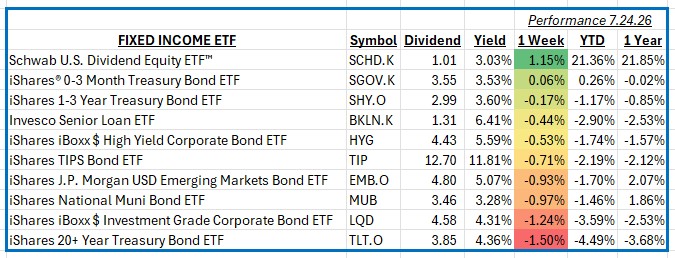
Dividend-oriented equities produced the strongest total return among the income-focused asset classes, gaining 1.15%. Financials, energy, and industrial companies contributed positively as investors favored high-quality businesses with attractive dividend yields and stable earnings. The combination of a 3.03% distribution yield and resilient corporate fundamentals continued to appeal to income-focused investors seeking an alternative to traditional fixed income.
Ultra-short Treasury securities also finished the week in positive territory, returning 0.06% while offering a 3.53% yield. With minimal interest rate sensitivity, these holdings benefited from their ability to preserve capital while continuing to generate competitive income. Their stability reinforced their role as a defensive allocation for investors awaiting greater clarity on the direction of monetary policy.
Short-term Treasury bonds declined a modest 0.17%, outperforming most longer-duration sectors as their 3.60% yield helped cushion the impact of rising market interest rates. Senior loans also held up relatively well, slipping 0.44% while continuing to offer an attractive 6.41% yield. Their floating-rate structure remained advantageous in an environment where policy rates are expected to stay elevated for longer.
High-yield corporate bonds fell 0.53% despite healthy corporate credit fundamentals. Although higher Treasury yields created modest price pressure, the sector’s 5.59% yield and relatively stable credit spreads continued to support investor demand, limiting downside compared with more interest-rate-sensitive bond sectors.
The weakest-performing areas were investment-grade corporate bonds and long-term U.S. Treasuries, which declined 1.24% and 1.50%, respectively. Rising Treasury yields weighed most heavily on longer-duration assets, as their greater sensitivity to interest rate movements amplified price declines. Even with yields of 4.31% and 4.36%, investors remained cautious about extending duration until there is greater confidence that inflation is moving sustainably toward the Federal Reserve’s target.
Overall, the week highlighted the continued importance of duration management. Higher-quality income opportunities remained available, but rising yields favored shorter maturities and floating-rate investments over longer-duration bonds as markets continued to adjust to evolving interest rate expectations.