The fixed income market is pricing a higher real-rate regime, not simply a higher long-term inflation forecast. That distinction is driving the near-term investment setup and is consistent with our fixed income model’s latest message: stay cautious on long duration, favor carry, and keep credit exposure balanced rather than aggressively risk-on.
The 10-year Treasury yield has moved above 4.70%, while the 30-year Treasury yield has stayed above 5%. At the same time, the 10-year breakeven inflation rate remains closer to the low-2% range. The bond market is not saying long-term inflation expectations are becoming unanchored. It is saying investors want more real compensation to own duration in an environment shaped by resilient growth, renewed energy risk, tariff uncertainty, heavy Treasury supply, AI-related capital spending, and a Fed that still has limited room to ease.
That is why nominal yields are behaving more inflation-sensitive than breakevens alone would suggest. Breakevens capture the market’s expected average inflation rate over time. Nominal Treasury yields also reflect real growth expectations, policy-rate risk, term premium, liquidity preference, and supply-demand pressure. The market can still believe the Fed will eventually contain inflation while demanding a higher real yield until the path becomes clearer.
The recent macro data support that message. Services activity remains firm, initial jobless claims have fallen to unusually low levels, new home sales improved, and earnings data continue to point to a durable corporate profit cycle. That does not look like a backdrop that forces the Fed into aggressive easing.
At the same time, forward inflation pressure has not disappeared. Oil remains vulnerable to Middle East escalation, with Red Sea and Strait of Hormuz disruption risk both active. Tariffs are back in the policy mix. Supplier delays have worsened, input costs are rising, and selling-price pressure remains elevated. AI is also becoming part of the inflation conversation because data-center growth, compute demand, memory shortages, power needs, and grid investment are absorbing capital and physical capacity.
For bond investors, the AI story is a real-rate issue as much as a growth story. Alphabet’s Cloud growth, rising capex plans, OpenAI’s larger compute budget, and large AI infrastructure partnerships reinforce that private-sector capital demand remains strong. When government borrowing is already heavy, that private capex cycle adds another reason for investors to demand more compensation for owning long-duration bonds.
What the Fixed Income Model Is Saying
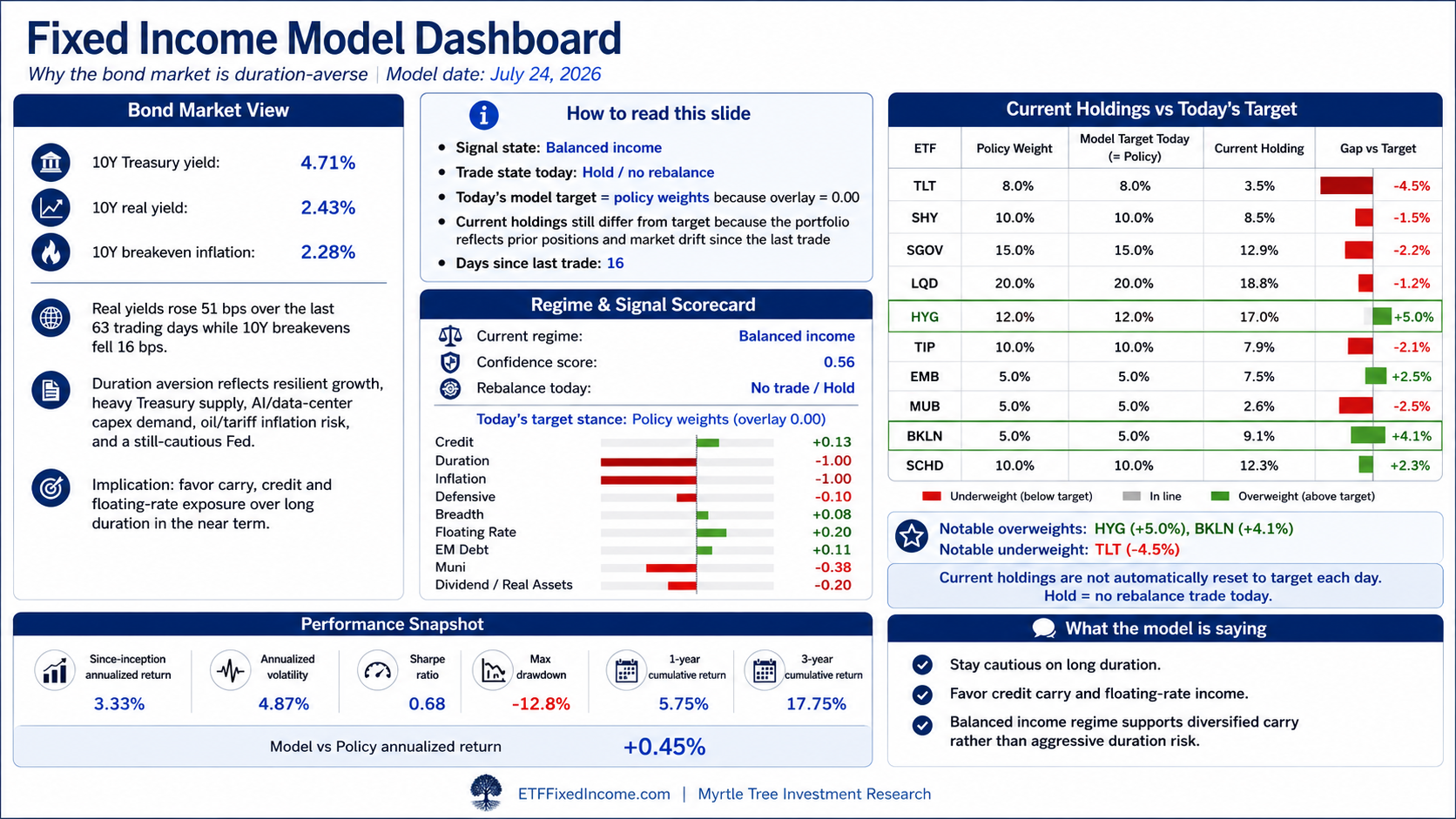
Our fixed income model has moved into a Balanced Income regime. That is an important shift from the more aggressive credit posture seen earlier in July. The model is not turning defensive, but it is also no longer pressing a full risk-on credit trade.
The current message is more balanced:
| Model area | Narrative read |
| Credit | Still constructive, but less forceful than earlier in July |
| Duration | Remains clearly unfavorable |
| Inflation | Inflation uncertainty is high, but TIPS/breakeven momentum is not strong enough for a major inflation-hedge tilt |
| Floating rate | Still supported by higher-for-longer front-end rates |
| Defensive | Not signaling a recessionary risk-off environment |
| Breadth | Still positive enough to support carry, but not strong enough to justify aggressive risk-taking |
| Munis / longer duration sleeves | Challenged by the weak duration backdrop |
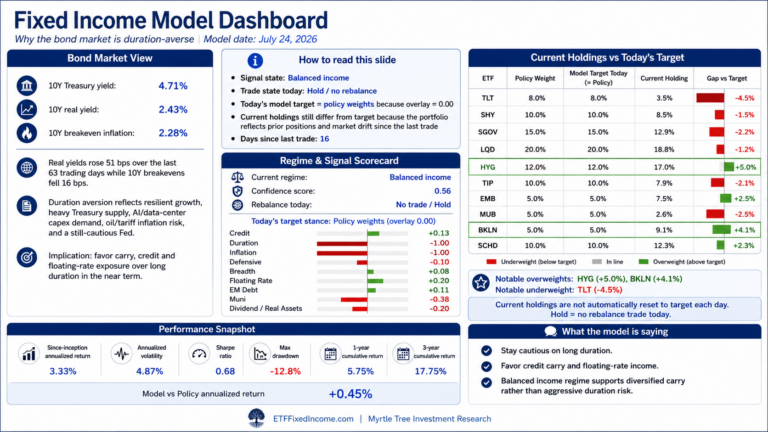
The practical positioning read is straightforward: the model prefers diversified income, credit carry, and floating-rate exposure over aggressive long-duration risk. Current holdings remain underweight long Treasuries and overweight high yield, floating-rate loans, emerging-market debt, and dividend/real-asset exposure versus policy. However, because the model’s active overlay is now off, today’s target stance has moved back toward policy weights rather than extending the prior active credit tilt.
That distinction matters. The portfolio can still show active tilts because it reflects prior signals and market drift since the last trade. The model’s current signal engine is now saying: hold the current portfolio, avoid forcing a rebalance, and wait for clearer confirmation before adding more duration or more credit risk.
What Changed Over the Last 15 Days
The biggest change over the last 15 days is that the model’s risk appetite has moderated. Earlier in July, the signal mix favored a more explicit credit-carry posture. Since then, the backdrop has become more complicated. Credit conditions remain healthy, but spreads are no longer improving fast enough to justify pressing the trade. Equity breadth and risk appetite remain supportive, but less powerful. The rate backdrop has become more restrictive as real yields moved higher and bond volatility concerns returned.
That is why the regime shifted from Risk-on Credit toward Balanced Income. The model is still recognizing a firm business cycle, resilient labor market, and stable credit environment. But it is also recognizing that the compensation for taking incremental credit risk has become less compelling while duration risk remains elevated.
The duration signal remains the most important part of the model. Long rates are being pulled higher by a mix of resilient growth, oil risk, tariff risk, AI-related investment demand, fiscal supply, and Fed uncertainty. Until that changes, the model has little reason to add long Treasury exposure. A cooler inflation print helps, but it is not enough by itself if forward cost pressure and real-rate volatility remain high.
The inflation signal is also more nuanced than the headlines. Energy, tariffs, and supply-chain pressure keep inflation risk alive, but breakevens have not confirmed a broad inflation breakout. That leaves the model cautious on both long duration and aggressive inflation-hedge exposure. The market is pricing inflation uncertainty more than a clean inflation trend.
Floating-rate exposure remains one of the better-supported areas. If the Fed stays cautious and front-end yields remain elevated, floating-rate income continues to make sense. That is why the model still favors carry and floating-rate exposure over a larger duration call.
Portfolio Implications
For fixed income investors, the near-term playbook remains disciplined:
| Fixed income sleeve | Current view |
| Long-duration Treasuries | Stay cautious; wait for real yields to stabilize |
| Short Treasuries / cash-like exposure | Useful ballast, but not the main active opportunity |
| Investment-grade credit | Hold selectively; duration exposure is still a headwind |
| High yield credit | Carry still supported, but position size should be disciplined |
| Floating-rate loans | Favored in a higher-for-longer rate environment |
| TIPS | Useful tactically, but not a model-led overweight while breakevens stay contained |
| Munis | Challenged by the weak duration signal |
| EM debt | Modestly supported, but not a high-conviction risk-on call |
The fixed income market is duration-averse because the data are not weak enough to force yields lower and the inflation path is not clean enough to give the Fed room to ease. Cooler backward-looking inflation data are helpful, but forward pressures from oil, tariffs, supply chains, AI power demand, and public/private capital needs are keeping real rates elevated.
Our model is aligned with that message. It has stepped back from aggressive risk-on credit, but it has not moved into defensive duration. The current Balanced Income regime favors carry, credit discipline, and floating-rate income. Until real yields stop rising, the fixed income market is likely to keep rewarding income generation more than duration risk.
Disclaimer: This material is for informational and educational purposes only and should not be considered investment advice, a recommendation, or a solicitation to buy or sell any ETF, bond, security, or strategy. Fixed income markets, interest rates, credit spreads, inflation expectations, and model signals can change quickly. Past performance is not indicative of future results. Investors should consider objectives, risk tolerance, liquidity needs, and consult a qualified financial professional before making investment decisions.