The Lead
Fixed income starts Tuesday with some rate relief from Monday, but the long end remains the key constraint. The 10-year Treasury eased to 4.69%, the 30-year slipped to 5.23%, and the 10-year real yield fell to 2.43%. Those moves helped on the day, but all three remain near the top of their one-year ranges.
Oil is still a live macro risk. August 4 data shows WTI crude at $80.34, down from last week’s shock, but Reuters reported Tuesday morning that oil rebounded more than 2% as uncertainty around U.S.-Iran diplomacy and shipping-route disruptions kept supply risk in the market.
The setup still favors an income-oriented allocation: collecting yield from ultrashort, floating-rate, short-duration, short-credit, and selective investment-grade segments while keeping long-duration Treasury exposure tactical.
Rates Tape
| Rate | Latest | 1D Change | 1W Change |
| 2Y Treasury | 4.25% | -1.7 bp | -6.8 bp |
| 10Y Treasury | 4.69% | -2.7 bp | +4.1 bp |
| 30Y Treasury | 5.23% | -2.0 bp | +10.5 bp |
| 2s10s Curve | 43.4 bp | -1.0 bp | +10.9 bp |
| 5s30s Curve | 83.5 bp | +0.5 bp | +11.0 bp |
The curve remains the story. The front end has eased over the past week, but the 30-year Treasury is still above 5.20%. Long-duration ETFs remain under pressure: TLT fell 2.04% over the past week, EDV declined 3.55%, ZROZ dropped 4.12%, and VGLT fell 0.70%. Intermediate Treasuries held up better, with VGIT up 0.21% and IEF down 0.45% over the week.
Macro Signal Board
| Signal | Latest | 1D Change | 1W Change | 1Y Percentile | Trading Read |
| 10Y Treasury | 4.69% | -2.7 bp | +4.1 bp | 99th | Rates eased, but yields remain near one-year highs. |
| 30Y Treasury | 5.23% | -2.0 bp | +10.5 bp | 100th | Long-end risk remains the main pressure point. |
| 10Y Real Yield | 2.43% | -4.0 bp | -1.0 bp | 99th | Real yields still limit duration upside. |
| 10Y Breakeven | 2.27% | -1.0 bp | +6.0 bp | 29th | Inflation compensation is contained but rising. |
| Fed Funds Implied Rate | 3.64% | +0.5 bp | -8.5 bp | 17th | Front-end policy pricing remains more dovish than last week. |
| IG OAS | 78 bp | -1 bp | -3 bp | 46th | IG credit stress remains contained. |
| HY OAS | 278 bp | -7 bp | -3 bp | 30th | HY spreads eased but remain tight. |
| MOVE Index | 80.5 | -2.5 | +3.3 | 83rd | Rates volatility remains elevated. |
| WTI Crude | $80.34 | -$4.33 | -$2.27 | 68th | Oil has cooled but remains a policy-risk input. |
The macro message is slightly better than last week, but not decisively bullish for duration. Oil has come off the highs, breakevens remain contained, and credit spreads eased. The constraint is that real yields and long-end nominal yields remain high, while rates volatility is still elevated.
Calendar Watch
Monday’s data was mixed but not soft enough to give bonds a clean growth-scare catalyst. ISM Manufacturing rose to 55.6, above 54.0 consensus and the strongest reading in more than four years, while construction spending fell 0.10% versus expectations for a 0.20% gain. Reuters noted that the ISM report showed stronger orders and factory employment, but also elevated input prices.
Today’s calendar shifts attention to trade, factory orders, and labor-market turnover:
| Time | Release | Consensus | Prior |
| 8:30 a.m. | Trade Balance, June | -$72.4B | -$77.6B |
| 10:00 a.m. | Durable Orders, final | +0.30% | +0.30% prelim. |
| 10:00 a.m. | Durable Orders ex-Transportation, final | +0.50% | +0.60% prelim. |
| 10:00 a.m. | Factory Orders | +0.15% | -1.3% |
| 10:00 a.m. | JOLTS Job Openings | 7.400M | 7.594M |
The bigger tests come later this week: ADP and ISM Services on Wednesday, claims, productivity, and unit labor costs on Thursday, and the July employment report on Friday. For bonds, the key question is whether labor-market data softens enough to offset the still-resilient manufacturing data and oil-driven inflation risk.
ETF Flow Leaders
| ETF | Segment | 1W Return | 1W Flows | 1M Flows |
| HYG | High Yield | +0.35% | +$1.11B | -$434M |
| USFR | Floating-Rate Treasuries | +0.06% | +$708M | +$1.17B |
| IAGG | Global Aggregate Bonds | -0.06% | +$433M | +$737M |
| BND | Broad Market Bonds | -0.33% | +$413M | +$2.60B |
| VCSH | Short IG Credit | +0.13% | +$409M | +$309M |
| JAAA | AAA CLOs | +0.12% | +$382M | +$935M |
| IGSB | Short IG Credit | +0.13% | +$323M | +$702M |
| SPTL | Long Treasuries | -1.78% | +$307M | +$525M |
| VCIT | Intermediate IG Credit | -0.07% | +$294M | +$1.46B |
| VTEB | Municipal Bonds | -0.22% | +$278M | +$695M |
The flow signal improved for credit, but the quality and duration mix still matters. HYG led weekly inflows, but its one-month flows remain negative, so the high-yield signal is not yet a broad risk-on confirmation. VCSH, IGSB, and VCIT point to continued demand for short and intermediate investment-grade credit. USFR and JAAA show demand for floating-rate and senior credit exposure.
The caution remains long duration and longer-duration credit. LQD saw $1.35B of weekly outflows, TLT lost $673M, SGOV lost $720M, AGG lost $244M, and BIL lost $338M. SGOV still has strong one-month inflows, but the weekly flow reversal shows cash allocations are not one-way.
Trading Implications
Core bonds: Maintain exposure, but expect returns to remain rate-sensitive while the 10-year and 30-year remain near one-year highs.
Duration: Favor short and intermediate duration over a full long-duration overweight. SPTL inflows show some long-end dip-buying, but TLT outflows, elevated MOVE, and the 30-year above 5.20% keep long Treasuries tactical.
Credit: Prefer short and intermediate investment-grade exposure. VCSH, IGSB, and VCIT are attracting assets, while LQD outflows show pressure in longer-duration credit.
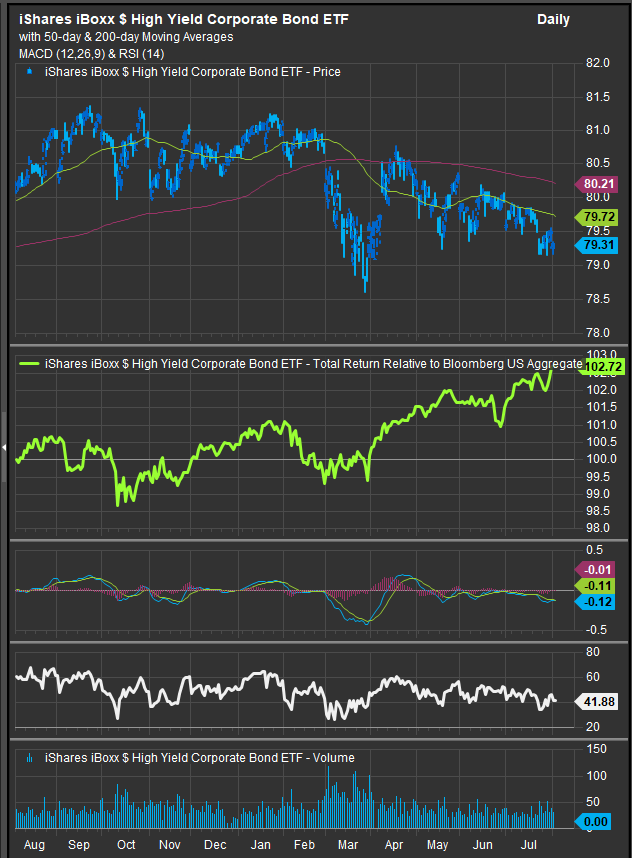
High yield: Stay selective. HYG had strong weekly inflows and HY spreads eased, but one-month flows remain negative and spreads are still tight.
Cash management: Keep ultrashort and floating-rate Treasury ETFs in the allocation mix. USFR is a strong flow leader, while SGOV and BIL still have positive one-month flow support despite weekly outflows.
Munis: Maintain tax-aware municipal exposure. VTEB and MUB remain supported by recent flows, though duration should still be managed carefully.
TIPS: Favor short-term inflation protection over broad long-duration TIPS. VTIP continues to attract assets, and oil volatility keeps targeted inflation protection relevant.
CLOs / loans: Senior floating-rate credit remains useful as a volatility buffer. JAAA and FLOT flows show demand is improving after recent volatility.
Bottom Line
The August 4 setup is more balanced than last week, but not a duration all-clear. Oil has cooled, credit spreads eased, and front-end policy pricing remains more dovish than last week. However, the 30-year Treasury remains above 5.20%, the 10-year real yield is near the top of its one-year range, and rates volatility remains elevated. ETF flows favor high yield tactically, floating-rate Treasuries, short investment-grade credit, AAA CLOs, global aggregate bonds, and selective municipal exposure. Keep long Treasuries and longer-duration credit tactical until the long end stabilizes.
Sources
- FactSet Research Systems Inc., ETFFixedIncome.com Fund Universe Return & Flow Database, August 4, 2026
- FactSet Research Systems Inc., August 4 rates, credit, volatility, commodity, FX, and economic calendar data
- Reuters reporting on oil, U.S.-Iran diplomacy, shipping-route disruptions, manufacturing activity, and input-price pressure
- CME Group / New York Fed reference materials on fed funds futures methodology
Disclaimer: This commentary is for informational and educational purposes only and should not be considered investment advice. ETF return and flow data can change quickly and may reflect short-term trading activity rather than durable allocation trends. Fixed income investments are subject to interest-rate risk, credit risk, liquidity risk, inflation risk, tax considerations, and potential loss of principal.