Conflicting accounts of negotiations, renewed attacks and uncertainty surrounding the Strait of Hormuz are keeping oil elevated and complicating the traditional safe-haven case for government bonds.
Diplomatic efforts to contain the US-Iran conflict remain active, but the widening gap between Washington’s and Tehran’s public positions is making it difficult for markets to identify a credible path toward peace.
President Donald Trump has characterized negotiations as constructive while simultaneously warning that Iran has little time left to reach an agreement. Iranian officials, by contrast, say their discussions are primarily with Oman and concern navigation through the Strait of Hormuz—not direct peace negotiations with the United States.
That distinction matters. Talks may be progressing on a temporary shipping arrangement without addressing the larger conflict, Iran’s nuclear program or the military confrontation between the two countries. A maritime agreement could lower near-term oil prices while leaving the underlying geopolitical dispute unresolved.
The latest evidence supports that cautious interpretation. A cargo vessel reported being struck near the Strait of Hormuz on Tuesday, while Iran and the United States continued to issue contradictory descriptions of the diplomatic process. Shipping activity through the strait has fallen sharply from normal conditions, despite negotiations over a temporary corridor.
Negotiations are focused on access and control
Oman has emerged as the principal intermediary because it controls the southern side of the Strait of Hormuz and maintains working relations with both Washington and Tehran. Iranian and Omani representatives are discussing a temporary two-way shipping corridor intended to improve maritime safety and restore commercial traffic.
The potential deal, however, contains the seeds of the next dispute. Iran wants any agreement to recognize a larger supervisory role over the waterway and has suggested that ships could use a route closer to the Iranian coast. Washington maintains that the strait is an international passage that must remain freely accessible and toll-free.
A compromise could help the Trump administration by reopening a critical route for oil and liquefied natural gas. But an agreement that formalizes Iranian authority over transit could also give Tehran lasting strategic leverage over regional trade. The immediate economic benefit of lower freight and insurance costs would therefore come with a potentially significant geopolitical concession.
The public disagreement over what is being negotiated suggests that the two sides may be seeking different outcomes. Washington wants de-escalation and reliable passage. Iran appears focused on converting its wartime control into a recognized role in the future administration of the strait.
Military escalation continues alongside diplomacy
The negotiations are taking place while military exchanges continue across the region. Reports that Iran’s Revolutionary Guard launched drones toward a US military facility in Kuwait reinforce the risk that a single attack could disrupt or end the talks.
That creates a negotiation structure in which diplomatic progress and military pressure are occurring simultaneously. Iran may believe that disruption of shipping, attacks on regional facilities and the threat of escalation improve its bargaining position. Washington is attempting to preserve the credibility of its military threats without triggering a larger conflict that would further restrict energy supplies.
The result is a highly unstable equilibrium. Neither side appears eager to absorb the economic and military costs of full escalation, but neither has demonstrated a willingness to abandon its central demands.
Fixed income is reacting differently than it would in a conventional crisis
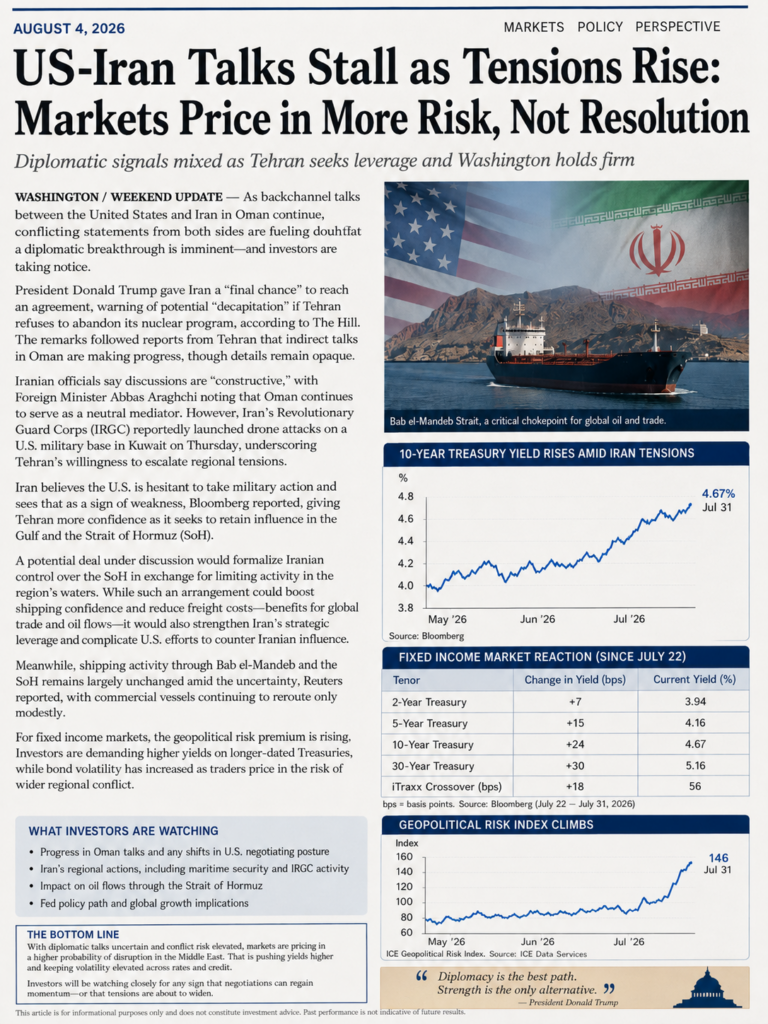
Geopolitical conflict typically produces a flight into US Treasuries, lowering yields as investors prioritize safety. The current episode has often produced the opposite result.
The reason is oil.
When prospects for an agreement improve, crude prices fall, inflation expectations ease and Treasury yields generally decline. When diplomacy appears to fail, oil rebounds and investors price a greater risk that energy costs will keep inflation above the Federal Reserve’s target. That inflation channel can overwhelm safe-haven demand and push bond yields higher.
On Tuesday, the benchmark 10-year Treasury yield rose roughly 3 basis points to approximately 4.71% as oil prices rebounded and uncertainty surrounding the talks increased. Markets also raised the implied probability of another Federal Reserve increase later this year.
Brent crude recovered toward $85 per barrel, while WTI traded near $81, after both contracts fell sharply on Monday amid premature optimism that a deal to reopen the strait was close.
Fixed-Income Reaction Function
| Diplomatic development | Oil response | Likely Treasury response | Most sensitive exposures |
| Credible ceasefire and open shipping corridor | Lower | Yields decline; curve may bull-steepen | Long Treasuries, investment-grade bonds, munis |
| Limited maritime agreement without broader peace | Moderately lower | Initial rally, but yields remain range-bound | Intermediate Treasuries, agency MBS |
| Negotiations stall but fighting remains contained | Higher | Inflation concerns push yields upward | TIPS outperform nominal bonds; long duration lags |
| Strait disruption or wider regional attacks | Sharply higher | Volatile: safe-haven demand versus inflation shock | TIPS, floating-rate credit, energy-linked issuers |
| Durable political settlement | Materially lower | Lower inflation expectations revive easing bets | Long-duration government and municipal bonds |
TIPS are the clearest direct hedge
Treasury Inflation-Protected Securities have a more favorable setup than nominal Treasuries when geopolitical risk is transmitted through oil. Higher energy prices can lift near-term inflation expectations and widen breakeven rates, supporting TIPS relative to comparable nominal securities.
The performance advantage is not guaranteed. Real yields can still rise if the market expects the Federal Reserve to maintain restrictive policy. But the inflation-linked principal adjustment gives TIPS a more direct defense against an extended energy-price shock.
Shorter-maturity TIPS may offer the cleanest exposure because near-term consumer inflation is more immediately sensitive to gasoline, transportation and utility costs. Longer-duration TIPS carry more real-rate sensitivity and may not benefit as directly from a temporary oil spike.
Credit markets face a sector split
Investment-grade credit has remained comparatively resilient, but prolonged conflict would create greater dispersion.
Energy producers and selected midstream companies could benefit from higher commodity prices and stronger cash generation. Airlines, transportation companies, chemicals, consumer businesses and issuers dependent on imported inputs face greater margin pressure. High-yield spreads would likely widen if higher oil prices begin to weaken consumption or revive expectations of tighter Federal Reserve policy.
Municipal bonds face a similar mix of forces. Higher Treasury yields pressure muni prices, but tax-exempt income becomes more attractive as absolute yields rise. Transportation issuers and regions sensitive to fuel prices could experience greater scrutiny, while high-quality state and local governments should remain supported by strong underlying credit and demand for tax-exempt income.
What fixed-income investors should watch
The first signal is physical shipping activity, not diplomatic rhetoric. A sustained increase in vessel traffic would demonstrate that any agreement is operational rather than merely political.
The second is crude oil. Bond markets appear to be treating oil as the primary transmission mechanism between the conflict and US monetary policy.
The third is the inflation curve. Rising short-term breakevens accompanied by stable long-term expectations would indicate that investors still view the shock as temporary. A broader increase would suggest concern that energy costs are spreading through wages, services and consumer expectations.
Finally, investors should watch the two-year Treasury yield. The front end will reveal whether markets believe the conflict is changing the Federal Reserve’s policy path rather than merely increasing geopolitical volatility.
The bottom line
The United States and Iran are negotiating, but they are not necessarily negotiating the same settlement. Discussions over a shipping corridor could produce a temporary decline in oil prices without resolving the larger political and military conflict.
For fixed-income investors, that means headline risk is likely to remain elevated. The most important market relationship is no longer simply conflict equals lower Treasury yields. It is conflict equals higher oil, higher inflation risk and potentially higher yields.
Until a settlement restores reliable shipping and reduces the likelihood of further attacks, the bond market is likely to demand additional inflation compensation rather than treat every escalation as a straightforward opportunity to buy duration.
Sources
- Reuters — Iran Demands Inbound Control of Hormuz and Outbound Oversight
Details Iran’s proposal to control inbound maritime traffic while Oman clears outbound shipping, the continuing disagreement over oversight rights and the importance of the strait to global energy supplies. - Reuters — Iran Says No Current Talks With the United States
Reports Tehran’s denial that it is directly negotiating with Washington and clarifies that current discussions with Oman are focused on temporary safe passage through the Strait of Hormuz. - Associated Press — Cargo Ship Struck as US and Iranian Accounts Diverge
Covers the August 4 attack on a vessel near Oman, conflicting US and Iranian descriptions of the negotiations and the continuing risk to commercial shipping. - The Wall Street Journal — Hormuz Opening Uncertain After New Strike
Examines obstacles to a maritime agreement, including Iran’s demands for control, security guarantees and sanctions relief, as well as the sharp reduction in Gulf oil flows. - Reuters — Oman and Iran Pursue Talks on Strait Navigation
Provides background on the joint Iran-Oman working group, proposed maritime services and the two countries’ stated commitment to safe passage and international navigation. - Bloomberg Government — US and Iran Extend Pause in Strikes
Reports on the temporary reduction in military activity, Oman’s mediation and the uncertainty surrounding Washington’s next move while maritime negotiations continue. - MarketWatch — Treasury Yields Rise as Oil Rekindles Inflation Concerns
Reports that the 10-year Treasury yield rose to approximately 4.71% as crude prices rebounded, peace-talk claims diverged and investors increased expectations for tighter Federal Reserve policy. - Reuters — Treasury Yields Climb During US-Iran Escalation
Documents the recent market relationship between renewed attacks, higher crude-oil prices, rising inflation concerns and upward pressure on Treasury yields.
Disclaimer
This material is provided for informational and educational purposes only and does not constitute investment, legal, tax or accounting advice, or a recommendation to purchase or sell any security. Fixed-income securities and ETFs are subject to interest-rate, inflation, credit, liquidity, call and market risks.
Geopolitical developments, diplomatic negotiations, military claims and maritime conditions can change rapidly and may be reported differently by the parties involved. Market prices, yields and expectations cited may change after publication. Treasury Inflation-Protected Securities can decline when real yields rise, and credit securities may lose value if spreads widen. Past performance does not guarantee future results.