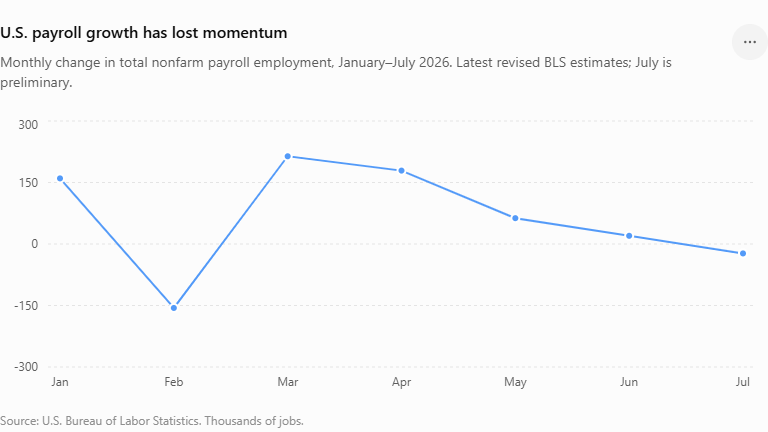
The U.S. labor market delivered its clearest warning of the summer Friday morning, with employers cutting 23,000 jobs in July, far below expectations for an 80,000 gain and following substantial downward revisions to the prior two months.
The Bureau of Labor Statistics revised May payroll growth to 63,000 from 129,000 and June to just 20,000 from 57,000, reducing the two-month total by 103,000 jobs. That leaves average payroll growth at only 20,000 per month over the past three months, a sharp deceleration from the pace seen earlier this year.
The headline unemployment rate nevertheless fell to 4.1% from 4.2%, but the details were considerably less encouraging. The civilian labor force contracted by 264,000 in July and the participation rate slipped to 61.4%, down from 61.5% in June and 62.1% in January. The employment-population ratio also fell to 58.9%. In other words, unemployment declined partly because fewer people were participating in the labor market—not because hiring strengthened.
Wage pressure also softened. Average hourly earnings rose just two cents in July to $37.62 and were up 3.2% from a year earlier, while the average workweek remained at 34.3 hours. That combination adds to evidence that labor-driven inflation pressure is easing even as energy, tariffs and other supply-side forces remain inflation risks.
Private Hiring Is Weak, but the Headline Overstates the Decline
The 23,000 payroll loss was heavily influenced by government employment. Local government education shed 50,000 jobs, while total private employment still increased by about 30,000.
Even so, private-sector breadth was weak. Retail trade lost 19,000 jobs and financial activities declined by 14,000, extending the latter sector’s drop to 121,000 jobs since May 2025. Health care remained a relative bright spot with 22,000 new positions, while construction added roughly 22,000 and manufacturing employment edged higher.
The more important signal is the direction of travel. After revised payroll gains of 214,000 in March and 179,000 in April, employment growth slowed to 63,000 in May, 20,000 in June and turned negative in July. February’s decline was distorted by strike activity, but the latest three-month deterioration is harder to dismiss as a one-off.
Bonds Rally as September Hike Odds Fall
The fixed-income market reacted immediately. The policy-sensitive 2-year Treasury yield fell about 8 basis points to 4.16%, while the 10-year dropped roughly 6 basis points to 4.61% after the report. Fed funds futures cut the probability of a September rate increase to roughly 40%–44%, from about 55%–57% before the release.
That is a meaningful shift because the Fed left its target range at 3.50%–3.75% last week while three policymakers preferred a quarter-point hike. Until this morning, continued labor-market resilience gave the Fed room to focus primarily on above-target inflation. July’s employment report complicates that calculation.
Goldman Sachs Asset Management’s Lindsay Rosner characterized the data as another midsummer loss of momentum and said slower job growth supports a September hold, while emphasizing that incoming inflation data remains decisive.
Fixed Income Implications
For bond investors, the report strengthens the case for intermediate-duration, high-quality fixed income.
Short Treasuries and cash-like ETFs still offer attractive income, but the opportunity cost of holding excessive cash is increasing as labor data weaken. Intermediate Treasury exposure through funds such as VGIT, IEF, IEI and SCHR should gain more support if the market increasingly prices a Fed hold and slower nominal growth.
The report is also constructive for agency MBS and high-quality investment-grade credit, where investors can combine current income with moderate duration. Active core funds and securitized strategies remain well positioned if yields continue to ease without a sharp deterioration in corporate fundamentals.
The signal is less straightforward for lower-quality credit. A softer labor market helps rates, but sustained employment weakness would eventually challenge leveraged borrowers and consumer-sensitive issuers. That argues for maintaining credit exposure while favoring quality, seniority and structure rather than simply reaching for the highest available yield.
Long-duration Treasuries also received an immediate boost, but next week’s July CPI report remains critical. Persistent energy or tariff-driven inflation could keep the Fed constrained even as employment softens, limiting how far long yields can fall.
Bottom Line
July’s payroll report materially changes the balance of risks for fixed income.
The unemployment rate still looks benign at 4.1%, but the payroll trend, downward revisions, falling participation rate and cooling wage growth all point to a labor market losing momentum. The three-month average gain of only 20,000 jobs is now weak enough that the Fed cannot treat employment as an uncomplicated source of resilience.
For ETF investors, the higher-conviction response is to add high-quality intermediate duration, maintain securitized and investment-grade income exposure, and become more selective in lower-quality credit.
The report does not yet make the case for recession positioning. It does make the case that the Fed has less room to tighten—and that bonds now have a stronger fundamental argument than they did 24 hours ago.
Sources: U.S. Bureau of Labor Statistics, July 2026 Employment Situation and current establishment/household survey tables.
Disclaimer: This material is for informational and educational purposes only and is not investment advice or a recommendation to buy or sell any security. Economic data are subject to revision. ETF values, yields and distributions fluctuate, and investors may lose principal