COMMENTARY:
U.S. fixed income markets finished the week on firmer footing as a surprisingly weak July employment report shifted expectations toward a less restrictive Federal Reserve. Employers unexpectedly shed 23,000 jobs, while prior-month payrolls were revised sharply lower. Treasury yields declined, with the 10-year yield falling toward 4.6%, providing support for longer-duration bonds. Meanwhile, the Treasury announced it would maintain current long-term issuance sizes for the next several quarters, reducing one potential source of upward pressure on long-term yields.
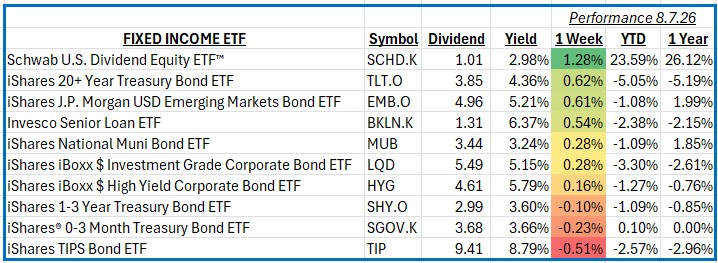
Dividend-oriented equities gained 1.28%, the strongest performance among the income-oriented exposures provided. This was supported by holdings such as Abbott Laboratories, Merck, Amgen and UnitedHealth Group, which were among the strategy’s largest positions entering the week. The group benefited from the broader equity rally and its emphasis on established, cash-generating companies. Its 1.28% return was notably ahead of every traditional fixed-income category in the group.
Long-term U.S. Treasuries advanced 0.62%, benefiting from falling yields following the weak employment report. The gain was 0.08 percentage points ahead of emerging-market bonds, which returned 0.61%, and 0.08 points ahead of senior loans, which gained 0.54%. The Treasury market also received some support from the decision to keep long-term auction sizes unchanged, helping ease concerns about an immediate increase in government bond supply.
Emerging-market bonds and senior loans delivered solid but more moderate gains. Emerging-market debt gained 0.61%, supported by improving global risk appetite, while senior loans rose 0.54%, benefiting from their floating-rate structure and relatively high income. Emerging-market exposure remains diversified across countries including South Africa, Malaysia, Mexico and Brazil, while senior loans provide additional credit-sensitive exposure.
Municipal and investment-grade corporate bonds each gained 0.28%, tying for the middle of the performance range. Municipal bonds benefited from lower Treasury yields, while investment-grade corporates received support from both declining rates and the week’s stronger risk sentiment. High-yield corporate bonds gained 0.16%, trailing investment grade by 0.12 percentage points as investors remained somewhat selective toward lower-quality credit.
At the shorter end, short-term Treasuries declined 0.10%, while Treasury bills fell 0.23%. Inflation-protected securities were the weakest exposure, declining 0.51%, 0.28 percentage points below Treasury bills and 1.79 points behind long-term Treasuries.
The week reinforced the value of duration as weaker employment data pushed yields lower. Overall, fixed income benefited from a more supportive rate environment, although performance remained differentiated across maturity, credit and inflation-sensitive exposures.