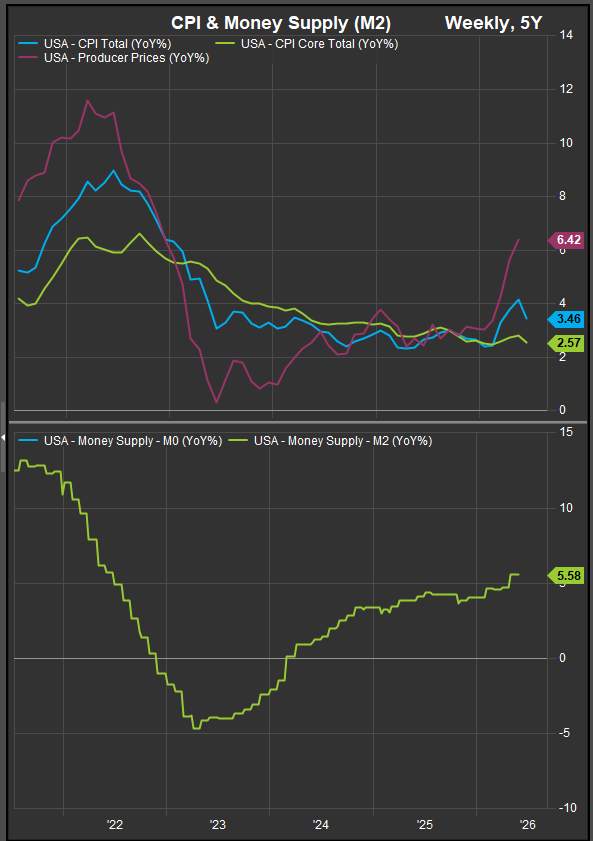
Consumer prices fell as energy costs retreated, yet elevated producer inflation suggests businesses may still face pressure to raise prices or accept weaker profit margins.
U.S. consumer inflation cooled sharply in June, providing welcome evidence that price pressures are easing. But the latest producer-price data remain much hotter, creating an important question for the Federal Reserve: Is inflation genuinely subsiding, or have higher business costs simply not reached consumers yet?
The Consumer Price Index fell 0.4% from May, its largest monthly decline since April 2020. Annual headline inflation slowed to 3.5% from 4.2%. More importantly for monetary policy, core CPI—which excludes food and energy—was unchanged for the month and eased to 2.6% year over year from 2.9%.
The details were broadly encouraging. Energy prices declined 5.7%, including a 9.7% drop in gasoline. Shelter increased just 0.1%, its smallest monthly gain since January 2021, while services excluding energy were unchanged. Prices also declined for motor-vehicle insurance, apparel, communications, medical care and used vehicles.
The report weakens the immediate case for another Federal Reserve rate increase. Flat core prices suggest the inflation acceleration seen earlier in the spring may not be developing into a persistent, economy-wide problem.
However, the consumer report sits uneasily beside the latest Producer Price Index.
Producer prices for final demand rose 1.1% in May and were 6.5% higher than a year earlier—the strongest annual increase since November 2022. The producer-price measure excluding food, energy and trade services increased 0.8% for the month and 5.1% from a year earlier.
A large share of May’s producer-price surge came from energy. Final-demand goods prices jumped 2.8%, led by a 10.7% rise in producer energy costs and a 23.4% increase in gasoline prices. Transportation and warehousing prices also rose 2.6%, potentially increasing costs for businesses throughout the supply chain.
The contrast between the two reports is partly a matter of timing. May PPI captured the earlier surge in energy and transportation costs, while June CPI captured the subsequent decline in retail gasoline prices. June producer-price data, scheduled for release on July 15, will provide a more direct comparison.
Even so, the divergence cannot be dismissed entirely as an energy effect. Producer prices excluding food, energy and trade services remain elevated, while goods prices excluding food and energy rose 0.8% in May. Intermediate input prices also increased sharply, indicating that manufacturers and other businesses continue to face higher costs for chemicals, plastics, fuel, freight and raw materials.
Higher producer prices do not automatically produce higher CPI. Companies can absorb rising costs through lower profit margins, improve productivity, switch suppliers or delay price increases. The PPI and CPI also measure different baskets: producer prices include goods, services and trade margins sold by businesses, while CPI measures what households pay for consumer goods and services.
Nevertheless, persistent producer inflation creates potential pipeline pressure. Businesses that cannot offset higher input and transportation costs may eventually pass them on to consumers. That risk is particularly relevant for goods producers, retailers, airlines, industrial companies and businesses with limited pricing power.
For the Fed, June CPI provides a reason to remain patient—but not necessarily to begin cutting rates. Policymakers will want to see whether softer consumer inflation persists once the temporary benefit from lower gasoline prices fades. They will also watch whether higher producer costs begin appearing in core goods or services prices.
The combination has mixed implications for companies. Softer CPI should support household purchasing power and reduce the risk of additional monetary tightening. But businesses facing rising input costs without the ability to raise prices could experience margin compression. Companies with strong pricing power, efficient supply chains and high productivity should be better positioned than firms competing primarily on price.
For financial markets, the CPI report is broadly constructive for Treasury bonds and rate-sensitive equities because it reduces expectations for a more restrictive Fed. But the higher PPI readings argue against declaring victory over inflation. Long-term bond yields may remain elevated if investors believe producer costs, energy volatility and heavy Treasury issuance will prevent inflation from returning smoothly to 2%.
June CPI is therefore an important disinflationary signal, but not an all-clear. Consumer prices have cooled considerably, while the production pipeline remains more unsettled. The next question is whether lower energy prices pull producer inflation down—or whether elevated business costs begin moving through to consumers and corporate profit margins.
Sources
- U.S. Bureau of Labor Statistics: Consumer Price Index—June 2026, released July 14, 2026. The official source for headline and core CPI, shelter, energy, food and other consumer-price categories.
- U.S. Bureau of Labor Statistics: Producer Price Index—May 2026, released June 11, 2026. The latest available producer-price report when the article was written; June PPI is scheduled for July 15.
- U.S. Bureau of Labor Statistics: “Producer Price Index up 6.5 percent over year ending May 2026,” including goods, energy, services, transportation and warehousing inflation.
- Federal Reserve: Monetary Policy Report—July 2026, for the Fed’s inflation mandate, economic assessment and policy framework.
- Federal Reserve: June 2026 FOMC statement and meeting minutes, for policymakers’ assessment of elevated inflation, energy-related supply pressures and economic resilience.
- FactSet Research Systems Inc.: July 14, 2026, economic-calendar data, including actual results, consensus estimates and prior readings.
Disclaimer: This material is provided for informational and educational purposes only and does not constitute investment advice, an offer to sell, or a solicitation to purchase any security. Economic data are preliminary, subject to revision and may be interpreted differently as additional information becomes available. CPI and PPI measure different sets of prices and should not be treated as directly interchangeable. Market and economic conditions can change rapidly. Investors should conduct independent research and consult an appropriate financial professional before making investment decisions. Myrtle Tree Investment Research LLC may hold positions in securities discussed.