The Federal Reserve is widely expected to leave interest rates unchanged today, but persistent inflation, geopolitical energy risks and a divided Committee could produce hawkish guidance—or even a surprise increase.
The Federal Open Market Committee concludes its two-day meeting Wednesday with one of its least predictable interest-rate decisions in recent years. The policy statement is scheduled for 2:00 p.m. ET, followed by Federal Reserve Chair Kevin Warsh’s press conference at 2:30 p.m.
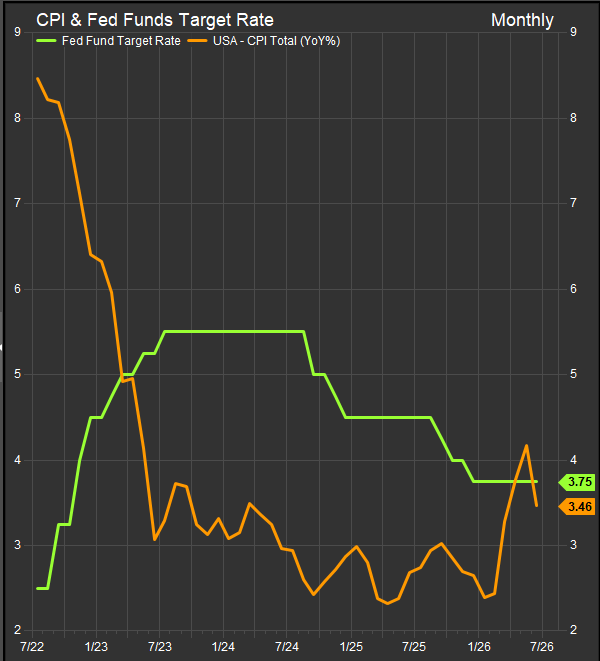
The most likely outcome is that the Fed holds its target rate at 3.50%–3.75%, where it has remained since the beginning of 2026. However, markets are assigning roughly a one-in-three probability to a quarter-point increase, reflecting elevated inflation and growing support within the Committee for tighter policy. A rate cut appears highly unlikely.
The decision will not be accompanied by a new Summary of Economic Projections or dot plot. As a result, the market’s interpretation of policy will depend heavily on changes to the FOMC statement, any dissents and Warsh’s description of what would trigger action at the September meeting.
Inflation has cooled—but not enough to settle the debate
June consumer inflation provided evidence that the spring price surge was moderating. The Consumer Price Index fell 0.4% from May, while the annual inflation rate declined to 3.5% from 4.2%. Core CPI was unchanged during the month and increased 2.6% from a year earlier, down from 2.9% in May.
Those figures support holding rates steady. The problem is that much of June’s improvement came from a 5.7% monthly decline in energy prices, including a 9.7% drop in gasoline. Energy prices were still 15.7% higher than one year earlier, leaving the inflation outlook vulnerable to another geopolitical shock.
Producer prices tell a similarly mixed story. The Producer Price Index declined 0.3% in June, but remained 5.5% higher over the preceding 12 months. The index excluding food, energy and trade services increased only 0.1% during the month, suggesting underlying pressures are moderating even as the annual rate remains uncomfortable.
The Fed’s preferred Personal Consumption Expenditures inflation measure was running at 4.1% in May, although that reading preceded June’s energy-price decline. Updated June PCE inflation will be released Thursday morning—less than 24 hours after the Fed’s decision.
The seven drivers shaping today’s decision
- Energy prices and the Middle East conflict
Energy remains the largest source of near-term inflation uncertainty. Oil and transportation costs rose sharply following disruptions related to the Middle East conflict before retreating on hopes for reduced hostilities. The Committee must determine whether the resulting price increases are temporary supply shocks or whether they are spreading into wages, services and inflation expectations.
The July Beige Book found that businesses continued to report higher fuel, freight, transportation and raw-material costs. Some firms linked those increases to the Middle East conflict, while others cited tariffs.
A renewed oil increase would strengthen the argument for higher rates. Continued energy-price normalization would allow the Fed to remain patient.
- Tariff pass-through
Tariffs are another source of supply-driven inflation. The Federal Reserve’s July Monetary Policy Report noted that higher import tariffs had already raised domestic prices for some consumer goods. Businesses across several Federal Reserve districts also reported higher input costs associated with tariffs.
The central question is whether companies absorb those costs through lower margins or pass them through to consumers. Broad pass-through would increase the risk that temporary goods inflation becomes more persistent.
- Slower job creation
The labor market is no longer overheating. Nonfarm payrolls increased by only 57,000 in June, while unemployment held at 4.2%. Layoffs remain relatively subdued, but hiring has slowed considerably.
That weakness argues against an immediate rate increase. However, slower immigration and aging-related declines in labor-force participation mean the economy may require fewer new jobs to keep unemployment stable. The Fed’s assessment is that labor demand and supply are now roughly balanced rather than materially weak.
The Committee must therefore decide whether 57,000 jobs represents an early warning of deterioration or a sustainable pace for a slower-growing workforce.
- Resilient economic activity
Broader activity has not weakened enough to force the Fed’s hand. First-quarter real GDP grew at a 2.1% annualized rate, while June retail sales rose 0.2% following a revised 1.0% increase in May. Capital spending, productivity and investment related to artificial intelligence remain important sources of support.
The July Beige Book found that economic activity expanded at a slight-to-moderate pace in 11 of the Fed’s 12 districts. Consumer price sensitivity increased, but widespread contraction was not evident.
That resilience gives policymakers room to prioritize inflation, even with payroll growth slowing.
- Inflation expectations and Fed credibility
Short-term inflation expectations increased following the earlier energy-price shock, although longer-term expectations remain broadly consistent with the Fed’s 2% objective.
The distinction is critical. The Fed can look through temporary oil or tariff increases when households and businesses expect inflation to return toward 2%. It becomes more difficult to remain patient when repeated shocks begin to influence wage demands, pricing plans and longer-term expectations.
Warsh has repeatedly emphasized the Fed’s commitment to price stability. Holding rates while delivering weak guidance could therefore be interpreted as inconsistent with that message. A hawkish statement may be needed to maintain credibility even without an immediate hike.
- A divided Committee
The June meeting produced a unanimous decision to hold rates, but the minutes showed that several policymakers did not view the current stance as meaningfully restrictive. A few participants believed there was already a case for raising rates, although they ultimately supported waiting.
The June dot plot revealed an unusually divided outlook. Of 18 participants, nine projected a year-end rate above the current 3.625% midpoint, eight projected no change and only one anticipated a lower rate. The median year-end projection was 3.8%, implying that the Committee was effectively split between holding and tightening.
A hold accompanied by one or more hawkish dissents would indicate that the threshold for a September hike is relatively low.
- Data arriving immediately after the meeting
Policymakers are making today’s decision without several important reports. The advance estimate of second-quarter GDP and June PCE inflation are scheduled for Thursday, while the July employment report will follow on August 7.
Waiting would allow the Fed to evaluate whether June’s inflation improvement continued and whether slower payroll growth represents a genuine change in labor-market conditions. That incomplete data set is one of the strongest arguments against a surprise hike today.
What to watch in the statement and press conference
The rate decision alone may not provide the market with a complete policy signal. Investors should focus on five elements:
The inflation description: Whether the Fed continues to say inflation is “elevated,” or adds language emphasizing persistent upside risks.
The labor-market assessment: Any change from describing employment conditions as stable would suggest the Committee is becoming more cautious about tightening.
September guidance: Warsh may decline to provide an explicit signal, but comments that every meeting is “live” would preserve the possibility of a near-term hike.
The treatment of energy and tariffs: Characterizing them as temporary supply shocks would be less hawkish than emphasizing second-round effects and inflation expectations.
The vote: Hawkish dissents on a decision to hold would raise the probability of action in September.
Base case: hold rates, retain a tightening bias
The most defensible outcome is a hold at 3.50%–3.75%, combined with language emphasizing that inflation remains above target and that the Committee is prepared to tighten if price pressures fail to moderate.
June CPI and PPI provide enough evidence of cooling to justify waiting. Slower payroll growth and major economic releases arriving immediately after the meeting further support patience.
However, the Fed is unlikely to validate expectations for rate cuts. Inflation remains too high, the economy continues to expand and June projections showed substantial support for higher rates. The larger market risk is therefore not an immediate cut, but either a surprise hike or guidance that positions September as a genuine tightening meeting.
Today’s decision may settle the interest rate for another seven weeks. It is less likely to settle the debate inside the Federal Reserve.
Sources
- Federal Reserve — July 2026 Calendar
Confirms the July 28–29 FOMC meeting, the 2:00 p.m. ET policy announcement and the 2:30 p.m. press conference. - Federal Reserve — July 2026 Monetary Policy Report
Provides the Fed’s latest assessment of elevated inflation, balanced labor demand and supply, solid economic growth, energy-price shocks and inflation expectations. - Federal Reserve — June 2026 Summary of Economic Projections
Supplies policymakers’ latest forecasts for GDP, unemployment, PCE inflation and the federal-funds rate, including the Committee’s upwardly revised inflation and rate projections. - Federal Reserve — Minutes of the June 16–17 FOMC Meeting
Documents the Committee’s debate over persistent inflation, Middle East energy risks, economic resilience and whether additional monetary tightening could become appropriate. - Federal Reserve — July 2026 Beige Book
Reports slight-to-moderate economic growth across most Fed districts, continued price sensitivity and widespread business concerns about fuel, freight and other input costs. - Bureau of Labor Statistics — June 2026 Consumer Price Index
Reports a 0.4% monthly CPI decline, 3.5% year-over-year headline inflation and 2.6% core inflation, with falling energy prices driving much of the monthly improvement. - Bureau of Labor Statistics — June 2026 Employment Situation
Reports a 57,000 increase in nonfarm payrolls, a 4.2% unemployment rate and downward revisions to April and May employment growth. - Bureau of Labor Statistics — June 2026 Producer Price Index
Provides the latest evidence on wholesale inflation and pipeline cost pressures affecting the Fed’s assessment of future consumer-price inflation. - Bureau of Economic Analysis — Release Schedule
Confirms that second-quarter GDP and June personal income, spending and PCE inflation are scheduled for release on July 30, one day after the FOMC decision. - Reuters — July FOMC Meeting Preview
Provides current market expectations, economist forecasts and analysis of the unusually uncertain choice between holding rates steady and delivering another increase.