Treasury yields surged last week as persistent inflation, resilient employment and disappointing bond auction demand challenged the duration rally. Retail sales, FOMC minutes and fresh housing data will test whether the economy can sustain further monetary tightening.
Last Week: Treasury Yields Reverse Sharply Higher
U.S. Treasury yields rose across the curve during the week of November 9–13, reversing much of the recent rally as inflation data and monetary-policy expectations shifted decisively toward additional tightening. The 2-year Treasury yield increased 37 basis points to 4.88%, the 10-year rose 29 basis points to 5.15%, and the 30-year climbed 21 basis points to 5.47%. The 2s10s spread narrowed to approximately 27 basis points, reflecting stronger pressure on policy-sensitive short maturities.
The selloff reinforced the market’s central concern: economic growth has not weakened sufficiently to give the Federal Reserve confidence that inflation will return sustainably to target. Following October’s stronger employment report, last week’s consumer and producer inflation readings reduced expectations that the Fed could remain on hold through year-end. The 30-year Treasury auction also attracted relatively soft demand, highlighting continued investor caution toward extending duration at prevailing yields.
The result was a difficult week for duration-sensitive fixed income portfolios. Broad investment-grade bond benchmarks declined as rising Treasury yields overwhelmed income accrual and relatively stable credit spreads. The pressure originated primarily in interest rates rather than widespread deterioration in corporate credit fundamentals.
Inflation: Less Energy Pressure, but Core Prices Remain Persistent
Tuesday’s October CPI report showed headline consumer prices increasing 0.4% month-over-month, down from September’s 0.6% increase. Core CPI advanced 0.3% for the third consecutive month, an annualized pace of approximately 3.7%. Shelter prices rose 0.3%, food prices increased 0.5%, and energy prices advanced just 0.7% following September’s 5.2% surge. The moderation in energy inflation was encouraging, but the persistence of core price increases provided little evidence that underlying inflation had returned to a trajectory consistent with the Fed’s 2% objective.
An unusual statistical limitation deserves attention: the BLS did not publish standard October 2026 year-over-year CPI readings for most categories because October 2025 survey data were unavailable following the federal government funding lapse. Investors must therefore rely more heavily on sequential inflation readings and other indicators rather than drawing conclusions from unavailable annual comparisons.
Friday’s Producer Price Index provided a similar message. Headline PPI increased 0.3% in October, considerably slower than September’s revised 1.4% increase, but annual producer inflation reached 6.5%, its highest rate since November 2022. The index excluding food, energy and trade services increased 0.5% for the second consecutive month and 4.9% annually. Transportation and warehousing costs continued rising, suggesting that businesses remain exposed to significant operating-cost pressure even as oil prices retreat.
WTI crude declined approximately 2.5% last week to $88.56 per barrel, supported by expectations of improving supply and softer demand. Lower energy prices could eventually reduce headline inflation and freight costs, but the benefit to underlying inflation will depend on whether businesses pass those savings through to customers. For now, the moderation in crude is encouraging but insufficient to offset persistent producer and services inflation.
Labor Markets and Credit: Resilience Complicates the Recession Argument
Labor-market data continue to challenge the case for a sustained duration rally driven by recession concerns. Initial unemployment claims increased to 200,000 for the week ended November 7, but the four-week average remained unchanged at 195,250. Continuing claims declined to approximately 1.70 million. These readings reinforce the message from October’s 165,000 payroll gain: employment conditions remain relatively stable despite restrictive borrowing costs.
Real average hourly and weekly earnings were unchanged in October, indicating that nominal wage increases were sufficient to offset the month’s inflation but did not produce additional purchasing-power gains. Consumer sentiment remains weak, although the University of Michigan’s preliminary November index improved to 51.0 from October’s 48.0.
Credit markets have proved more resilient than Treasury prices. Through November 12, the ICE BofA U.S. High Yield Option-Adjusted Spread narrowed to approximately 320 basis points from 342 basis points on November 6, while investment-grade spreads tightened from 93 to 89 basis points. This suggests investors are not yet pricing an imminent deterioration in corporate credit fundamentals.
The distinction is important for portfolio construction. Higher Treasury yields are challenging duration-sensitive bonds, but relatively contained credit spreads suggest that the business cycle remains sufficiently healthy to support corporate cash flows. Nevertheless, elevated refinancing costs and increasingly selective lending conditions argue against assuming that low-quality credit will remain insulated if monetary policy tightens further.
Treasury Supply and Fed Expectations
Last week’s $125 billion Treasury refunding offered another test of investor demand. The $58 billion three-year and $42 billion ten-year auctions were followed by Thursday’s $25 billion 30-year sale, which cleared at 5.441%. The long-bond bid-to-cover ratio declined to 2.36 from 2.54 at the previous auction, while primary dealers absorbed a larger share of the issuance.
The results suggest that investors continue to require attractive yields to absorb long-duration government debt. Persistent fiscal borrowing requirements and uncertainty about future inflation could keep term premiums elevated even if the Fed eventually slows its tightening cycle.
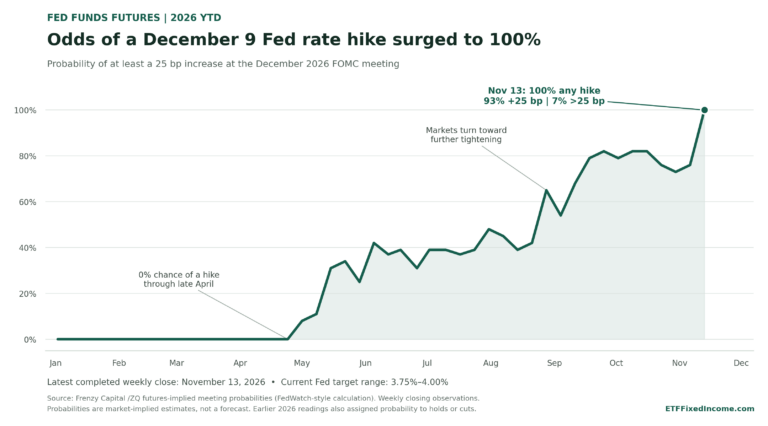
Fed-funds futures now overwhelmingly favor a December increase. The latest market-implied estimates assign approximately 93% probability to a 25-basis-point increase at the December 9 meeting, with additional probability attached to a larger move. That represents a substantial change from earlier in the year, when investors were anticipating a considerably less restrictive policy path.
The primary risk to the Treasury market is that resilient demand and persistent inflation encourage the Fed to tighten beyond the increase currently anticipated for December.
The Week Ahead: Retail Sales, FOMC Minutes and Treasury Auctions
This week’s calendar should provide additional evidence about whether consumer demand and industrial activity can absorb further monetary restraint.
- Monday, November 16: The November Empire State Manufacturing Survey is due at 8:30 a.m. ET, with consensus near 17, down from 25.5. Fed Chair Kevin Warsh is also scheduled to speak. Investors will focus on new orders, employment and pricing components for evidence that industrial activity is moderating.
- Tuesday, November 17: October retail sales and import/export prices arrive at 8:30 a.m. ET, followed by industrial production at 9:15 a.m. Retail sales are expected to increase approximately 0.1%, compared with September’s 0.8% gain, while industrial production is expected to rise 0.1%. These releases will help determine whether strong nominal spending is translating into sustainable real demand.
- Wednesday, November 18: October housing starts and building permits are scheduled for 8:30 a.m., followed by pending home sales at 10:00 a.m. The October FOMC minutes arrive at 2:00 p.m. ET, providing greater detail about the Committee’s divided decision to hold rates steady. Treasury will also auction approximately $16 billion of 20-year bonds, testing long-duration demand after last week’s relatively weak refunding auctions.
- Thursday, November 19: Initial unemployment claims and the November Philadelphia Fed Manufacturing Survey are released at 8:30 a.m. ET, followed by the Leading Economic Index at 10:00 a.m. Treasury’s $19 billion reopening of 10-year TIPS at 1:00 p.m. will offer a timely assessment of demand for real yields and inflation protection.
- Friday, November 20: The final November University of Michigan Consumer Sentiment Survey and October state employment report arrive at 10:00 a.m. ET. Inflation expectations will be especially important after last week’s CPI and PPI reports.
Investment Outlook: Income Remains Attractive, but Duration Conviction Requires Better Inflation Evidence
The bond market enters the week with stronger expectations for December tightening, a yield curve that remains relatively flat and long-duration Treasury valuations increasingly sensitive to inflation and supply developments. We continue to favor high-quality short- and intermediate-duration exposure rather than an aggressive long-duration overweight. Elevated Treasury yields provide attractive income, but the recent selloff demonstrates that carry alone cannot protect longer-duration portfolios against another material repricing of Fed expectations.
Intermediate Treasuries are becoming more attractive as a strategic allocation, particularly for investors with excess cash-like exposure. However, a durable rally will require evidence that core inflation is moderating or that economic growth is slowing sufficiently to limit additional tightening. Long-duration Treasuries offer greater upside if those conditions develop but remain vulnerable to another rise in real yields or term premiums.
Within credit, investment-grade bonds remain appealing for investors seeking quality income, while high-yield spreads deserve careful scrutiny. Credit-market resilience is encouraging, but relatively tight spreads provide limited compensation for a more severe deterioration in growth. Floating-rate credit and AAA CLOs can continue to offer attractive carry, although issuer quality, liquidity and underlying loan fundamentals remain important considerations.
The key question for this week is whether consumer spending and industrial production confirm continued economic resilience or begin revealing more substantial damage from restrictive monetary policy. Strong activity and persistent inflation would reinforce December tightening expectations and challenge duration. Weaker demand accompanied by moderating prices would offer a more convincing foundation for a Treasury recovery. Until that evidence emerges, the preferred approach remains disciplined duration exposure, emphasis on credit quality and preservation of portfolio flexibility.
Primary Sources
- U.S. Bureau of Labor Statistics — October CPI, November 10
- U.S. Bureau of Labor Statistics — October PPI, November 13
- U.S. Bureau of Labor Statistics — October Real Earnings
- U.S. Department of Labor — Weekly Unemployment Claims
- U.S. Treasury — Daily Treasury Yield Curve
- Federal Reserve — November 2026 Calendar
- Federal Reserve Bank of St. Louis — High-Yield Credit Spreads
- University of Michigan — Surveys of Consumers
- Federal Home Loan Bank of New York — Weekly Market Update, November 13
Market observations through November 13, 2026, except credit spreads, which reflect the latest verified November 12 observations. December rate probabilities are indicative futures-derived estimates and may change intraday.
Disclaimer: This publication is intended for informational and educational purposes only and does not constitute investment advice or a recommendation to purchase or sell securities. Market assessments and forward-looking statements reflect information available as of November 16, 2026, and are subject to change. Fixed income investments involve interest-rate, inflation, credit and liquidity risks. Past performance does not guarantee future results.