Treasuries rallied as equity-market volatility and weakening economic indicators renewed demand for safety. This week’s PCE inflation, GDP and Treasury auctions will test whether the rally can endure persistent Fed tightening expectations.
Treasury Yields Retreat as Growth Concerns Intensify
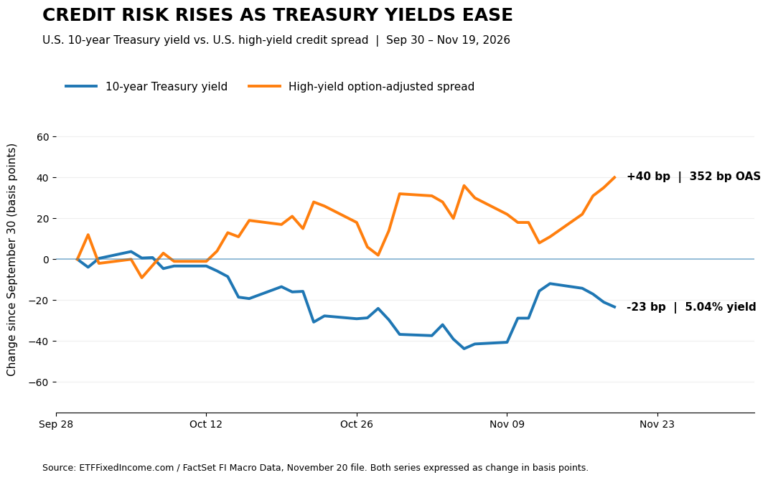
U.S. Treasury yields declined sharply during the week of November 16–20, reversing the previous week’s selloff as equity-market volatility and growing credit concerns renewed demand for government bonds. The 2-year Treasury yield fell 25 basis points to 4.63%, the 5-year declined 27 basis points to 4.71%, the 10-year dropped 23 basis points to 4.92%, and the 30-year declined 16 basis points to 5.31%. The 2s10s spread widened modestly to approximately 29 basis points, reflecting a rally concentrated in shorter and intermediate maturities.
The reversal came amid pronounced weakness in technology shares and concerns about AI infrastructure financing, capital expenditure commitments and corporate valuations. Treasuries benefited from deteriorating risk appetite despite continued expectations for additional Federal Reserve tightening. The central question is whether the bond market is anticipating a genuine deterioration in economic growth or responding primarily to an equity-market correction. Last week’s releases suggest the expansion is becoming less uniform, but the evidence for an imminent recession remains incomplete.
Economic Data: Softer Activity, Persistent Inflation
October retail sales increased just 0.2% month-over-month, down from September’s 0.8% gain, although the underlying retail control group advanced approximately 0.6%, exceeding expectations. The distinction suggests household spending retains some resilience beneath weaker headline growth. Industrial production declined 0.4%, primarily reflecting a 4.3% contraction in utilities output. Manufacturing production increased 0.3%, although output excluding motor vehicles declined 0.1%, while capacity utilization slipped to 76.4%, approximately three percentage points below its long-term average.
Inflation indicators were less encouraging. October import prices increased 1.1% for the second consecutive month, including a 0.8% increase excluding fuel. Capital goods import prices jumped 1.5%, the largest monthly increase in the history of the series, reflecting higher prices for computers, semiconductors and industrial equipment. These readings suggest that international trade costs, supply constraints and AI-related investment demand continue generating inflation pressure even as crude oil prices moderate. The economy is losing momentum in selected sectors, but underlying cost pressures remain sufficiently persistent to complicate monetary easing.
Housing and Labor: Cycle Risks Are Becoming More Visible
Housing provided the strongest evidence of weakening fundamentals. October building permits declined 7.4% to an annualized 1.295 million units, with single-family permits falling 8.7%. Housing starts rebounded 9.9%, but the increase followed a substantially revised September decline and was not statistically significant. More concerning, pending home sales fell 4.7% monthly and 16.7% annually, with declines across all four major regions. The Conference Board’s Leading Economic Index declined 0.3% in October, reflecting weakness in permits and consumer expectations, although its six-month change remained marginally positive.
Labor data also suggest rising vulnerability without confirming contraction. Initial unemployment claims increased modestly to 203,000, while continuing claims climbed 70,000 to 1.763 million, suggesting unemployed workers may be taking longer to find new positions. Consumer sentiment improved to 51.5 from 48.0 in October, while one-year inflation expectations moderated to 3.7% from 4.7%, consistent with some relief from declining gasoline prices.
The economy appears to be weakening at its interest-sensitive margins rather than entering a synchronized downturn. Housing is contracting, industrial demand is uneven and labor-market transitions are becoming more difficult, but consumer spending and business investment remain important offsets. The risk is that these vulnerabilities spread before inflation moderates enough to permit a less restrictive monetary policy.
Fed Policy and Credit: Restrictive Rates Meet Greater Financial Vulnerability
Wednesday’s October FOMC minutes reinforced policymakers’ concern that inflation remains too persistent. Nearly all participants expected additional tightening under their baseline forecasts, while some discussed the possibility of larger increases if inflation failed to improve. The minutes also highlighted potential vulnerabilities associated with AI infrastructure financing, private credit and increasingly concentrated capital expenditure. These concerns are becoming more relevant as investors question whether leveraged businesses can sustain investment commitments and refinancing obligations at elevated borrowing costs.
Fed-funds futures continue to assign a high probability to another 25-basis-point increase at the December 8–9 meeting, even as Treasury yields decline. This divergence reflects competing expectations: policymakers remain concerned about inflation, while investors are increasingly sensitive to the risk that restrictive rates undermine growth.
Credit markets are also becoming more cautious. The ICE BofA High Yield Option-Adjusted Spread widened from 323 basis points on November 13 to 352 basis points by November 19, indicating rising concerns about refinancing risk and lower-quality borrowers. The increase remains modest relative to historical recessionary conditions, but the direction reinforces the case for investment-grade credit over high yield and greater selectivity among preferred securities, BDCs and other leveraged income investments.
The Week Ahead: PCE Inflation and GDP Lead a Compressed Calendar
The Thanksgiving-shortened week concentrates several important economic releases and Treasury auctions into the first three trading sessions.
Monday, November 23: November flash manufacturing and services PMIs arrive at 9:45 a.m. ET, with consensus near 54.5 and 55.7, respectively. Investors should focus on new orders, employment and selling-price components. Treasury will auction $69 billion of 2-year notes.
Tuesday, November 24: September home-price indexes arrive at 9:00 a.m. ET, followed by November consumer confidence at 10:00 a.m. Consensus expects confidence near 92, compared with 91.7 previously. Treasury will auction $70 billion of 5-year notes, testing intermediate-duration demand following last week’s rally.
Wednesday, November 25: The week’s major releases arrive at 8:30 a.m. ET, including October PCE inflation, personal income and spending, the second estimate of third-quarter GDP, durable goods orders and weekly jobless claims. New-home sales follow at 10:00 a.m., with the Fed’s Beige Book scheduled for 2:00 p.m. Treasury will auction $44 billion of 7-year notes.
Thursday–Friday, November 26–27: U.S. bond markets are closed for Thanksgiving Thursday, with a recommended 2:00 p.m. ET early close Friday. October advance trade and inventory data are scheduled for Friday morning. Reduced holiday liquidity could amplify market reactions.
Investment Outlook: The Duration Rally Needs Inflation Confirmation
Wednesday’s PCE report represents the most consequential catalyst. Consensus expects headline inflation near 3.8% year-over-year and core PCE near 3.2%, compared with September’s 3.6% and 3.1%, respectively. Both measures are expected to increase approximately 0.3% monthly. The second estimate of third-quarter GDP is expected near 3.5% annualized, potentially reinforcing the Fed’s view that underlying growth remains resilient despite weakening housing and consumer confidence.
Stronger inflation alongside firm GDP growth would reinforce December tightening expectations and could reverse last week’s Treasury rally. Conversely, moderating core PCE accompanied by softer real consumption would strengthen the case for extending duration. The Beige Book will provide additional evidence about employment demand, business pricing power and financing conditions.
We continue to favor high-quality income and selective intermediate-duration exposure rather than an aggressive long-duration overweight. Short Treasuries offer attractive carry and liquidity, while intermediate maturities provide a balanced opportunity to benefit if growth deteriorates. Long-duration Treasuries offer greater upside during a genuine growth shock but remain vulnerable to renewed inflation pressure and higher real yields. Investment-grade credit remains preferable to lower-quality spread exposure, particularly where refinancing requirements and leverage are substantial.
The key question is whether disinflation can validate the Treasury rally before deteriorating financial conditions force a more defensive reassessment of the business cycle. Until that evidence emerges, maintaining credit quality, earning attractive carry and preserving portfolio flexibility remain the preferred approach.
Primary Sources
- U.S. Treasury — Daily Treasury Yield Curve
- Federal Reserve — October Industrial Production and FOMC Minutes
- Bureau of Labor Statistics — October Import and Export Prices
- U.S. Census Bureau — Retail Sales, Housing Starts and Building Permits
- National Association of Realtors — Pending Home Sales
- Conference Board — Leading Economic Index
- Bureau of Economic Analysis — GDP and PCE Release Calendar
- University of Michigan — Consumer Sentiment
- SIFMA — Fixed Income Holiday Schedule
Market observations through November 20, 2026, with credit spreads through November 19. Consensus forecasts reflect information available before November 23 releases.
Disclaimer: This publication is for informational and educational purposes only and does not constitute investment advice or a recommendation to purchase or sell securities. Market assessments and economic forecasts are subject to change. Fixed income investments involve interest-rate, credit, inflation and liquidity risks. Past performance does not guarantee future results.