The Federal Reserve held rates steady in a divided vote, but futures markets continue to anticipate additional tightening in December. Treasury yields, inflation risks and fresh economic data suggest the Fed’s next decision may be more consequential than yesterday’s pause.
The Fed Holds, but Two Policymakers Want Higher Rates
The Federal Reserve maintained its target federal funds rate at 3.75%–4.00% on October 28, as widely expected, but the 10–2 vote revealed meaningful disagreement about the appropriate level of monetary restraint. Governor Lisa Cook and Cleveland Fed President Beth Hammack dissented in favor of another 25-basis-point increase. The Committee also upgraded its characterization of economic activity from “solid” to “strong,” reflecting resilient business investment, consumer spending and relatively stable employment conditions.
Chair Kevin Warsh declined to commit to another increase in December, emphasizing the importance of upcoming inflation and employment data. The decision therefore represents a pause in the tightening cycle rather than a transition toward monetary easing. With September’s inflation reports showing renewed price pressures, the Fed remains concerned that policy may not be sufficiently restrictive to return inflation sustainably to its 2% objective.
Fed-funds futures continue to favor additional tightening. As of early Thursday morning, December futures implied an 82.2% probability of a 25-basis-point increase, compared with 17.8% for another hold. The probability was little changed from approximately 80.2% before Wednesday’s decision, indicating that the announcement did relatively little to alter expectations for the next meeting.
The Dot Plot Still Points Toward Restrictive Policy
The September 16 Summary of Economic Projections remains the Fed’s latest official dot plot, as the October meeting did not include updated economic forecasts. The median projected federal funds rate was 4.1% for both 2026 and 2027, followed by 3.9% in 2028, 3.6% in 2029 and 3.2% over the longer run. Sixteen of 18 participants projected a year-end 2026 rate of at least 4.125%, consistent with expectations for additional tightening.
These projections suggest that policymakers anticipate maintaining restrictive monetary conditions well beyond the current meeting. Although the longer-run median indicates eventual normalization, the projected path offers little support for expectations of near-term rate cuts.

Fed-Funds Futures Have Repriced Higher Throughout 2026
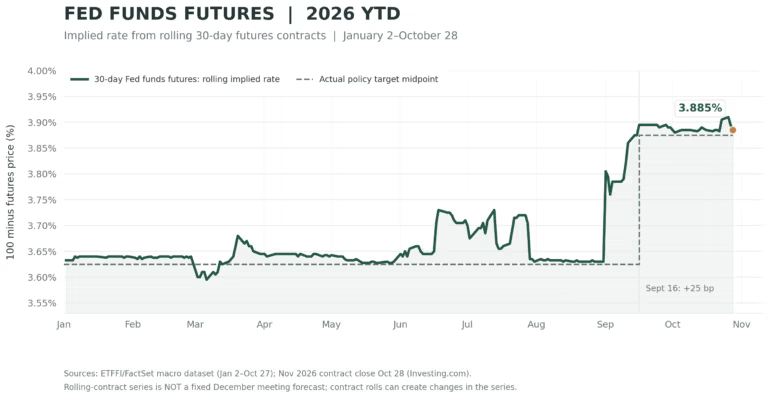
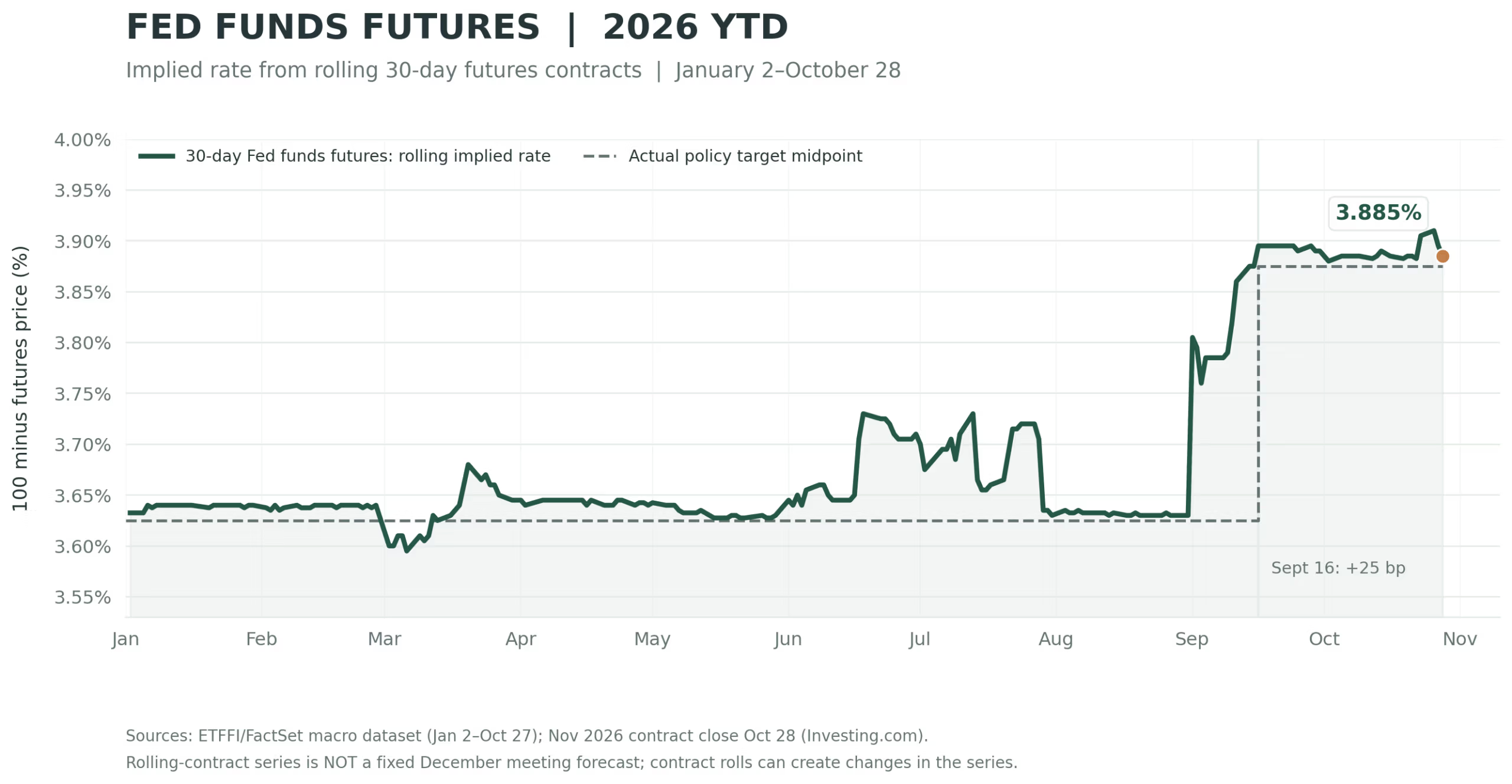
The 2026 YTD futures chart illustrates how monetary-policy expectations have shifted during the year. The implied rate derived from the rolling 30-day federal funds futures contract increased from approximately 3.63% at the beginning of January to 3.885% on October 28, reflecting tighter policy expectations and September’s actual 25-basis-point increase.
The chart measures the implied rate on a rolling futures contract rather than the probability of a specific FOMC decision. Nevertheless, it provides useful perspective on the market’s broader repricing toward higher interest rates despite periodic concerns about economic growth.
With futures still assigning a substantial probability to another increase in December, the bond market cannot assume that October’s pause marks the end of tightening. The coming inflation and employment releases will determine whether the Fed follows through on the additional restraint currently reflected in market pricing.
Treasury Markets Respond With a Steeper Yield Curve
Treasury yields moved in opposite directions across the maturity spectrum following Wednesday’s announcement. The 2-year yield declined 3 basis points to 4.67%, while the 5-year increased 3 basis points to 4.85%, the 10-year rose 6 basis points to 5.05%, and the 30-year increased 7 basis points to 5.37%. The 2s10s yield spread widened approximately 9 basis points to +38 basis points.
The curve steepening suggests that investors interpreted the Fed’s comments as reducing the immediate risk of additional tightening while maintaining uncertainty about longer-term inflation and interest rates. Shorter maturities benefited from the pause, but rising longer-term yields indicate that inflation compensation, real-rate expectations and term premiums remain significant considerations.
This is an important distinction for duration investors. A Fed pause does not automatically justify extending aggressively into longer-maturity Treasuries. The market continues to demand compensation for inflation uncertainty, heavy government borrowing requirements and the possibility that restrictive monetary policy persists longer than anticipated.
Wednesday’s Economic Releases: Trade Weakness, Labor Stability and Energy Pressure
Economic releases published alongside the FOMC decision provided additional evidence of an expansion that remains resilient but increasingly uneven.
The September advance goods trade deficit widened 2.1% to $134.9 billion, as imports increased to $344.1 billion and exports reached $209.2 billion. Capital-goods imports rose 7.5%, reinforcing the strength of corporate investment, including spending associated with AI infrastructure and industrial equipment. However, the widening trade deficit could detract from third-quarter GDP growth. Wholesale inventories increased 0.6% and retail inventories advanced 0.3%, potentially providing a partial offset through inventory investment.
Labor-market data continued to suggest limited hiring rather than widespread layoffs. The BLS reported that unemployment rates declined year-over-year in 226 of 387 metropolitan areas, while payroll employment was essentially unchanged in most metropolitan areas. A separate Business Employment Dynamics report showed 7.4 million gross private-sector job gains against 7.3 million losses during the first quarter, leaving only modest net employment creation. Although these figures are lagged, they reinforce the distinction between a stable unemployment rate and robust labor demand.
Energy remains the more immediate inflation concern. The Energy Information Administration reported that commercial crude inventories declined 1.9 million barrels to 410.6 million, marking a fourth consecutive weekly reduction. Distillate inventories fell another 1.5 million barrels and remained approximately 10% below their five-year seasonal average. Persistently tight diesel inventories are especially important because transportation and freight costs can transmit energy inflation into broader consumer and producer prices.
Taken together, the data illustrate the Fed’s underlying problem: business investment remains substantial, the labor market is slowing without collapsing, and supply-related inflation pressures have not disappeared.
The Next Test: GDP, PCE Inflation and Employment Costs
The most consequential economic releases may arrive immediately after the FOMC decision. Third-quarter GDP and September PCE inflation are scheduled for Thursday, October 29, at 8:30 a.m. ET, followed by the Employment Cost Index on Friday.
The GDP report will clarify whether strong capital expenditure and business activity are sufficient to offset weakening housing and the widening trade deficit. The PCE report will be particularly important because it measures inflation using the Fed’s preferred methodology and will help determine whether September’s CPI and PPI acceleration is feeding into underlying consumer prices.
Stronger-than-expected GDP and core PCE inflation would reinforce expectations for December tightening and could put renewed upward pressure on Treasury yields. Conversely, weaker consumption and moderating underlying inflation would strengthen the case for a longer policy pause and potentially support intermediate-duration bonds.
Fixed Income Outlook: Favor Quality and Selective Duration
The October FOMC decision leaves the central fixed income dilemma unresolved. Monetary policy remains restrictive, futures markets expect another increase, and longer-term yields continue to reflect considerable inflation and fiscal uncertainty. At the same time, slowing hiring, weakening housing activity and elevated starting yields have improved the investment case for high-quality duration.
We continue to favor short- and intermediate-duration Treasuries over a concentrated long-duration overweight. Front-end securities offer attractive income and liquidity, while intermediate maturities provide a more balanced opportunity to benefit if the growth outlook deteriorates or December tightening expectations diminish. Long-duration Treasuries remain vulnerable to renewed inflation surprises and higher term premiums, even if the Fed ultimately pauses for longer.
Within credit, investment-grade exposure remains preferable to aggressively pursuing high-yield spreads, while selective TIPS allocations can help diversify inflation risk. The case for extending duration would strengthen with sustained moderation in core PCE, softer labor demand and declining real yields.
The central conclusion is that October delivered a policy pause, not confirmation of a monetary-policy pivot. The December decision remains the more important test, and the next round of inflation and growth data will determine whether the bond market can sustain its recent recovery without another increase in long-term yields.
Sources
Federal Reserve — October 28 FOMC Statement; September 2026 Summary of Economic Projections; CME Fed-Funds Futures via Investing.com Fed Rate Monitor; U.S. Treasury — Daily Treasury Yield Curve; U.S. Census Bureau — September Advance Goods Trade and Inventories; Bureau of Labor Statistics — Metropolitan Employment and Business Employment Dynamics; Energy Information Administration — Weekly Petroleum Status Report.
Market data: FactSet, supplemented with the October 28 futures close.
Disclaimer: This publication is for informational and educational purposes only and does not constitute investment advice or a recommendation to purchase or sell securities. Futures-implied probabilities and Federal Reserve projections are estimates subject to change. Fixed income investments involve interest-rate, inflation, credit and liquidity risks. Past performance does not guarantee future results.