
U.S. fixed income markets faced renewed volatility as the Federal Reserve raised its policy rate by 25 basis points to a 3.75%–4.00% range, its first hike since 2023. The move reinforced concerns that rates could remain higher for longer. The 10-year Treasury yield briefly reached 5%, while the 2-year yield climbed toward 4.75%. Persistent oil prices near $100 per barrel also kept inflation concerns elevated.
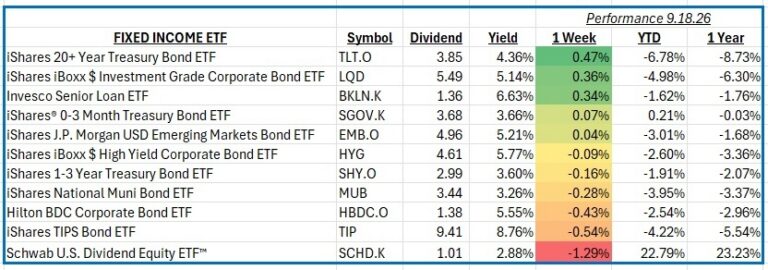
Long-term government bonds led the fixed-income exposures, gaining 0.47%, as investors continued to find value in higher long-term yields despite elevated rate volatility. The strongest performance within the group came from longer-maturity Treasuries, which benefited as yields eased modestly late in the week. By comparison, short-term government bonds declined 0.16%, highlighting the difference in interest-rate sensitivity across the Treasury curve.
Investment-grade corporate bonds advanced 0.36%, supported by their attractive income levels and relatively stable credit conditions. The combination of yields above 5% and generally solid corporate fundamentals continued to provide investors with meaningful income opportunities. Investment-grade credit also outperformed senior loans, which gained 0.34%, as floating-rate securities benefited from elevated short-term rates but had less potential for price appreciation.
Short-duration and floating-rate bonds remained comparatively resilient. Ultra-short Treasury securities gained 0.07%, while senior loans rose 0.34%, reflecting their limited duration exposure and ability to generate income from higher short-term rates. Emerging-market dollar-denominated bonds edged higher at 0.04%, while high-yield corporate bonds declined 0.09%, suggesting investors remained selective toward lower-quality credit as borrowing costs increased.
Municipal bonds, specialty corporate credit and inflation-protected securities struggled. Municipal bonds declined 0.28%, specialty corporate bonds fell 0.43%, and inflation-protected bonds dropped 0.54%. Higher nominal Treasury yields and renewed inflation concerns created a challenging environment for these exposures. The broader environment was also complicated by unexpectedly weaker August U.S. manufacturing output, which declined 0.3%, adding another variable for investors assessing economic growth alongside inflation. (Reuters)
Overall, the week demonstrated the importance of duration, credit quality and income in today’s bond market. Long Treasuries and investment-grade credit led, while inflation-sensitive and equity-like income exposures lagged. With the 10-year Treasury near 5%, the bond market continues to offer substantial income while requiring careful management of interest-rate and credit risk.
