
Crude prices approaching $100 are reviving inflation and rate-hike concerns, overpowering the traditional safe-haven bid for government bonds.
A renewed surge in oil prices sent global bond yields sharply higher Thursday morning as investors focused on the inflationary consequences of the escalating U.S.–Iran conflict rather than seeking safety in government debt.
Brent crude climbed nearly 5% to about $98.60 per barrel, while West Texas Intermediate moved above $90. The advance followed attacks on two Saudi oil tankers near the Bab el-Mandeb Strait and heightened threats to shipping through the Strait of Hormuz, raising the possibility that disruption could affect two of the world’s most important energy transit routes.
The oil move accelerated an already difficult week for fixed-income markets. The 10-year U.S. Treasury yield rose to approximately 4.68%, approaching its highest level since May 2025, while the 30-year yield remained above 5%. Interest-rate-sensitive two-year yields also reached a 17-month high as traders increased the probability that the Federal Reserve may need to tighten policy again.
The reaction represents a reversal of the conventional geopolitical playbook. Government bonds often rally during military escalation as investors seek liquid safe assets. This time, the market is treating the conflict as a negative energy-supply shock—one that could raise inflation, weaken household purchasing power and keep central banks restrictive.
Fed funds futures were assigning roughly a one-third probability to a rate increase at the Federal Reserve’s July 28–29 meeting, up substantially from earlier in the week. The Fed is widely expected to remain on hold, but the oil shock has reduced confidence that the softer June CPI and PPI reports marked a durable turning point in inflation.
TIPS Face Their Most Important Test of the Week
Treasury Inflation-Protected Securities are receiving renewed attention as investors look for protection against a possible rebound in consumer prices.
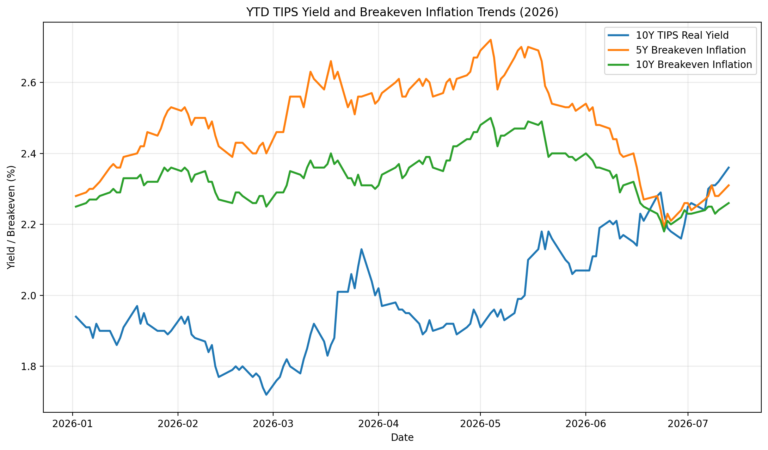
Five-year breakeven inflation—the difference between nominal and inflation-protected Treasury yields—rose to approximately 2.31%, from 2.21% on June 24. The increase indicates that investors are demanding more compensation for near-term inflation risk as oil and transportation costs rise.
TIPS, however, are unlikely to provide a clean outright rally while real yields are also increasing. Official Treasury data showed the 10-year real yield rising to 2.37% on July 21, from 2.31% on July 17. Because TIPS remain duration-sensitive bonds, higher real yields can push their prices lower even when inflation expectations are rising.
That tension makes Thursday’s $21 billion 10-year TIPS auction an important test of investor demand. Strong bidding would suggest investors are willing to lock in historically attractive inflation-adjusted yields while adding protection against an extended oil shock. Weak demand would reinforce concerns that rising real rates and heavy Treasury supply are overwhelming the appeal of inflation protection.
The auction may also help distinguish between short- and long-term inflation concerns. The oil shock has had a more visible effect on shorter-dated breakevens, while longer-term inflation expectations remain comparatively contained. That suggests investors still believe the Fed can prevent the energy shock from becoming permanently embedded in wages and broader prices.
Jobless Claims Could Temper—or Extend—the Selloff
The next domestic catalyst is the weekly unemployment-claims report, scheduled for 8:30 a.m. Eastern. A materially weaker labor-market reading could provide some support for Treasuries by reviving concerns about economic growth. Another low claims number would reinforce the view that the economy can withstand higher rates and leave the bond market focused primarily on oil and inflation.
For fixed-income investors, the near-term environment favors caution on long-duration nominal bonds. Short-term Treasuries continue to offer substantial income with limited price sensitivity, while short-duration TIPS provide more direct exposure to realized inflation without assuming as much real-yield risk as longer-maturity inflation-linked securities.
The central message from Thursday morning’s market is that geopolitical escalation is no longer producing a simple flight to safety. Oil near $100 is reviving the stagflation trade: higher inflation compensation, higher real yields and growing doubt that the Fed can ease policy soon.
