
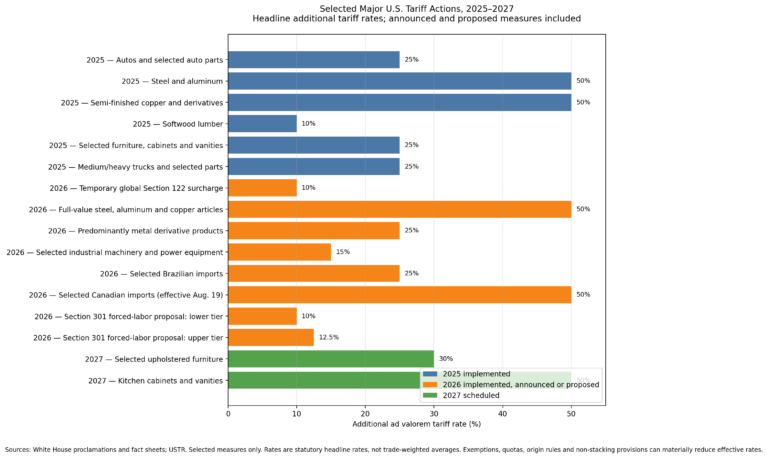
The Trump administration is accelerating its use of targeted tariffs, replacing the broad emergency trade measures of 2025 with a more fragmented system of country- and sector-specific duties.
The latest action imposes additional 50% tariffs on selected Canadian products, including some food, beverage, furniture, construction and consumer-goods categories. The duties are scheduled to take effect August 19 and will apply even when products would otherwise qualify for duty-free treatment under the U.S.-Mexico-Canada Agreement.
Energy, critical minerals and products already subject to separate national-security tariffs are excluded. The White House said the measures were a response to Canadian retaliation against earlier U.S. tariffs.
The administration relied on Section 338 of the Tariff Act of 1930, which permits duties of as much as 50% against countries judged to discriminate against U.S. commerce. Its use signals that the White House is searching for new legal tools after the Supreme Court limited its ability to impose sweeping tariffs under emergency-powers legislation.
The Canadian action follows new 25% tariffs on selected Brazilian imports, including machinery, furniture and some agricultural products. Politically sensitive goods with few domestic substitutes, including coffee, beef and aircraft components, received exemptions.
That selective approach reflects the administration’s broader challenge: using tariffs as trade leverage while limiting their effect on household costs and inflation.
From Global Tariffs to a Layered System
The current U.S. tariff regime is no longer built around one universal policy. It now combines several legal authorities.
A temporary 10% global import surcharge under Section 122 remains in effect but is scheduled to expire unless Congress extends it. Durable national-security tariffs under Section 232 continue to cover automobiles, steel, aluminum, copper and other industrial products. Section 301 actions target foreign trade practices, while Section 338 is now being used for direct country retaliation.
Many of the largest 2025 sector tariffs remain intact. Imported vehicles and selected auto parts generally face additional duties of 25%. Steel and aluminum tariffs were increased to 50%, while selected copper products also face 50% rates. Lumber, furniture, cabinets and heavy trucks are subject to additional duties ranging from 10% to 25%.
The administration is also considering a broader next phase. U.S. trade officials have proposed new Section 301 tariffs of roughly 10% to 12.5% on imports from dozens of countries, based partly on forced-labor and industrial-policy concerns.
Inflation and Investment Implications
The tariff burden remains below its 2025 peak, but it is beginning to rise again.
The direct beneficiaries are domestic producers competing with tariffed imports, particularly in metals and selected industrial industries. The costs fall more heavily on automakers, homebuilders, retailers, manufacturers and infrastructure developers that rely on imported materials or components.
The inflation effect may be narrower than under a universal tariff, but targeted duties can still raise prices for furniture, building materials, vehicles, machinery and consumer products. Companies may pass those costs to customers, absorb them through lower margins or alter supply chains.
The largest economic risk may be uncertainty rather than the headline tariff rate. Frequent changes in exemptions, effective dates, country treatment and product classifications can delay investment and complicate corporate planning.
The United States is therefore not abandoning tariffs after the legal setbacks of early 2026. It is rebuilding the tariff wall using older, more specific statutes. The result is a regime that is less uniform, more complicated and potentially more durable.
Sources
- White House: Proclamation imposing an additional 50% tariff on selected Canadian products beginning August 19, 2026, under Section 338 of the Tariff Act of 1930.
- Reuters: Reporting on the scope of the Canadian action, its roughly $20 billion trade exposure and its application outside normal USMCA preferences.
- White House: February 2026 proclamation imposing a temporary 10% global import surcharge under Section 122 for 150 days.
- U.S. Trade Representative: Proposed Section 301 tariffs of 10% or 12.5% on imports from 60 trading partners tied to forced-labor enforcement practices.
- Reuters: Reporting on new 25% tariffs covering selected Brazilian imports and exemptions for several important consumer and industrial products.
- U.S. Supreme Court: Learning Resources, Inc. v. Trump, holding that the International Emergency Economic Powers Act does not authorize presidential tariffs.
- White House: Section 232 tariff actions covering automobiles and auto parts at 25% and steel and aluminum at 50%.
- Reuters: Reporting that additional tariffs on dozens of countries could follow as the temporary global surcharge approaches expiration.
