Fixed Income Outlook
Markets Are Already Pricing the Next Move—The Bigger Question Is Whether the Fed Delivers
July 8, 2026
One of the biggest mistakes fixed income investors can make is focusing solely on what the Federal Reserve might do next. Treasury yields and bond prices are driven just as much by what the market has already priced into interest-rate expectations as by the Fed’s ultimate decision.
Following today’s release of the June FOMC minutes, the message from policymakers remains consistent: inflation is moving in the right direction but has not yet been fully defeated, leaving the Committee unwilling to commit to either rate cuts or additional tightening. The minutes reinforced a data-dependent approach while offering little new forward guidance on the timing of future policy moves.
What Is the Market Already Pricing In?
Fed Funds futures continue to signal that investors expect the Federal Reserve to leave interest rates unchanged at the July meeting, with the overwhelming majority of market pricing favoring another pause. More importantly, futures markets continue to imply that any eventual easing cycle is expected to be gradual rather than aggressive, reflecting confidence that inflation will continue moderating but remain above the Fed’s 2% target for some time.
For bond investors, that distinction matters.
If the market is already pricing one or two modest rate cuts over the next year, those expectations are largely embedded in Treasury yields today. Unless incoming inflation or employment data deteriorate materially, there may be limited room for long-duration Treasury prices to rally simply because the Fed eventually delivers those anticipated cuts.
Conversely, the greatest risk to the bond market may be that inflation proves more persistent than investors expect. In that scenario, the Fed could delay easing—or even keep the door open to additional tightening—forcing markets to reprice higher policy rates for longer.
What Does This Mean for Fixed Income?
Today’s Treasury market reflects a fairly balanced outlook. Investors are no longer expecting an aggressive easing cycle, nor are they positioning for a significant new tightening campaign. Instead, yields suggest a growing consensus that policy rates will remain restrictive for longer before gradually moving lower.
That environment continues to favor:
- Investment-grade corporate bonds, which offer attractive income while credit fundamentals remain healthy.
- Ultrashort Treasury ETFs, where investors can continue capturing elevated yields with limited duration risk.
- Intermediate-duration bond funds, which provide attractive carry without taking excessive interest-rate exposure.
Long-duration Treasury ETFs, however, remain the most sensitive segment of the market. Unless inflation falls faster than expected, duration volatility is likely to persist.
Warsh Changes the Conversation More Than the Outcome
Markets also continue to digest President Trump’s nomination of former Federal Reserve Governor Kevin Warsh to become the next Fed Chair. While Warsh has generally been viewed as supportive of lower interest rates over time, investors should remember that the Chair is one vote among twelve on the Federal Open Market Committee.
His greatest influence may come through leadership, communication, and consensus building rather than dramatically changing the direction of monetary policy. Given his experience navigating both the 2008 financial crisis and financial markets, Warsh is widely expected to serve as a pragmatic voice capable of bridging the Committee’s hawkish and dovish factions.
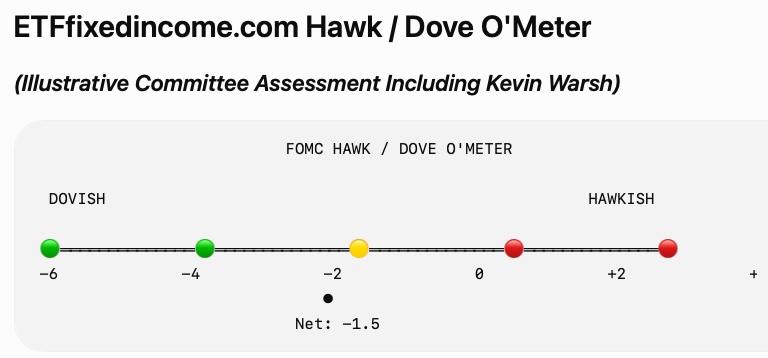
ETFfixedincome.com Hawk / Dove O’Meter
(Illustrative Committee Assessment Including Kevin Warsh)
                          FOMC HAWK / DOVE O'METER

 DOVISH                                                   HAWKISH

🟢══════════════🟢══════════════🟡══════════════🔴══════════════🔴
-6             -4             -2              0             +2             +4             +6
                              ●
                           Net: -1.5
How to Read the Meter
🟢 Green (-6 to -2): Dovish policy bias favoring lower interest rates and supporting economic growth.
🟡 Yellow (-2 to +2): Neutral or balanced Committee, allowing incoming inflation, employment, and growth data to determine policy.
🔴 Red (+2 to +6): Hawkish policy bias emphasizing inflation control and tighter monetary policy.
⚫ Black Dot: Illustrative estimate of the overall voting bias of the 12-member FOMC, including Kevin Warsh.
Current Reading: –1.5 — Mildly Dovish, Near Equilibrium
Bottom Line
The bond market appears appropriately priced for today’s policy outlook. Investors are expecting a prolonged pause followed by a gradual easing cycle—not a rapid series of rate cuts. As a result, the next major move in Treasury yields will likely depend less on the Fed’s rhetoric and more on whether inflation and labor market data evolve differently from what markets already expect.
For fixed income investors, the emphasis should remain on earning attractive carry while maintaining diversified duration exposure, rather than positioning aggressively for a policy pivot that is already substantially reflected in current bond prices.