
Executive Summary
The ETFFI Alternative Credit Strategy is a diversified fixed-income allocation designed to produce competitive income and total return while reducing reliance on the two dominant risks embedded in conventional corporate-bond portfolios: high-yield spread exposure and longer-duration investment-grade credit.
The strategy combines high-yield bonds, short-maturity BBB credit, publicly traded alternative-credit exposures, short-duration investment-grade corporate bonds, and a small Treasury liquidity reserve. Its quarterly allocation process uses macroeconomic, credit, duration, inflation, breadth, and defensive indicators to determine whether portfolio adjustments are justified.
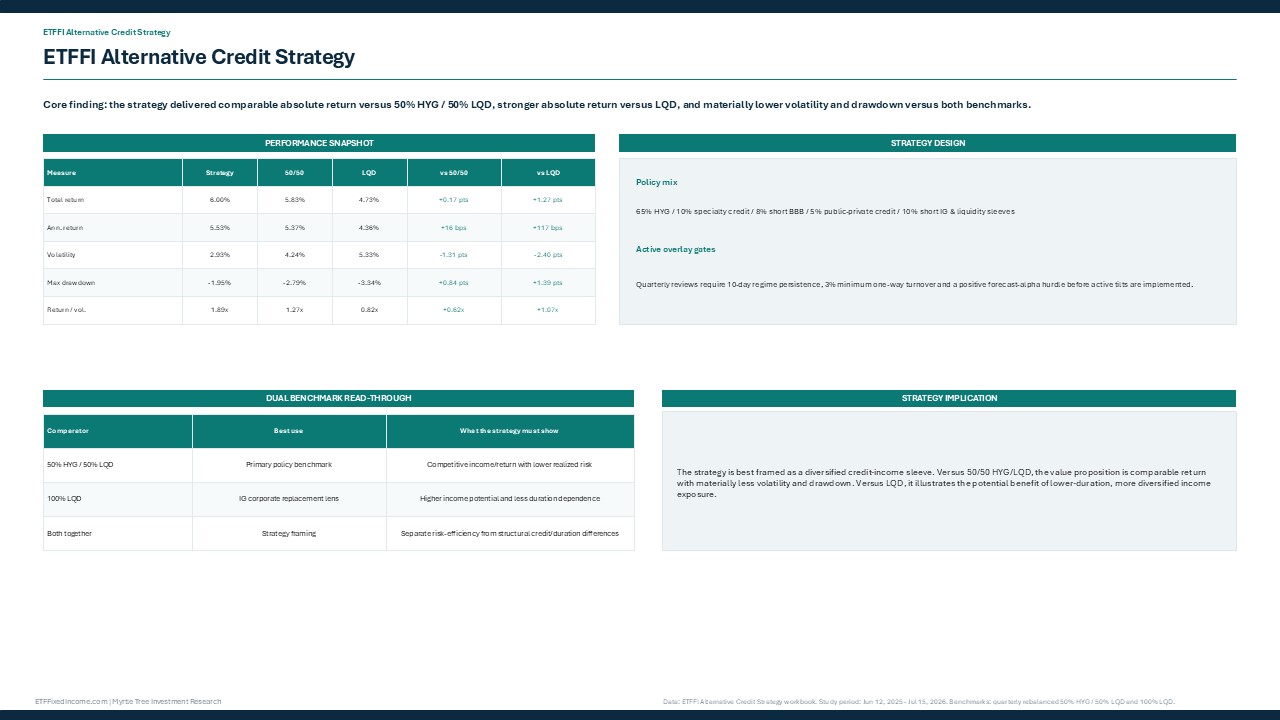
The strategy should not currently be presented as a high-alpha or high-turnover tactical model. Its strongest historical result is risk efficiency: during the available actual-fund test period, it generated returns comparable to a 50% HYG/50% LQD benchmark with materially lower volatility and a shallower drawdown.
The strategy also outperformed LQD on an absolute and risk-adjusted basis. That comparison illustrates the potential advantages of replacing a portion of a traditional investment-grade corporate allocation with a broader, lower-duration credit mix. It should not, however, imply that the strategy and LQD have identical credit quality, duration, or portfolio use cases.
Strategy Objective
The ETFFI Alternative Credit Strategy seeks to:
- Generate competitive income from multiple corporate- and alternative-credit segments.
- Produce total returns comparable to a blended high-yield and investment-grade corporate benchmark.
- Reduce interest-rate sensitivity relative to a traditional investment-grade corporate allocation.
- Lower portfolio volatility and drawdown through credit-segment and maturity diversification.
- Use macro and market signals to control risk without creating excessive turnover.
- Avoid dependence on any single credit structure, issuer type, or duration exposure.
The strategy is best positioned as a diversified credit-income allocation rather than a replacement for cash, Treasuries, or a complete core fixed-income portfolio.
Portfolio Construction
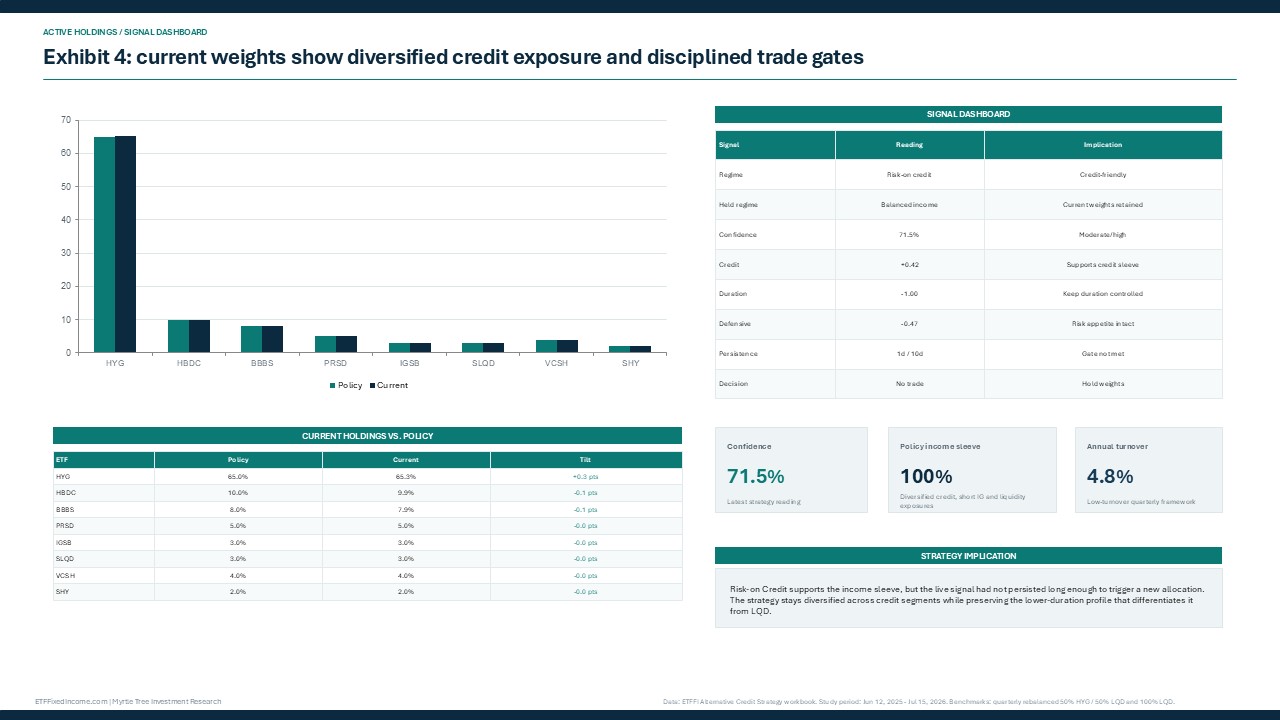
The strategy’s policy allocation is diversified across eight exchange-traded funds:
| Exposure | Policy Weight | Portfolio Role |
| HYG | 65% | Primary high-yield corporate-credit and income sleeve |
| HBDC | 10% | BDC-issued corporate-bond exposure |
| BBBS | 8% | Short-maturity BBB corporate credit |
| PRSD | 5% | Short-duration public and private investment-grade credit |
| VCSH | 4% | Broad short-term corporate credit |
| IGSB | 3% | Broad short-duration investment-grade credit |
| SLQD | 3% | Low-duration investment-grade corporate exposure |
| SHY | 2% | Treasury liquidity and defensive reserve |
| Total | 100% |
The portfolio retains a meaningful high-yield allocation as its primary return and income engine. The remaining allocation is spread across several shorter-duration and specialized credit segments instead of relying on one large LQD position.
This construction is intended to diversify the sources of portfolio income and reduce sensitivity to a single interest-rate or credit-spread outcome.
Strategic Rationale
A conventional 50% HYG/50% LQD portfolio combines two distinct but concentrated sources of risk.
HYG contributes high-yield credit-spread risk and sensitivity to the corporate default cycle. LQD contributes investment-grade corporate exposure but also carries considerably more interest-rate duration. The combination can produce attractive income, but its return path remains dependent on both credit conditions and changes in longer-term Treasury yields.
The ETFFI Alternative Credit Strategy retains credit-market participation while replacing most of the benchmark’s longer-duration investment-grade exposure with a broader collection of shorter-duration credit instruments.
Potential benefits include:
Broader credit diversification
The strategy distributes exposure across high yield, BBB corporate bonds, BDC-issued bonds, public and private investment-grade credit, short-term corporate bonds, and Treasury securities.
These exposures remain influenced by common economic and credit-market conditions, but they do not have identical duration, liquidity, issuer, or spread characteristics.
Lower interest-rate sensitivity
Most of the strategy’s non-high-yield holdings emphasize shorter maturities or lower effective duration. This may reduce losses when Treasury yields rise or when the yield curve reprices higher.
Lower duration also means the strategy may retain more of its income return during periods when longer-duration corporate bonds experience mark-to-market losses.
Multiple sources of income
The portfolio is not dependent exclusively on the yield offered by broad high-yield bonds or traditional investment-grade corporates. Its income is generated across several credit structures and maturity segments.
Improved risk efficiency
The strategy’s historical advantage has come primarily from delivering competitive absolute returns with less realized volatility and shallower drawdowns—not from producing large raw-return alpha.
Dual-Benchmark Framework
The strategy should be evaluated against two benchmarks because each comparison answers a different portfolio question.
Primary benchmark: 50% HYG / 50% LQD
The blended benchmark is the more appropriate test of the strategy’s overall credit-income mandate.
It challenges a diversified credit portfolio to produce returns and income comparable to a balanced high-yield and investment-grade corporate allocation while taking less risk.
Against this benchmark, the strategy’s primary value proposition is lower volatility, shallower drawdown, and broader exposure.
Secondary benchmark: 100% LQD
LQD is useful when evaluating the strategy as a potential alternative to part of a traditional investment-grade corporate allocation.
Can an investor increase income potential and reduce duration by reallocating from conventional investment-grade corporate bonds into a diversified credit strategy?
The comparison is informative, but it is not completely like-for-like. The ETFFI Alternative Credit Strategy carries more credit-spread and high-yield risk than LQD, while LQD has higher average credit quality and greater potential to benefit from a major duration rally. However, in environments where duration risk is primary, the model offers advantages from diversified sources of credit income.
Performance Snapshot
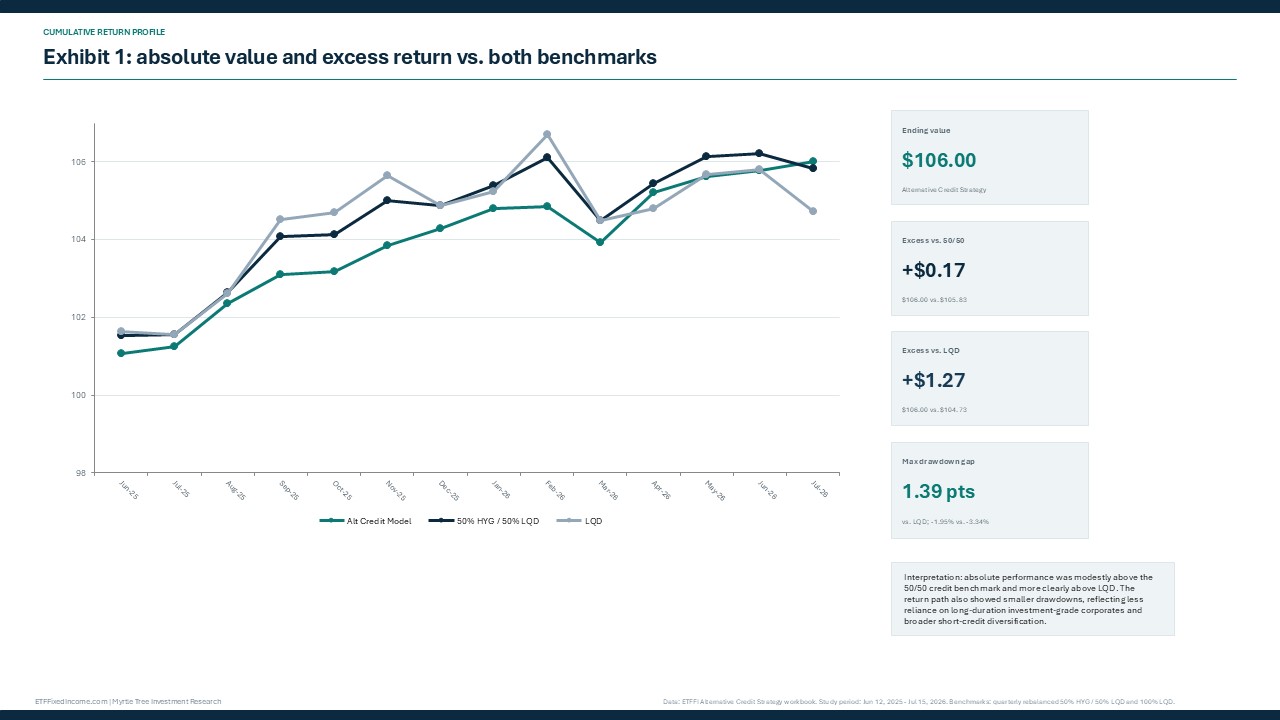
The backtest covers June 12, 2025 through July 15, 2026:
| Measure | ETFFI Alternative Credit Strategy | 50% HYG / 50% LQD | 100% LQD |
| Total return | 6.00% | 5.83% | 4.73% |
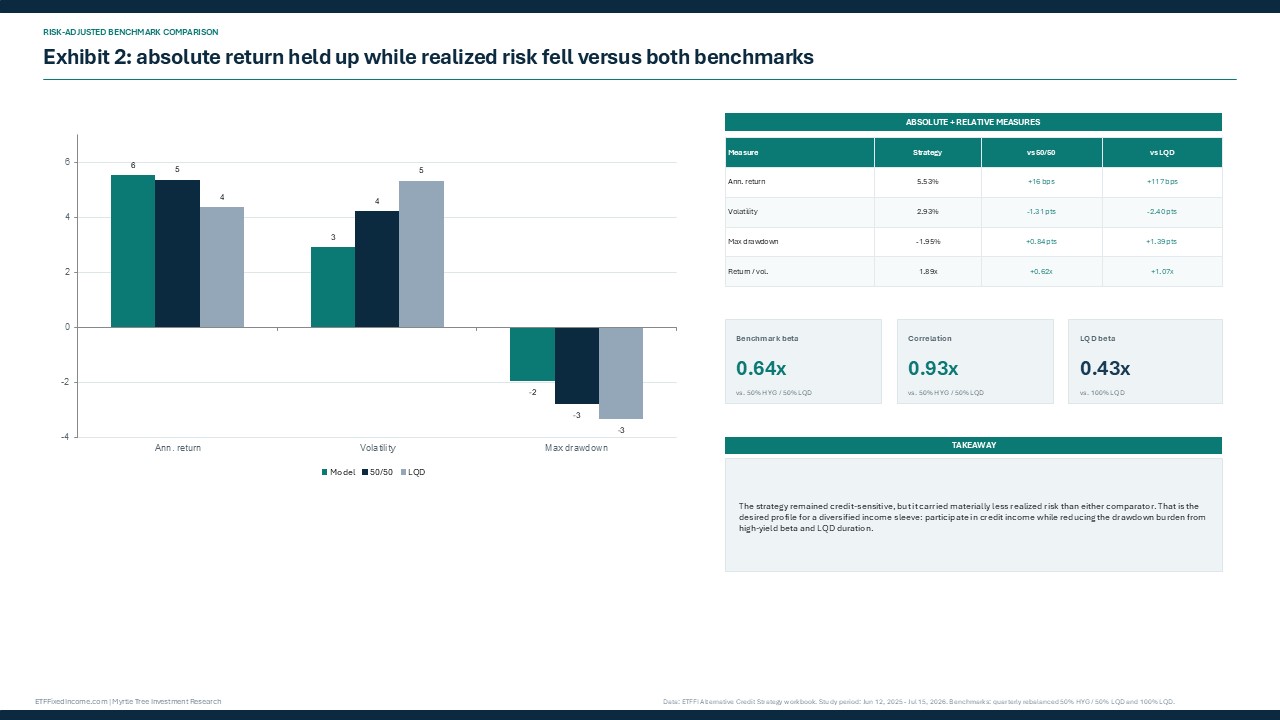
| Annualized return | 5.53% | 5.37% | 4.36% |
| Annualized volatility | 2.93% | 4.24% | 5.33% |
| Maximum drawdown | (1.95%) | (2.79%) | (3.34%) |
| Return-to-volatility ratio | 1.89x | 1.27x | 0.82x |
| Positive months | 13 of 14 | 11 of 14 | 10 of 14 |
Results relative to 50% HYG / 50% LQD
The strategy produced:
- 0.17 percentage point more cumulative return.
- Approximately 16 basis points of annualized excess return.
- Approximately 31% lower annualized volatility.
- A maximum drawdown approximately 0.84 percentage point shallower.
- A drawdown roughly 30% smaller in relative terms.
- More positive months during the test period.
The return advantage is too small and the test period too short to support a meaningful alpha claim. The more important result is that the strategy produced approximately the same return with substantially less realized risk.
Results relative to LQD
The strategy produced:
- 1.27 percentage points more cumulative return.
- Approximately 117 basis points of annualized excess return.
- Approximately 45% lower annualized volatility.
- A maximum drawdown approximately 1.39 percentage points shallower.
- A materially stronger return-to-volatility ratio.
These results illustrate the potential benefit of reducing duration and broadening the sources of credit income. They also reflect a favorable environment for the strategy’s structural allocation; they should not be interpreted as proof that the strategy will outperform LQD in every market regime.
Active Risk-Control Framework
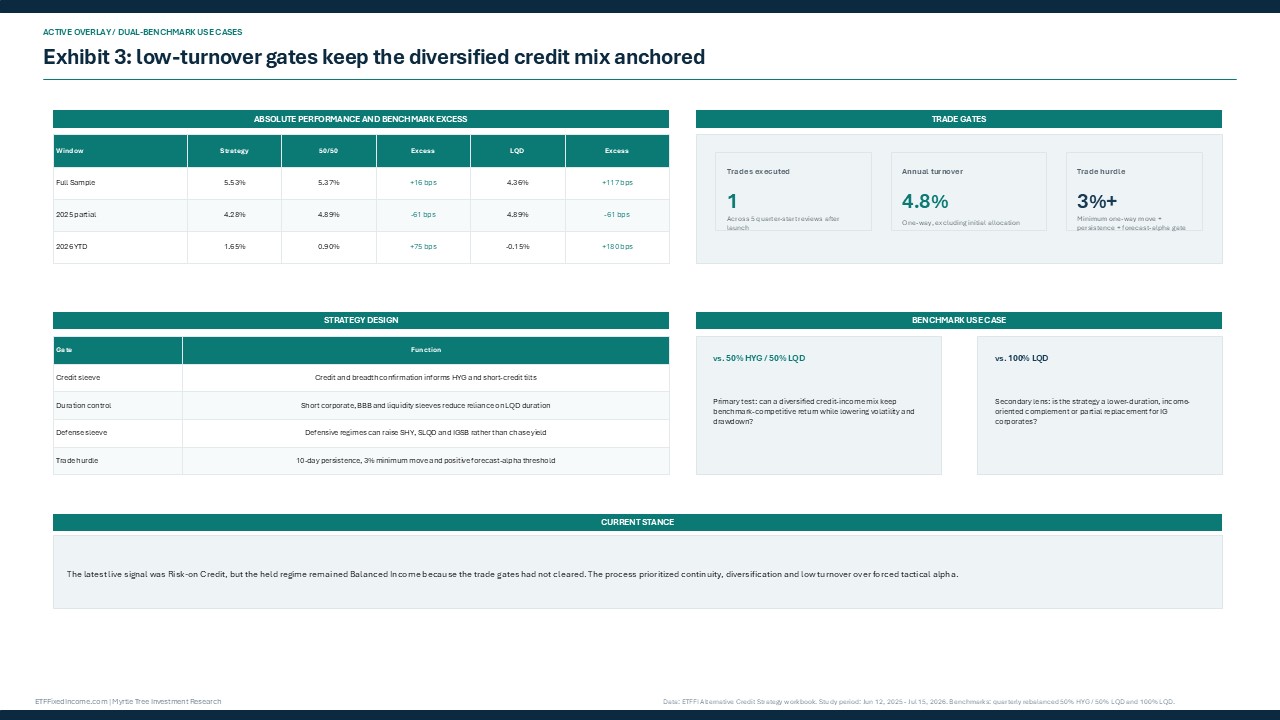
The strategy is reviewed at quarterly decision points using the most recently available macro and market signals.
The signal framework evaluates:
- Credit conditions.
- Interest-rate duration.
- Inflation pressure.
- Defensive demand.
- Market breadth.
- Floating-rate preference.
- Overall signal confidence.
A proposed allocation change must satisfy several trade controls:
- The new regime must persist for at least 10 trading days.
- The proposed allocation must require at least a 3% one-way portfolio change.
- Forecast excess return must exceed a 10-basis-point hurdle after applying the model’s shrink factor.
- Trades must be consistent with the broader credit and duration signal framework.
These controls are intended to reduce false signals and unnecessary turnover.
The active overlay should be understood primarily as a risk-management mechanism. The current sample does not demonstrate that the quarterly overlay independently generated substantial alpha. Its value lies in creating a disciplined process for reducing or reallocating risk when macro and credit conditions materially deteriorate.
Portfolio Use Cases
Diversified income allocation
The strategy may suit investors seeking corporate-credit income without relying exclusively on either high-yield bonds or longer-duration investment-grade corporates.
Core-plus fixed income
The portfolio can serve as a return-seeking credit sleeve alongside Treasuries, core bonds, or other defensive fixed-income holdings.
Partial LQD replacement
The strategy may replace a portion of an investment-grade corporate allocation when the investor is willing to accept additional spread risk in exchange for lower duration and potentially higher income.
It should not automatically replace an entire LQD allocation for investors who require high average credit quality, meaningful duration, or liability-matching characteristics.
Lower-risk alternative to a blended credit benchmark
The strategy may also suit investors seeking the income and return profile of a blended HYG/LQD portfolio with a smoother historical return path and reduced drawdown.
Total-portfolio risk budgeting
By generating competitive return with lower realized volatility, the strategy may consume less of an investor’s overall risk budget. This can provide greater flexibility when combining fixed income with equities, commodities, real assets, or other return-seeking allocations.
Conditions That May Favor the Strategy
The strategy may be relatively well positioned when:
- Credit conditions remain stable or improve.
- Corporate defaults remain contained.
- Shorter-duration credit offers attractive income.
- Treasury yields rise or remain volatile.
- The yield curve reprices higher.
- Investors seek income but remain cautious about duration.
- Credit dispersion creates opportunities across different fixed-income segments.
Conditions That May Challenge the Strategy
The strategy may underperform when:
- Credit spreads widen materially.
- Defaults and downgrades accelerate.
- Economic growth contracts sharply.
- Liquidity deteriorates across corporate-credit markets.
- Longer-duration Treasury yields fall rapidly.
- LQD benefits from a major duration rally.
- Investors rotate aggressively toward government bonds and higher-quality investment-grade securities.
The portfolio’s diversification can reduce concentration, but it does not eliminate systemic credit risk. Most holdings remain exposed to corporate financing conditions and investor risk appetite.
Risks and Limitations
The strategy’s backtest is based on a limited actual-fund history beginning June 12, 2025. The period does not include a complete economic cycle, a severe recession, or a prolonged private-credit stress event.
Several exposures are relatively new or have shorter live histories than established bond indexes. Their early trading behavior may not represent future liquidity, volatility, or correlation patterns.
The strategy also carries materially more credit risk than a traditional Treasury or core investment-grade portfolio. Its lower duration should not be confused with capital protection.
Backtested results are hypothetical and may differ from live performance because of transaction costs, bid-ask spreads, taxes, market impact, implementation timing, index changes, and future signal behavior.
Conclusion
The ETFFI Alternative Credit Strategy is designed to broaden the sources of fixed-income income while reducing duration concentration and improving portfolio risk efficiency.
Against a 50% HYG/50% LQD benchmark, the strategy’s advantage is not substantial raw-return alpha. Its more credible proposition is competitive absolute return with lower volatility, a shallower drawdown, and a more diversified credit structure.
Against LQD, the strategy demonstrates the potential benefits of lower duration and greater income participation. That comparison is most useful when evaluating the strategy as an enhanced-income alternative to part of an investment-grade corporate allocation.
The strategy is therefore best described as:
A diversified credit-income strategy seeking benchmark-competitive returns with lower duration, reduced volatility, shallower drawdowns, and disciplined quarterly risk management.
Data and Methodology
Performance calculations are based on daily total-return data for the strategy’s underlying ETFs. The primary benchmark is a 50% HYG/50% LQD portfolio rebalanced quarterly. LQD is included as a secondary comparator.
The strategy uses quarterly decision points, prior-day signals, a 10-day regime-persistence requirement, a 3% minimum one-way trade threshold, a forecast-alpha hurdle, and estimated transaction costs.
The policy allocation and signal framework are contained in the ETFFI Alternative Credit Strategy updateable workbook.
Disclaimer: This material is for informational and research purposes only and does not constitute investment advice, an offer to sell, or a solicitation to buy any security. Backtested performance is hypothetical, does not represent actual client results, and is subject to limitations. Past performance does not guarantee future results. Fixed-income investments are subject to interest-rate, credit, liquidity, default, spread, and market risks. Investors should evaluate their objectives, risk tolerance, liquidity needs, and tax circumstances before making an investment decision.