
The traditional fixed income allocation often forces investors into an uncomfortable trade-off. A broad investment-grade bond portfolio can provide diversification and income, but it may carry substantial interest-rate risk. Adding high-yield bonds can improve income and return potential, but it also introduces greater sensitivity to the economic cycle and credit markets.
The ETFFI 5-Spot Model is designed to address that trade-off through a more flexible allocation across five distinct fixed income exposures:
- SGOV: Ultra-short U.S. Treasury bills
- TLT: Long-term U.S. Treasuries
- LQD: Investment-grade corporate bonds
- SRLN: Senior floating-rate loans
- HYG: High-yield corporate bonds
Rather than relying on a permanent allocation to duration or credit risk, the strategy combines a defensive strategic portfolio with a disciplined active overlay informed by the ETFFI Core Aggressive Model’s macro, credit and market-positioning signals.
The objective is straightforward: generate better risk-adjusted returns than a balanced core-and-credit bond portfolio while limiting drawdowns, volatility and unnecessary turnover.
A More Relevant Fixed Income Benchmark
The ETFFI 5-Spot Model is benchmarked against a portfolio invested:
- 50% in the iShares Core U.S. Aggregate Bond ETF (AGG)
- 50% in the iShares iBoxx High Yield Corporate Bond ETF (HYG)
The benchmark is rebalanced quarterly.
This blend is a more demanding comparison than AGG alone. AGG represents the traditional investment-grade bond market, while HYG adds a meaningful allocation to credit risk and income. Together, the two funds create a straightforward balanced fixed income portfolio with exposure to both interest rates and corporate credit conditions.
The ETFFI 5-Spot Model is not simply trying to outperform a low-risk bond index. It is being evaluated against a portfolio that already includes a substantial return-seeking credit allocation.
The Strategic Foundation
The model begins with a defensive policy portfolio:
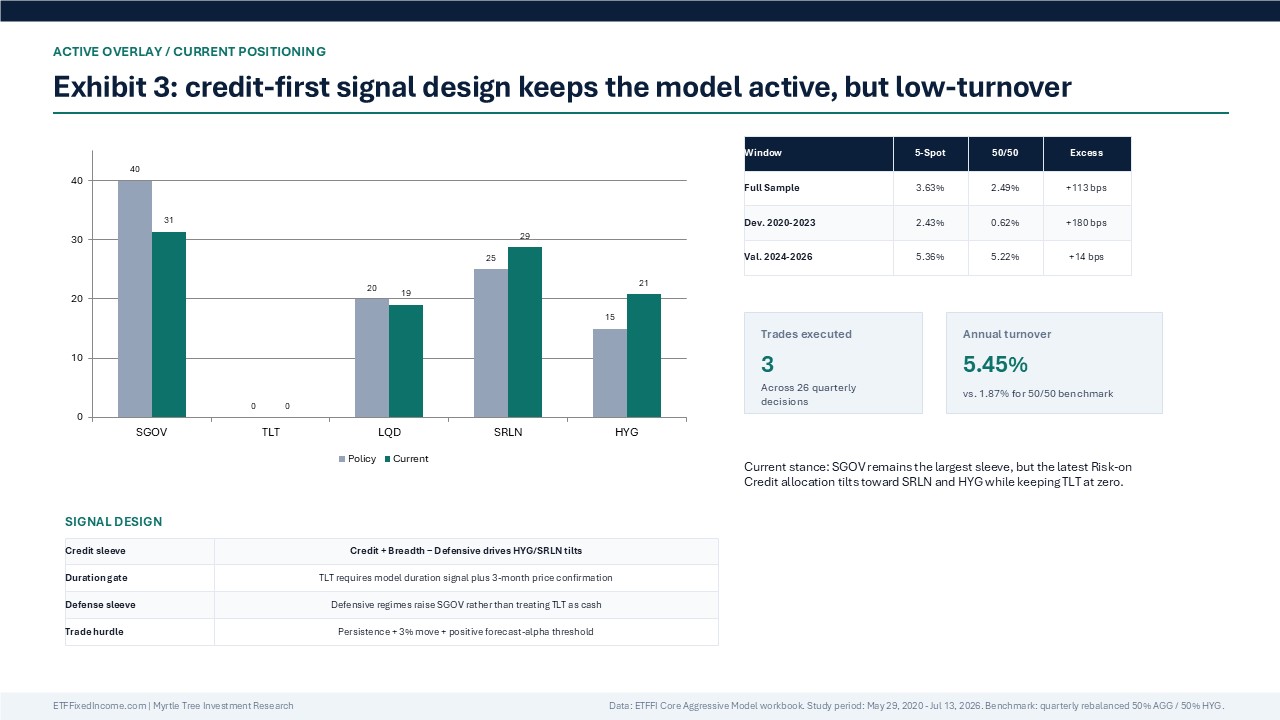
| ETF | Policy weight | Strategic role |
| SGOV | 40% | Liquidity, income and drawdown control |
| TLT | 0% | Conditional long-duration exposure |
| LQD | 20% | Investment-grade corporate income |
| SRLN | 25% | Floating-rate income and reduced duration risk |
| HYG | 15% | Selective high-yield credit exposure |
This starting allocation is intentionally different from a conventional aggregate bond portfolio.
The large SGOV allocation provides liquidity and limits sensitivity to rising interest rates. SRLN adds income through floating-rate loans whose coupons can adjust with short-term rates. LQD provides a core investment-grade credit allocation, while HYG supplies a measured amount of higher-yielding credit exposure.
TLT has no permanent policy weight. Long-term Treasury exposure must earn its position through the model’s duration signals and market-price confirmation.
This structure means the portfolio is not dependent on declining interest rates to generate returns. It can collect income from Treasury bills, floating-rate loans and corporate credit while retaining the ability to add duration when conditions become favorable.
How the Active Overlay Works
The model evaluates conditions at the beginning of each calendar quarter using the prior trading day’s signals. Its active allocation decisions are organized into four independent sleeves.
Credit sleeve
The credit sleeve combines the model’s Credit, Breadth and Defensive indicators.
Improving credit conditions and healthy market breadth can increase allocations to HYG and SRLN. Deteriorating credit conditions shift capital toward SGOV and, to a lesser extent, LQD.
Credit is intended to be the strategy’s primary active alpha source.
Floating-rate sleeve
The floating-rate sleeve evaluates the interaction between inflation, duration and floating-rate conditions.
When inflation or short-term rate conditions favor floating-rate instruments, the model can increase SRLN while reducing exposure to fixed-rate bonds. When duration conditions improve, that preference can be reduced.
Defensive sleeve
A strong Defensive signal raises SGOV exposure and reduces economically sensitive credit positions.
Importantly, the model does not assume that every defensive environment should lead to a TLT overweight. During inflationary or rising-rate periods, ultra-short Treasuries may provide better defense than long-duration government bonds.
Duration sleeve
Positive Duration signals can increase TLT and LQD exposure, but only when long-duration Treasury performance confirms the model’s macro signal.
Before adding TLT, the strategy requires its trailing three-month total return to exceed both SGOV and LQD. This confirmation rule is intended to prevent the model from buying long-duration bonds simply because economic conditions appear defensive while Treasury yields are still rising.
Designed to Avoid False Trades
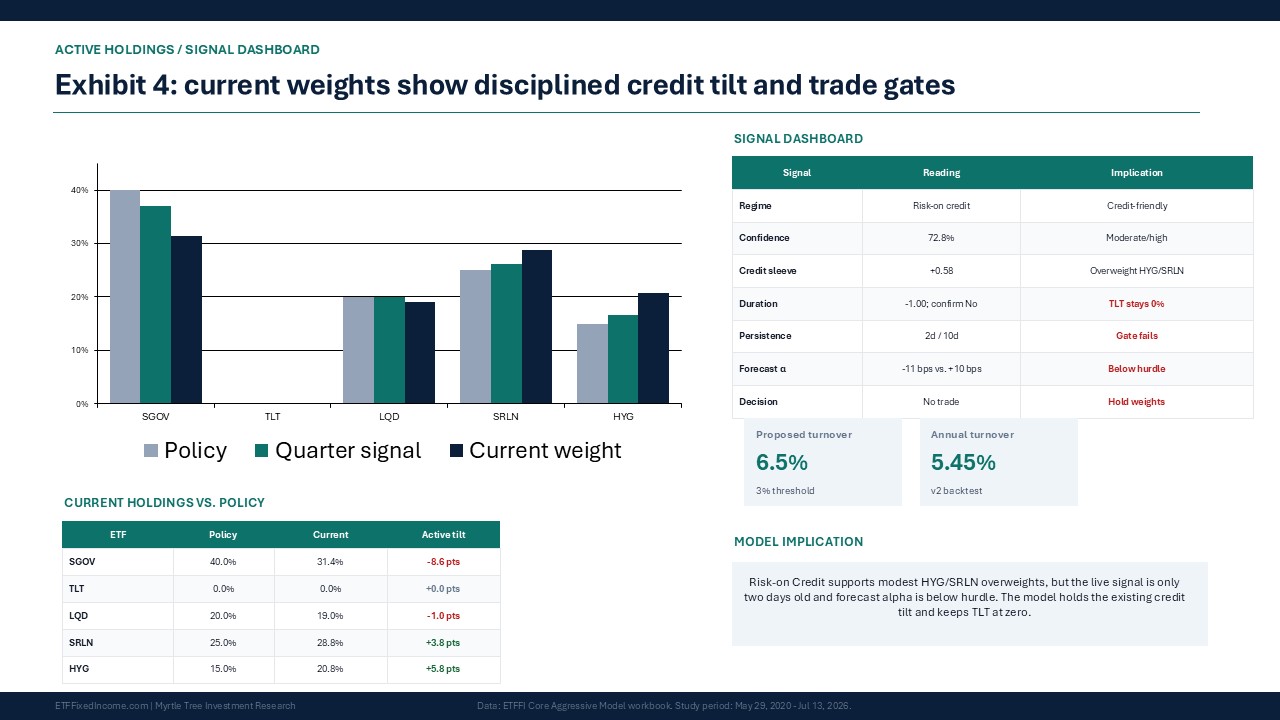
Quarterly evaluation does not necessarily produce quarterly trading.
A proposed allocation change must pass three tests:
- The model regime must have persisted for at least 10 trading days.
- The proposed one-way allocation change must be at least 3%.
- The estimated active-return opportunity must exceed the strategy’s forecast-alpha hurdle.
These rules are designed to reduce reactions to short-lived regime changes and avoid making small trades unlikely to overcome transaction costs or forecast uncertainty.
During the historical test, the strategy executed only three material active reallocations across 26 quarterly decision dates.
Historical Results
The following results cover the period from May 29, 2020 through July 13, 2026. The starting date reflects the available history for SGOV, the newest of the five required ETFs.
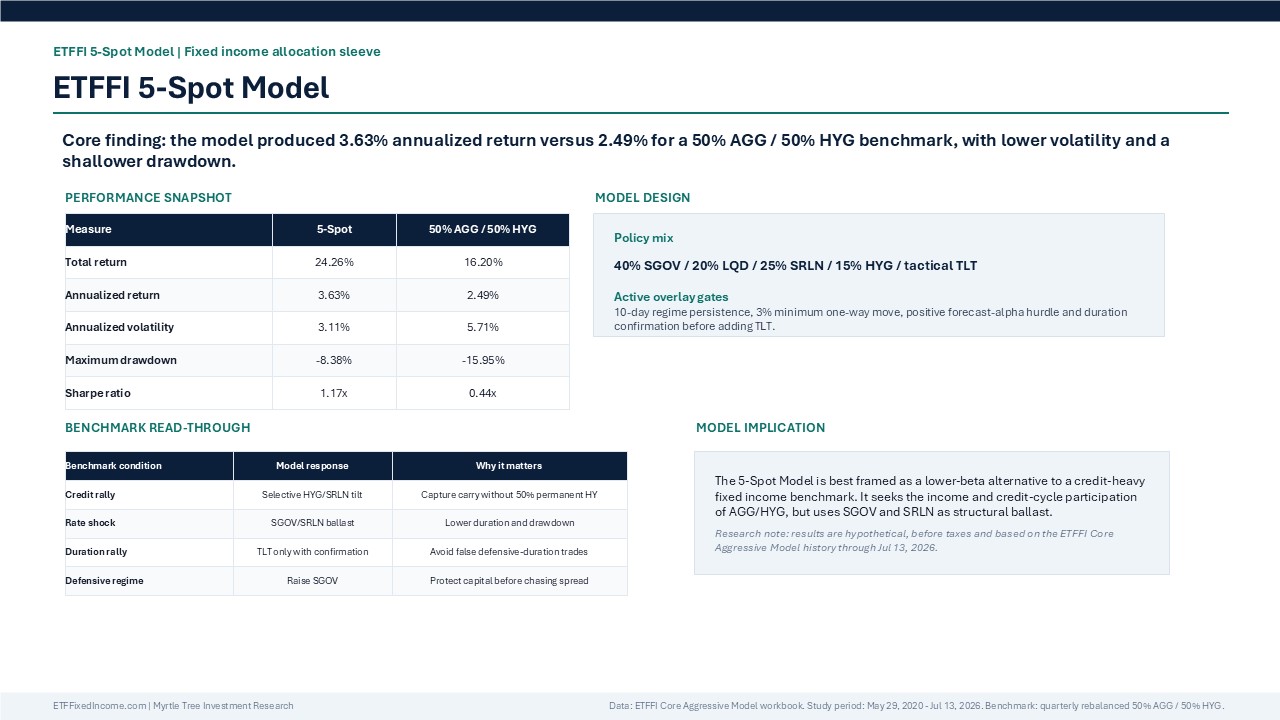
| Performance measure | ETFFI 5-Spot Model | 50% AGG / 50% HYG benchmark |
| Total return | 24.26% | 16.20% |
| Annualized return | 3.63% | 2.49% |
| Annualized excess return | +1.13 percentage points | — |
| Annualized volatility | 3.11% | 5.71% |
| Maximum drawdown | -8.38% | -15.95% |
| Sharpe ratio | 1.17 | 0.44 |
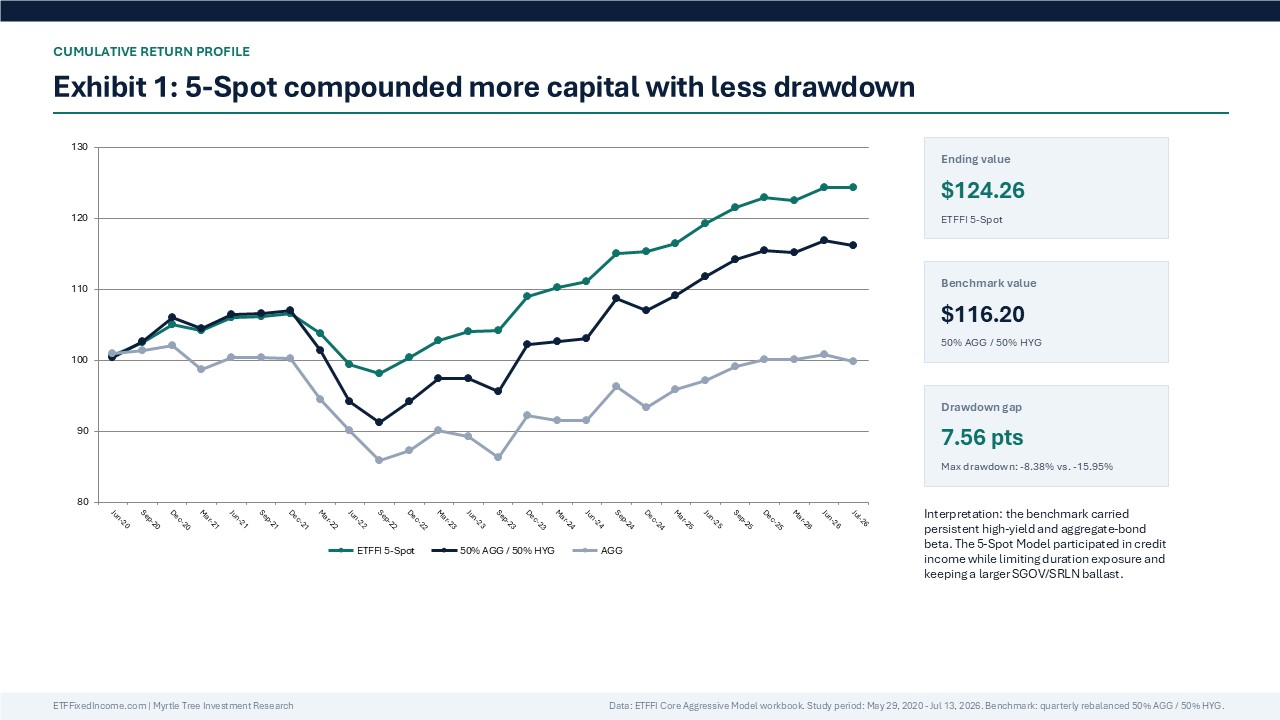
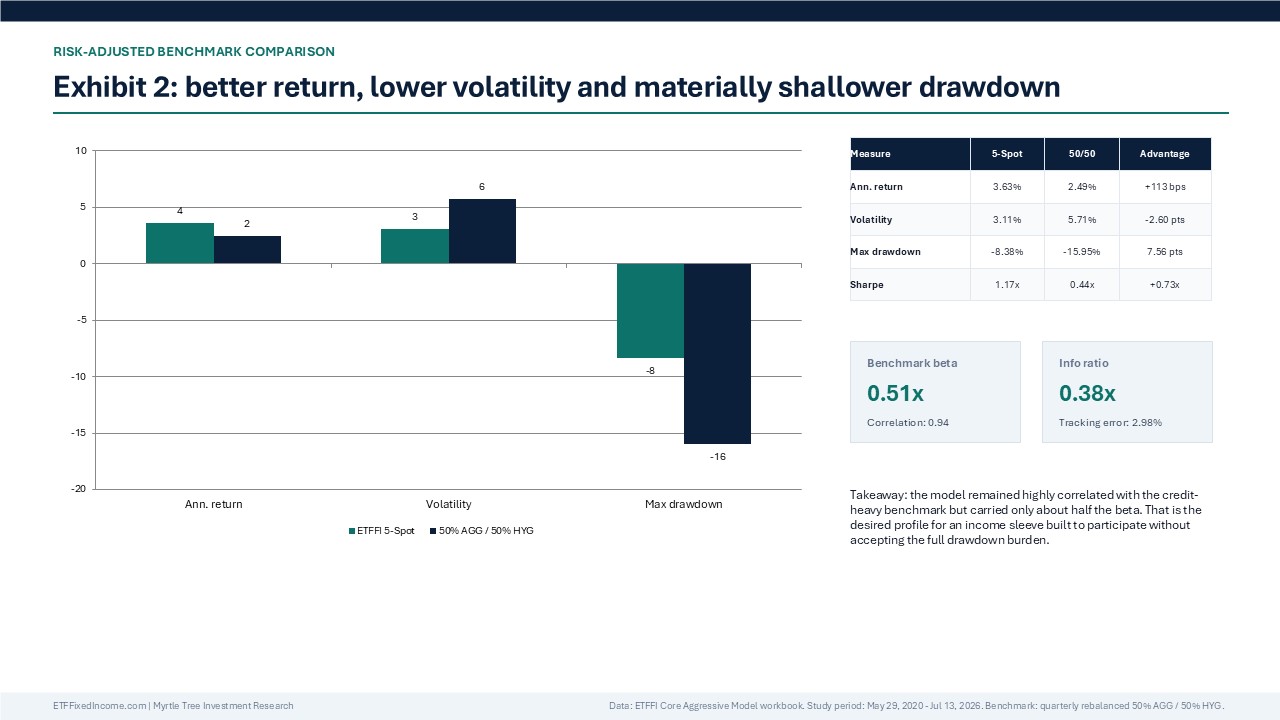
The model generated approximately 113 basis points of annualized excess return while experiencing about 46% less volatility than the benchmark.
Its maximum drawdown was also approximately half as large.
The two portfolios remained closely related, with a historical correlation of approximately 0.94. However, the model’s estimated beta to the benchmark was about 0.51, indicating that it participated in many of the same fixed income and credit-market trends with roughly half the benchmark’s daily market sensitivity.
Downside Protection Was the Main Differentiator
The strategy’s largest relative advantage occurred during the 2022 bond-market decline.
| Period | ETFFI 5-Spot Model | 50% AGG / 50% HYG | Excess return |
| 2020 partial year | 4.98% | 5.95% | -0.97% |
| 2021 | 1.57% | 0.97% | +0.59% |
| 2022 | -5.92% | -11.96% | +6.04% |
| 2023 | 8.64% | 8.57% | +0.07% |
| 2024 | 5.81% | 4.60% | +1.21% |
| 2025 | 6.55% | 7.90% | -1.35% |
| 2026 through July 13 | 1.14% | 0.68% | +0.45% |
The model outperformed in five of the seven calendar periods.
It can lag during strong, persistent credit rallies because it maintains more liquidity and less permanent high-yield exposure than the benchmark. That occurred during portions of 2020 and 2025.
Over the full test, however, the value of reducing losses during adverse markets more than compensated for lower participation during some risk-on periods.
Separating Policy Alpha from Active Alpha
Most of the model’s excess return versus the 50% AGG / 50% HYG benchmark came from its strategic portfolio construction.
The combination of SGOV, SRLN, LQD and a smaller permanent HYG allocation was better suited to the tested environment than a portfolio with 50% permanent exposure to AGG and 50% permanent exposure to high-yield bonds.
The active overlay added a smaller but positive incremental contribution. Relative to the same five-fund policy portfolio without tactical changes, the overlay added approximately 11 basis points of annualized return.
More importantly, the overlay improved volatility, maximum drawdown and the strategy’s Sharpe ratio. It also produced positive incremental alpha during both the 2020–2023 development period and the 2024–2026 validation period.
The overlay should therefore be viewed as a risk-management and allocation-enhancement process—not as the sole source of the strategy’s return advantage.
Where the Strategy May Fit
The ETFFI 5-Spot Model may be appropriate for investors seeking:
- A lower-volatility alternative to a traditional core-plus bond portfolio
- Fixed income exposure that is less dependent on falling interest rates
- A systematic way to adjust credit, duration and floating-rate exposure
- Higher income potential than a Treasury-only allocation
- More downside protection than a permanent aggregate-bond and high-yield blend
The strategy is not designed to maximize returns during every credit rally. Its larger liquidity allocation and selective approach to duration and high yield can cause it to trail more aggressive bond portfolios when risk assets advance without interruption.
Its objective is to produce a more consistent fixed income return profile across different rate, inflation and credit regimes.
The Strategic Takeaway
The ETFFI 5-Spot Model treats fixed income allocation as a dynamic balance among liquidity, duration, investment-grade credit, floating-rate income and high-yield risk.
Its historical advantage came from starting with a more resilient portfolio, avoiding uncompensated duration exposure, limiting permanent high-yield risk and requiring multiple forms of confirmation before changing positions.
The result was a strategy that historically generated more return than a 50% AGG / 50% HYG benchmark with substantially lower volatility and a meaningfully shallower drawdown.
The results presented are hypothetical and reflect a backtest using historical total-return data. The analysis includes an assumed transaction cost of 3 basis points per one-way traded dollar but does not include taxes, bid-ask spread variation, market impact or investor-specific expenses. Past performance does not guarantee future results. Consult an investment professional before making any investment decisions.