The Lead
Fixed income starts Friday with the rates market back under pressure ahead of the July payroll report. The 2-year Treasury rose to 4.24%, the 10-year climbed to 4.67%, and the 30-year moved back to 5.21%. The 10-year real yield rose to 2.43%, keeping the long end vulnerable even though oil is well below last week’s shock levels.
The key event is the 8:30 a.m. ET Employment Situation report. July 7 data shows consensus for 95K nonfarm payrolls, 82.5K private payrolls, 0.3% monthly wage growth, and a 4.2% unemployment rate. The BLS calendar confirms the July employment report is scheduled for release this morning. (Bureau of Labor Statistics)
Oil relief remains helpful but fragile. Reuters reported Friday that oil prices fell as investors weighed a potential temporary deal involving Iran and Gulf states around reopening the Strait of Hormuz, though geopolitical and shipping risks remain active. (Reuters)
The setup still favors an income-oriented allocation: collecting yield from ultrashort, floating-rate, short-duration, short-credit, municipal, and selective credit segments while keeping long-duration Treasury exposure tactical.
Rates Tape
| Rate | Latest | 1D Change | 1W Change |
| 2Y Treasury | 4.24% | +6.4 bp | +0.8 bp |
| 10Y Treasury | 4.67% | +4.9 bp | 0.0 bp |
| 30Y Treasury | 5.21% | +3.9 bp | +0.3 bp |
| 2s10s Curve | 42.2 bp | -1.5 bp | -0.7 bp |
| 5s30s Curve | 82.5 bp | -2.2 bp | -0.5 bp |
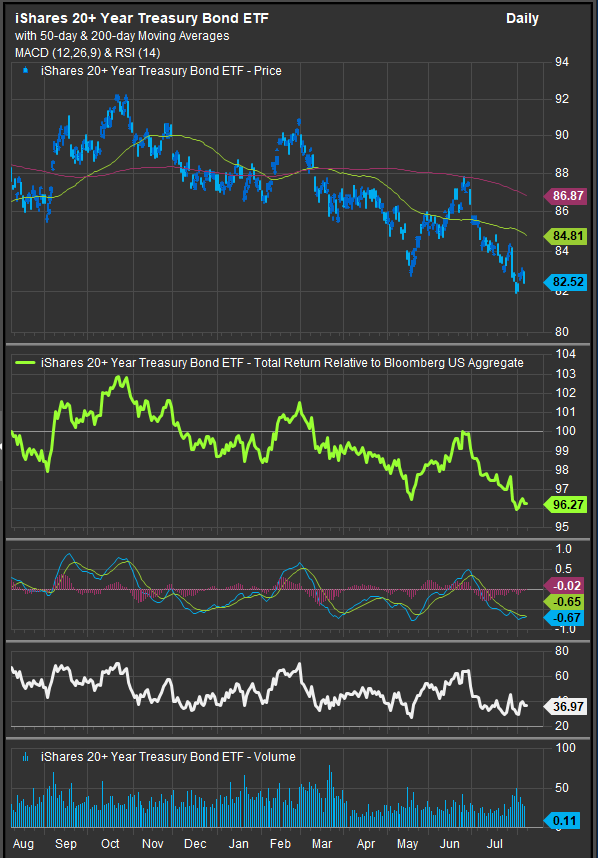
Thursday’s rate backup reversed part of the earlier oil-relief rally. Long-duration ETF returns remain positive over the past week, but the level of long-end yields still argues for caution. TLT gained 0.73% over the past week, EDV gained 1.11%, and ZROZ gained 1.07%, but TLT also saw heavy weekly outflows, keeping the signal tactical rather than broadly bullish.
Macro Signal Board
| Signal | Latest | 1D Change | 1W Change | 1Y Percentile | Trading Read |
| 10Y Treasury | 4.67% | +4.9 bp | 0.0 bp | 98th | Yields remain near one-year highs. |
| 30Y Treasury | 5.21% | +3.9 bp | +0.3 bp | 99th | Long-end risk remains elevated above 5%. |
| 10Y Real Yield | 2.43% | +2.0 bp | +2.0 bp | 99th | Real yields remain the main duration headwind. |
| 10Y Breakeven | 2.26% | +4.0 bp | -1.0 bp | 23rd | Inflation compensation is contained but oil-sensitive. |
| Fed Funds Implied Rate | 3.64% | +0.3 bp | 0.0 bp | 16th | Front-end policy pricing remains relatively dovish. |
| IG OAS | 78 bp | 0 bp | -2 bp | 43rd | IG credit stress remains contained. |
| HY OAS | 271 bp | -4 bp | -13 bp | 10th | HY spreads tightened and remain very tight. |
| MOVE Index | 76.1 | +2.5 | -1.0 | 65th | Rates volatility remains elevated. |
| WTI Crude | $77.29 | +$2.07 | -$6.30 | 65th | Oil is off the highs but still a swing factor. |
The macro message is mixed. Credit spreads are constructive, breakevens remain contained, and front-end Fed pricing is still relatively dovish. But long-end yields, real yields, and rates volatility remain too elevated for a clean long-duration overweight.
Calendar Watch
Thursday’s data was mixed but broadly consistent with a stable labor market and easing labor-cost pressure. Initial claims were 199K, below 205K consensus, while continuing claims rose to 1.801M. Productivity rose 1.4%, twice consensus, and unit labor costs rose only 1.3%, below the 2.7% consensus. Reuters reported that jobless claims remained low, productivity accelerated, and unit labor costs were contained. (Reuters)
Today’s calendar is payroll-driven:
| Time | Release | Consensus | Prior |
| 8:30 a.m. | Nonfarm Payrolls | +95K | +57K |
| 8:30 a.m. | Private Payrolls | +82.5K | +49K |
| 8:30 a.m. | Unemployment Rate | 4.2% | 4.2% |
| 8:30 a.m. | Hourly Earnings M/M | +0.30% | +0.30% |
| 8:30 a.m. | Hourly Earnings Y/Y | +3.5% | +3.5% |
| 8:30 a.m. | Average Workweek | 34.3 | 34.3 |
| 3:00 p.m. | Consumer Credit | +$12.1B | -$0.18B |
Fed communication remains a risk. Reuters reported that St. Louis Fed President Alberto Musalem said the Fed should have raised rates at the last meeting, reinforcing that softer inflation and productivity data have not fully removed policy risk. (Reuters)
Treasury supply is also still part of the long-end discussion. Treasury raised its Q3 borrowing estimate to $739B, though market reports noted that refunding guidance kept note and bond auction sizes steady for now. (Reuters)
ETF Flow Leaders
| ETF | Segment | 1W Return | 1W Flows | 1M Flows |
| HYG | High Yield | +0.46% | +$1.24B | +$367M |
| SGOV | Ultra-Short Treasuries | +0.06% | +$941M | +$4.43B |
| VTEB | Municipal Bonds | +0.43% | +$717M | +$1.29B |
| BND | Broad Market Bonds | +0.38% | +$695M | +$2.85B |
| USFR | Floating-Rate Treasuries | +0.06% | +$574M | +$984M |
| JAAA | AAA CLOs | +0.06% | +$568M | +$1.16B |
| IAGG | Global Aggregate Bonds | +0.42% | +$445M | +$759M |
| MUB | Municipal Bonds | +0.29% | +$390M | +$698M |
| SHY | Short Treasuries | +0.25% | +$384M | +$155M |
| IGSB | Short IG Credit | +0.19% | +$331M | +$616M |
The flow signal is constructive for income but still selective. HYG led weekly inflows, and high-yield spreads tightened, suggesting a tactical rebound in lower-quality credit demand. SGOV, USFR, SHY, and ICSH show continued demand for cash-management, floating-rate, and short-duration exposure. VTEB and MUB confirm municipal demand, while JAAA, IGSB, and VCSH support senior credit and short investment-grade exposure.
The caution remains long duration and longer-duration credit. TLT saw $794M of weekly outflows despite positive weekly returns, and LQD lost $156M on the week and $1.33B over the past month.
Trading Implications
Core bonds: Maintain exposure. Broad bond ETFs are still attracting assets, but returns remain sensitive to long-end yields.
Duration: Favor short and intermediate duration over a full long-duration overweight. Positive weekly Treasury returns are constructive, but the 30-year above 5%, elevated real yields, and TLT outflows keep long Treasuries tactical.
Credit: Prefer short and intermediate investment-grade exposure. IGSB and VCSH are attracting assets, while LQD outflows show weaker demand for longer-duration credit.
High yield: Stay selective but less defensive. HYG inflows, tighter spreads, and positive weekly returns support tactical exposure, but spreads are very tight and the trade is sensitive to payrolls and oil.
Cash management: Keep ultrashort and floating-rate Treasury ETFs in the allocation mix. SGOV, USFR, ICSH, and JPST remain supported by flow demand.
Munis: Maintain tax-aware municipal exposure. VTEB and MUB are both strong flow leaders, though duration should still be managed carefully.
TIPS: Favor short-term inflation protection over broad long-duration TIPS. Oil risk remains active, but breakevens are still contained.
CLOs / loans: Senior floating-rate credit remains useful as a volatility buffer. JAAA flows remain constructive, while broader loan demand is more uneven.
Bottom Line
The August 7 setup is constructive for income, but still not a duration all-clear. Oil has eased from last week’s shock, credit spreads have tightened, and ETF flows favor high yield tactically, cash management, floating-rate Treasuries, munis, AAA CLOs, short Treasuries, and short investment-grade credit. The constraint is still the long end: the 30-year Treasury is above 5%, real yields remain near one-year highs, and TLT flows are negative. Keep long Treasuries and longer-duration credit tactical into today’s payroll report.
Sources
- FactSet Research Systems Inc., ETFFixedIncome.com Fund Universe Return & Flow Database, August 7, 2026
- FactSet Research Systems Inc., August 7 rates, credit, volatility, commodity, FX, and economic calendar data
- Reuters reporting on oil, Strait of Hormuz negotiations, jobless claims, productivity, Fed commentary, and Treasury supply
- U.S. Bureau of Labor Statistics release calendar
- Treasury refunding and borrowing estimate reporting
Disclaimer: This commentary is for informational and educational purposes only and should not be considered investment advice. ETF return and flow data can change quickly and may reflect short-term trading activity rather than durable allocation trends. Fixed income investments are subject to interest-rate risk, credit risk, liquidity risk, inflation risk, tax considerations, and potential loss of principal.