COMMENTARY:
U.S. fixed income markets delivered mixed results for the week ending July 31, 2026, as investors balanced encouraging economic data against the prospect of interest rates remaining higher for longer. Strong second-quarter economic growth and generally resilient corporate earnings reinforced confidence in the economy, but they also pushed Treasury yields higher as investors reduced expectations for near-term Federal Reserve rate cuts. As a result, shorter-duration bonds and credit-sensitive sectors generally outperformed long-duration government bonds, while income continued to be an important driver of total returns.
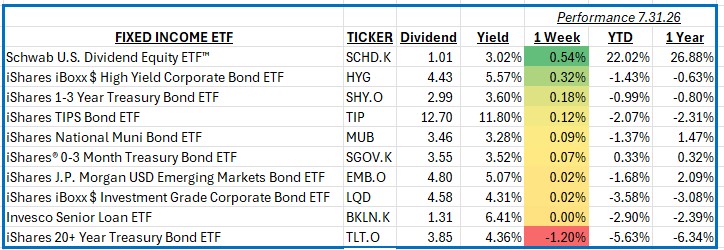
Dividend-focused equities produced the strongest returns among the income-oriented asset classes, gaining 0.54% for the week. Companies with durable cash flows and consistent dividend growth, including leaders such as Broadcom, Coca-Cola, Home Depot, Verizon, and Cisco Systems, attracted investors seeking both income and quality. The combination of resilient earnings and dependable dividends helped this segment outperform every traditional fixed income category.
High-yield corporate bonds returned 0.32%, making them the strongest-performing bond sector, followed by short-term U.S. Treasuries, which gained 0.18%. High-yield debt benefited from continued confidence in corporate fundamentals and relatively low default expectations, while short-duration Treasuries remained attractive because their limited interest-rate sensitivity helped cushion the impact of rising yields. Treasury Inflation-Protected Securities also posted a positive 0.12% return as investors continued to monitor inflation risks despite recent moderation in price pressures.
Municipal bonds, ultra-short Treasury securities, emerging market bonds, and investment-grade corporate bonds all generated modest positive returns ranging from 0.02% to 0.09%. Tax-exempt municipal bonds remained supported by healthy state and local government finances, while investment-grade corporate bonds benefited from generally solid corporate balance sheets despite higher Treasury yields. Emerging market debt delivered a small gain as a stable U.S. dollar and resilient global risk sentiment offset pockets of geopolitical uncertainty.
Senior loans finished the week essentially unchanged. Their floating-rate structure continued to appeal to income-oriented investors seeking protection from rising interest rates, although the asset class lacked a meaningful catalyst to outperform during the week. Healthy corporate credit conditions and relatively stable loan fundamentals helped prevent broader weakness despite higher market yields.
Long-term U.S. Treasury bonds were the week’s weakest performer, declining 1.20% as rising Treasury yields weighed heavily on longer-duration securities. Stronger economic data and the Federal Reserve’s cautious outlook reduced expectations for imminent rate cuts, leading investors to rotate away from interest-rate-sensitive government bonds.
Overall, the week’s bond market reflected the importance of duration management in a higher-rate environment. Credit-sensitive sectors and shorter maturities continued to demonstrate resilience, while longer-term government bonds remained under pressure as investors assessed the outlook for economic growth, inflation, and future Federal Reserve policy.