COMMENTARY:
U.S. fixed income had a mixed week ending November 20, 2026. Treasury prices rose as investors sought safety amid the sharp stock-market selloff, and the 10-year yield finished lower for the week. At the same time, Federal Reserve minutes and policymakers’ comments kept inflation and the prospect of a December rate increase in focus. Credit-sensitive bonds were weaker, while short-term government debt was comparatively steady.
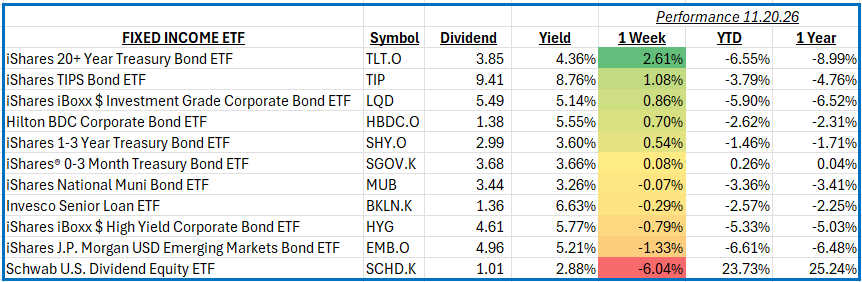
Long-term Treasury bonds gained 2.61%, the strongest return in the group, as falling yields lifted prices. Inflation-protected Treasuries rose 1.08%, also benefiting from the Treasury rally.
Investment-grade corporate bonds advanced 0.86%. Their higher-quality company debt gained alongside Treasuries, though corporate credit carries additional spread risk. Bonds issued by business development companies returned 0.70%, reflecting a modest gain in this specialized corporate-credit segment.
Short-term Treasury bonds returned 0.54%, while very short-term Treasury bills gained 0.08%. Their shorter maturities generally mean less price sensitivity to yield changes, so they moved less than long-term bonds during the rally.
Municipal bonds slipped 0.07%, close to flat for the week. Senior loans declined 0.29% as their floating-rate income offered limited support amid changing rate expectations. High-yield corporate bonds fell 0.79%, showing greater sensitivity to the week’s risk aversion.
Emerging-market dollar bonds posted the steepest decline among the bond categories, losing 1.33%. The equity dividend strategy fell 6.04%. It holds company shares rather than bonds, so its sharp decline reflected the broad stock selloff, not fixed-income performance.
The return figures show how each portfolio category performed, but they do not identify the best- and worst-performing individual bond issuers. The main contrast was between longer-term government debt, which benefited from falling yields, and riskier credit, which faced pressure as investors turned cautious.
Overall, Treasuries led and credit lagged. Rates moved lower late in the week as investors sought safety, even while inflation concerns kept the Fed’s next move uncertain.