COMMENTARY:
U.S. bond markets delivered mixed results as investors balanced safe-haven demand, election developments, and resilient employment. Treasuries rallied during the week as technology shares weakened, but Friday’s stronger-than-expected October payroll increase of 165,000 and unemployment rate of 4.1% tempered that momentum and reinforced concerns about further Federal Reserve tightening. These competing forces shaped government and corporate debt performance.
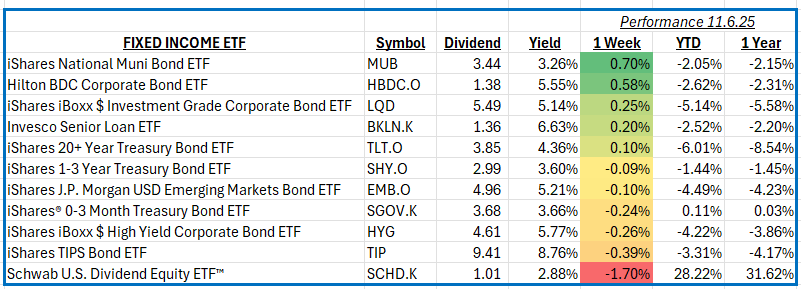
Municipal bonds led the supplied fixed income exposures, gaining 0.70%, ahead of business development company debt at 0.58%. California and New York City tax-backed obligations represent notable municipal exposures; Ares Capital, Blue Owl Capital, and Apollo Debt Solutions feature among business development company borrowers. These names identify relevant holdings, not verified weekly contributors: security-level attribution was unavailable.
Investment-grade corporate bonds advanced 0.25%, outperforming senior secured loans, which gained 0.20%, and high-yield corporate bonds, which declined 0.26%. JPMorgan Chase, Morgan Stanley, and Goldman Sachs are major investment-grade issuers; Hologic and Sedgwick are notable loan borrowers, while TransDigm and CCO Holdings are prominent high-yield exposures. The return pattern favored higher-quality corporate debt over lower-rated bonds, although loans held up better.
Long-term Treasury bonds gained 0.10%, outperforming one-to-three-year government securities at −0.09% and Treasury bills at −0.24%. All represent U.S. government obligations, with maturity—not issuer selection—the key distinction. Longer maturities generally respond more strongly to changing yields. However, without confirmation that the supplied figures include distributions, these comparisons should not be interpreted as definitive total-return attribution.
Dollar-denominated emerging-market bonds slipped 0.10%, narrowly trailing short-term Treasuries but outperforming Treasury bills and high-yield corporate debt. Inflation-protected Treasuries declined 0.39%, the weakest fixed income result listed. Their U.S. Treasury backing does not eliminate price volatility; changing inflation expectations and inflation-adjusted yields can affect performance. The supplied returns alone cannot establish which factor or sovereign issuer drove the losses.
Dividend-paying U.S. equities fell 1.70%, trailing every bond exposure shown. This allocation belongs to equities rather than fixed income, despite its income objective. Procter & Gamble, Home Depot, and Texas Instruments were significant holdings, but their individual weekly contributions require separate verification. The comparison highlights the distinction between dividend income and contractual bond payments.
Overall, municipal and selected corporate exposures led, while inflation protection and dividend equities lagged. Diversification remained important amid shifting economic signals.