
COMMENTARY:
U.S. fixed income markets remained under pressure during the week ending October 2 as investors balanced a sharply weaker labor market against persistent inflation and supply concerns. September payrolls increased by only 29,000, well below expectations near 90,000, while unemployment rose to 4.2%. The report reduced expectations for another Federal Reserve rate hike this month. However, Treasury yields ultimately moved higher, with the 10-year yield ending the week near 5.24%, as inflation concerns and heavy government borrowing continued to weigh on longer-duration bonds.
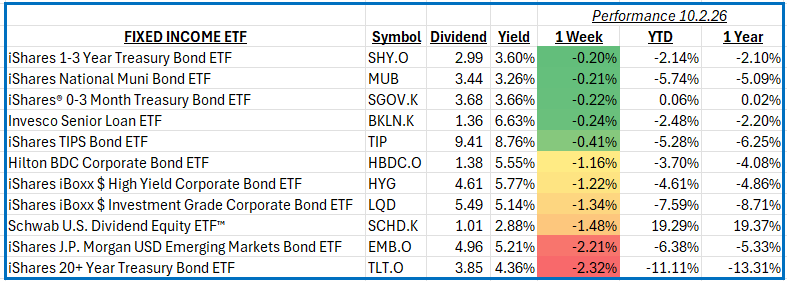
Short-term Treasuries were among the most resilient fixed income exposures, with 1–3 year Treasuries declining 0.20%. Their shorter duration helped limit the impact of rising yields, while the roughly 3.6% yield continued to provide an attractive source of income. Tax-exempt municipal bonds fell 0.21%, nearly matching short-term Treasuries, as their relatively stable income characteristics helped cushion the broader rate volatility.
Cash and floating-rate exposures also held up relatively well. Three-month Treasury bills declined 0.22%, while senior loans fell 0.24%. Senior loans benefited from their floating-rate structure, which reduces sensitivity to changes in longer-term Treasury yields. With short-term government securities still offering yields above 3.5%, investors continued to have attractive options for maintaining liquidity while earning meaningful income.
Inflation-protected and corporate bonds experienced greater pressure. Treasury Inflation-Protected Securities declined 0.41%, while investment-grade corporate bonds fell 1.34% and high-yield corporate bonds dropped 1.22%. The weakness reflected the broader rise in Treasury yields, which pressured bond prices even as credit fundamentals remained relatively stable. High-yield bonds held up slightly better than investment-grade credit, helped by their shorter duration and higher income.
Longer-duration and higher-risk exposures were the week’s weakest performers. Long-term Treasuries declined 2.32%, while emerging-market bonds fell 2.21% and dividend-oriented equities declined 1.48%. The contrast with short-term Treasuries was significant: long-duration government bonds lost more than 11 times as much as short-term Treasuries. Rising yields made longer maturities particularly vulnerable, while emerging-market debt faced additional currency and geopolitical risks.
Overall, the week reinforced the importance of duration and credit selection. Short-term, high-quality bonds remained relatively resilient, while longer-duration and riskier exposures faced meaningful headwinds. With economic growth slowing but inflation concerns persisting, the fixed income market remains highly sensitive to every new signal from the Federal Reserve and the economy.
