
COMMENTARY:
The U.S. fixed-income market faced renewed pressure during the week ended September 25 as Treasury yields moved sharply higher. The 10-year Treasury yield reached roughly 5.2%, its highest level in nearly two decades, while the 30-year yield reached a fresh 22-year high. Stronger-than-expected economic data and hawkish Federal Reserve commentary increased expectations that rates could remain higher for longer. At the same time, falling oil prices late in the week provided some relief to inflation concerns and helped stabilize Treasury yields.
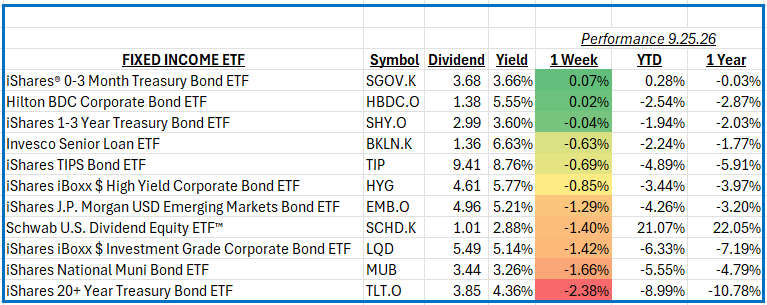
Short-Term Treasuries & Cash: Short-duration government bonds were the most resilient part of the fixed-income market. Treasury bills gained 0.07%, while one- to three-year Treasuries slipped only 0.04%. Their limited interest-rate sensitivity helped cushion portfolios as longer-term yields climbed. With short-term Treasury yields around 4%, investors continue to receive meaningful income while taking relatively little duration risk. Federal Reserve data showed three-month Treasury yields near 4.08% at the end of the week.
Senior Loans & Floating-Rate Credit: Senior loans declined 0.63%, but held up better than most longer-duration and fixed-rate credit exposures. Their floating-rate structure provides some protection when interest rates rise because coupon payments adjust with short-term rates. The approximately 6.63% yield remains attractive for investors seeking income, although credit quality and economic growth remain important considerations.
Corporate Bonds: Investment-grade and high-yield corporate bonds both declined as rising Treasury yields overwhelmed income from their coupons. Investment-grade corporates fell 1.42%, while high-yield bonds declined 0.85%. Interestingly, investors became more selective toward new corporate debt, particularly bonds issued to finance AI infrastructure. Spreads on AI-related corporate debt widened as investors considered the amount of borrowing required to fund data centers and semiconductor infrastructure.
Inflation-Protected, Municipal & Emerging-Market Bonds: Inflation-protected bonds declined 0.69%, while municipal bonds fell 1.66% and emerging-market bonds dropped 1.29%. Rising nominal Treasury yields pressured these longer-duration exposures, while the stronger dollar and tighter financial conditions created additional challenges for emerging markets. Municipal bonds also faced a particularly difficult week as yields increased across the curve.
Long-Term Treasuries & Dividend Stocks: Long-duration Treasuries were the weakest exposure, falling 2.38%, as the 10-year and 30-year yields moved sharply higher. Dividend-oriented equities also declined 1.40%, illustrating how higher bond yields can reduce the relative appeal of income-producing stocks. The contrast with short-term Treasuries highlights the importance of managing duration in the current environment.
Rising yields dominated fixed-income performance this week, rewarding shorter-duration exposures while pressuring longer-term bonds and rate-sensitive credit. With employment and inflation data approaching, the direction of Treasury yields remains central to the fixed-income outlook.
